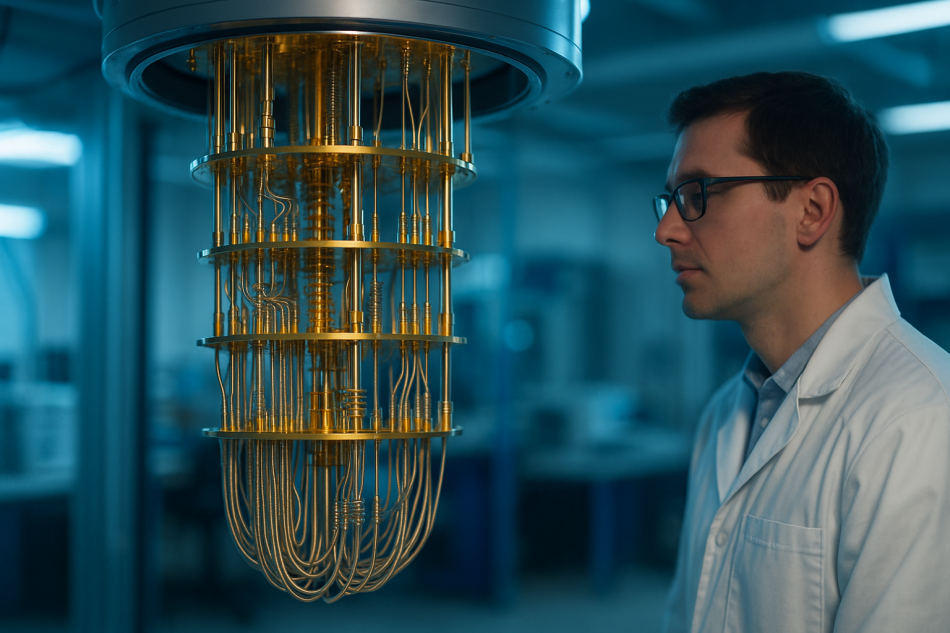

Most quantum computers you read about are trying to be universal. They chain gates together, one operation at a time, to run any algorithm you can compile. D-Wave took a different road early and never left it. Its machines do not run gates at all. They solve a single class of problem by settling into a low-energy state, the way a ball rolls to the bottom of a valley. This is quantum annealing, and it has spent two decades being both the most commercially deployed and the most argued-about approach in the field.
What an annealer actually does
Imagine a landscape of hills and valleys where the deepest valley represents the best answer to a problem. Many real-world puzzles look like this: scheduling delivery routes, arranging cell tower frequencies, balancing a financial portfolio. Encode the problem so that its optimal solution sits at the lowest point, then let a physical system find that point on its own.
A D-Wave processor is a grid of superconducting loops, each acting as a qubit, connected by tunable couplers. The machine starts every qubit in a fuzzy quantum superposition, then slowly turns up the problem's constraints while turning down the quantum mixing. If the process is slow and gentle enough, the system stays in its lowest-energy configuration the whole way down and lands on a good answer. Quantum tunneling lets it slip through energy barriers that a purely classical search would have to climb over.
The catch is that annealing is specialized. You cannot use a D-Wave machine to run Shor's algorithm or simulate a molecule the way a gate-based device can. It maps naturally onto optimization and sampling, and little else. That narrowness is exactly what let D-Wave scale hardware faster than anyone. Its latest systems carry more than 5,000 qubits, a count that gate-model machines are nowhere near, because annealing qubits do not need the same exquisite gate fidelity.
The scaling that critics discount
Skeptics have long pushed back on that qubit count. A gate-model qubit and an annealing qubit are not the same currency. Annealing qubits are noisier, more loosely connected, and never error-corrected in the way surface codes protect logical qubits. The connectivity matters enormously: on D-Wave hardware, each qubit only couples to a handful of neighbors, so embedding a densely connected problem forces you to chain several physical qubits together to mimic one well-connected variable. That embedding overhead eats into the raw number.
The deeper argument has been about whether annealing delivers a genuine quantum speedup over the best classical algorithms. For years, every time researchers reported an annealer beating a classical solver, someone wrote a smarter classical method that caught up. The honest answer is that a clean, general speedup for optimization has been hard to nail down, because classical optimization is a mature and ferociously competitive field.
Where the machine earns its keep
D-Wave's counter-argument is pragmatic. Customers do not care whether the win is asymptotically quantum. They care whether the machine returns useful answers on messy problems in reasonable time. Grocery chains have used it to optimize shelf and promotion planning, logistics groups to reroute fleets, and researchers to explore materials and protein folding through the sampling that annealers do naturally. Because the systems run in the cloud, a developer can throw a problem at real hardware in an afternoon rather than waiting years for fault tolerance.
The company has also hedged. It reported evidence of quantum speedup on certain hard magnetic simulation problems, an area closer to physics than business logistics, where the annealer models the very kind of system it is built from. And it has publicly committed to building a gate-model machine of its own, an acknowledgment that annealing alone cannot cover everything the market eventually wants.
Why the detour still matters
The rest of the industry is now converging on a lesson D-Wave learned early: you win customers by putting hardware in their hands and letting them find value, even before the machine is perfect. Annealing was never going to be the universal quantum computer. It was a way to ship something real while the harder gate-model and error-correction work matured elsewhere.
Whether annealing ends up a footnote or a durable branch of the family tree depends on questions still open. Can it show a speedup that survives the next round of classical cleverness? Can specialized optimization hardware coexist with fault-tolerant universal machines, each doing what it does best? D-Wave bet that a narrow, scalable, available machine beats a perfect one that does not exist yet. The field spent years insisting that was the wrong bet. It is no longer so sure.







