
Nearly every qubit you have read about stores information in two states: an ion's two energy levels, a transmon's lowest two rungs, an atom's ground and excited configurations. The trouble with two states is that there is nowhere to hide. When noise nudges the system, it lands somewhere between the two allowed answers, and by the time you measure it the damage is already baked in.
A different idea, dreamed up in 2001 by Daniel Gottesman, Alexei Kitaev, and John Preskill, refuses to live in such cramped quarters. Instead of two levels, it uses a single harmonic oscillator, a microwave resonator whose state can be described by continuous variables of position and momentum. Into that spacious canvas it paints a logical qubit as a comb of evenly spaced peaks, a grid of spikes in phase space. The scheme is now universally called the GKP code, and it is the foundation of the Canadian startup Nord Quantique.
Why a comb beats a coin flip
The beauty of the grid is that it turns an invisible problem into a visible one. Picture the allowed states as teeth on a ruler, spaced at regular intervals. The small errors that plague oscillators are tiny shifts, a nudge in position or a drift in momentum. If a shift is smaller than half the spacing between teeth, you can measure how far the state has slid off the nearest tooth and push it back without ever learning which logical value it held. The error becomes a measurable distance rather than a corrupted bit.
This is the crucial trick. In an ordinary qubit, trying to peek at an error tends to destroy the information you are trying to protect. The GKP encoding lets you ask a narrower question, "how far off the grid are we," whose answer reveals the drift while staying blind to the stored data. A small ancilla qubit coupled to the cavity does the asking, and a feedback pulse does the nudging back into place.
Doing more with one piece of hardware
The usual recipe for quantum error correction is brute force: tile dozens or hundreds of physical qubits into a surface code so their collective behavior shelters one logical qubit. That approach is well understood, but the hardware overhead is punishing. Every logical qubit might demand a thousand physical ones, each with its own wiring and calibration headaches.
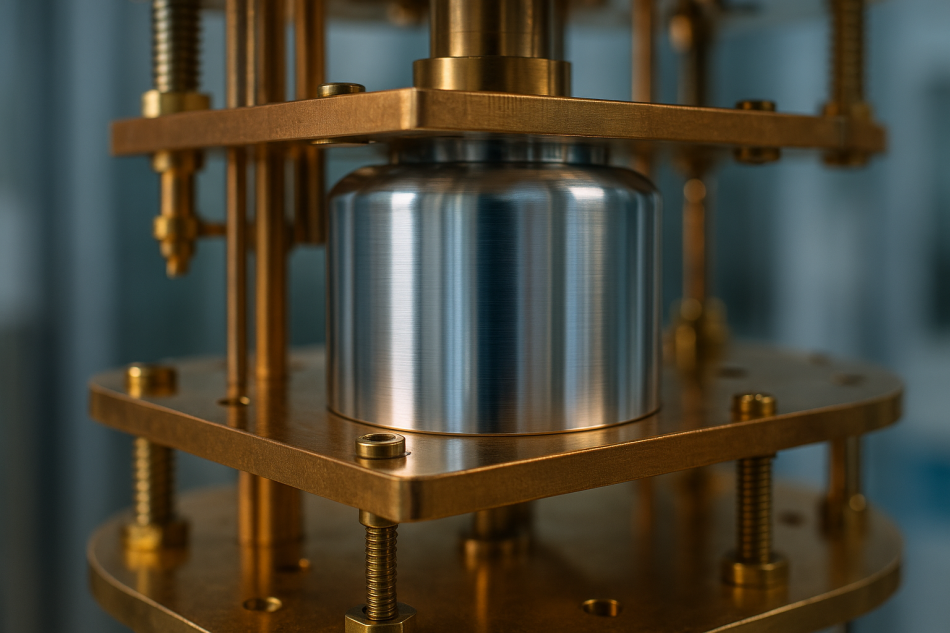
Bosonic codes like GKP take a different route. A single high-quality microwave cavity holds enough structure, in its many photon-number states, to carry redundancy inside one physical object. Instead of spreading a qubit across many chips, you build the redundancy into the light itself. Nord Quantique leans on this, pairing superconducting cavities with the control electronics borrowed from the transmon world. The company has reported experiments in which its bosonic encoding corrected errors well enough to extend the useful life of the stored information, a demonstration of correction paying for itself rather than adding more noise than it removes.
Nord Quantique has also pushed a multimode variant, encoding across several resonant modes of the same physical cavity to catch more kinds of errors with the same footprint. The pitch to investors and partners is blunt: if one carefully engineered cavity can do the work of a large qubit array, the path to a useful machine needs far fewer physical parts, less wiring, and smaller refrigerators.
The catch in the comb
None of this is free. A true GKP state, with infinitely sharp teeth, would require infinite energy and is impossible to build. Real grid states are finite and slightly smeared, which limits how large an error they can absorb before a tooth is mistaken for its neighbor. Preparing these states cleanly is delicate, and the ancilla qubit used to read errors can inject faults of its own. Cavity lifetimes, while impressive, still bleak photons, and photon loss is exactly the kind of error that bosonic codes must work hardest to contain.
Whether the comb approach scales to a full fault-tolerant processor is still an open question, and the surface-code camp has a large head start in demonstrated logical qubits. But the appeal is clear. Rather than fighting noise with sheer numbers, GKP hardware tries to make each physical device smart enough to heal itself. If that bet pays off, the road to a practical quantum computer could run through far fewer cables than the current blueprints suggest.







