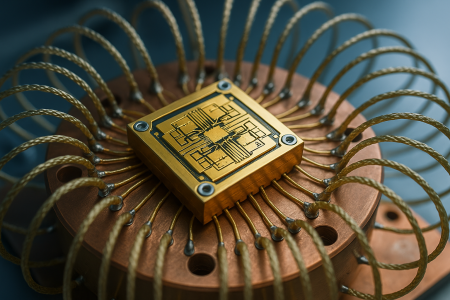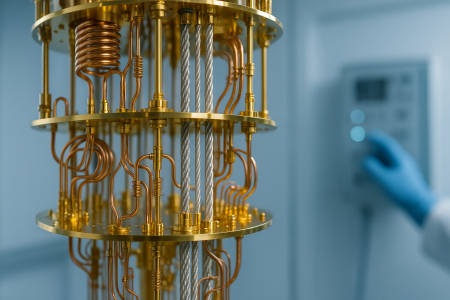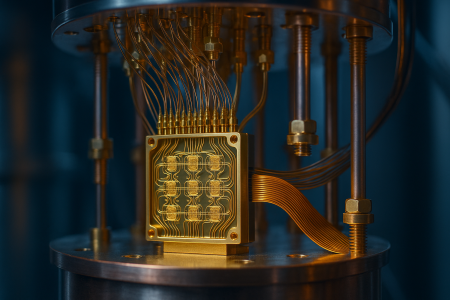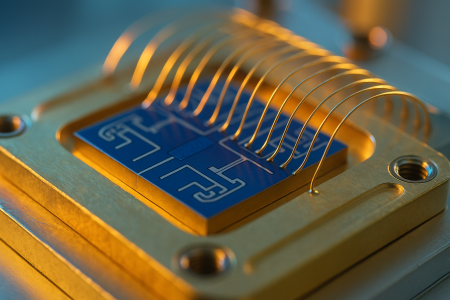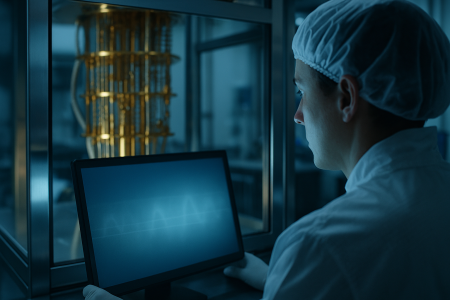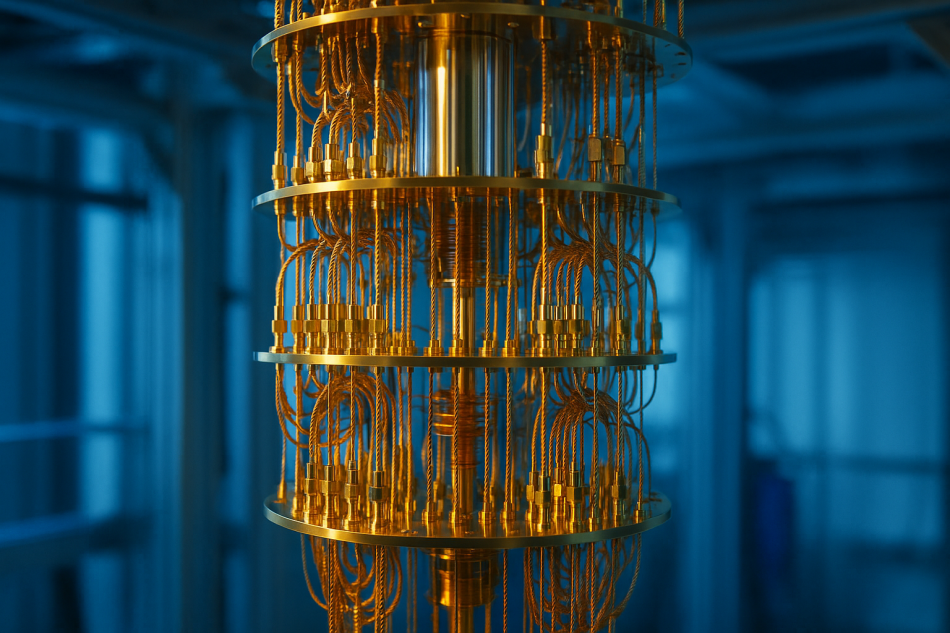

Look at a photo of a superconducting quantum computer and the thing that catches your eye is rarely the chip. It is the chandelier: a tiered tower of gold-colored plates, copper braids, and coaxial cable that hangs from the ceiling of the lab. The chip sits at the very bottom, no bigger than a fingernail. Everything above it exists to make that fingernail colder than almost anywhere in the known universe.
Why cold at all
Transmon qubits and their superconducting cousins store information in tiny energy differences. At room temperature, the ambient thermal energy is thousands of times larger than the gap between a qubit's two states. Random heat would flood the system, flipping qubits and drowning out any computation before it began. To keep the qubit reliably in its ground state and to let the metal go superconducting, engineers have to strip away nearly all thermal noise. That means reaching roughly 10 to 20 millikelvin, or about a hundredth of a degree above absolute zero. Interstellar space, by comparison, sits at a balmy 2.7 kelvin.
The staircase down
No single machine drops from 300 kelvin to 10 millikelvin in one leap. The refrigerator does it in stages, each plate colder than the one above. The top stages use a pulse-tube cooler, a device that shuttles helium gas through cycles of compression and expansion to reach around 50 kelvin and then 4 kelvin. That handles the brute-force heat lifting and replaces the older habit of dunking everything in a bath of liquid helium.
The real magic happens lower down, and it depends on a peculiar property of two helium isotopes. Below about 0.87 kelvin, a mixture of helium-3 and helium-4 spontaneously separates into two layers, like oil and water. One layer is rich in helium-3, the other is dilute. When helium-3 atoms cross the boundary from the concentrated phase into the dilute phase, they absorb energy, much as sweat cools skin by evaporating. This crossing happens in the mixing chamber, the coldest point of the whole apparatus. By continuously pumping helium-3 out of the dilute side and circulating it back, the machine sustains this cooling indefinitely rather than in a one-shot burst. That continuous operation is what makes dilution refrigerators, and not simpler coolers, the workhorse of the field.
More than a freezer
The tower is also a giant filter and shield. Every control signal that reaches a qubit has to travel down from room-temperature electronics through those cables, and each signal carries its own thermal noise. So the cables are threaded with attenuators and filters bolted to the cold plates, each stage knocking the noise down further. Microwave signals coming back up from the chip pass through carefully protected amplifiers so the qubit's faint whisper survives the journey. The copper braids you see are not decoration; they are thermal highways carrying stray heat away from the chip to the cold plates.
All of this competes for space and cooling power. The mixing chamber can only remove a few hundred microwatts of heat at its coldest. Every cable, every amplifier, every qubit control line dumps a little warmth into the system. This is one of the quiet reasons scaling superconducting machines is hard: you cannot simply add ten thousand more control lines without overwhelming the fridge's cooling budget. It is a big part of why researchers are pushing electronics into the cold stages and chasing qubits that tolerate slightly warmer conditions.
The unglamorous bottleneck
A single large dilution refrigerator can cost well over a million dollars and takes many hours, sometimes more than a day, to cool down and warm back up. That cycle time shapes how labs work. You cannot casually pop the lid to swap a chip; a full thermal cycle eats into precious experiment schedules. Companies building at scale now design custom cryostats far larger than the lab units of a decade ago, some tall enough to require their own platforms, precisely because the cooling infrastructure, not the qubit, increasingly sets the ceiling on machine size.
The chip gets the headlines and the qubit counts get the press releases. But the tower of cold that surrounds it is doing quiet, relentless thermodynamic work every second the computer runs. Without a hair-above-zero environment held steady for weeks at a time, none of the fragile quantum behavior above it would last long enough to be useful.