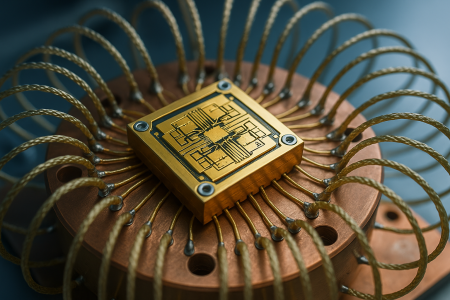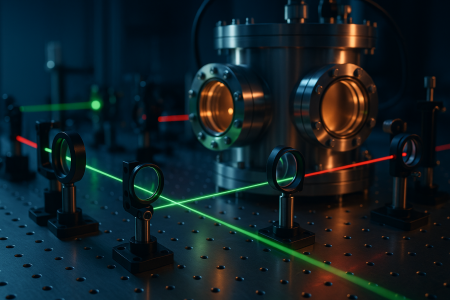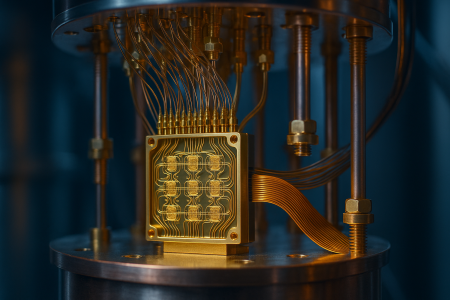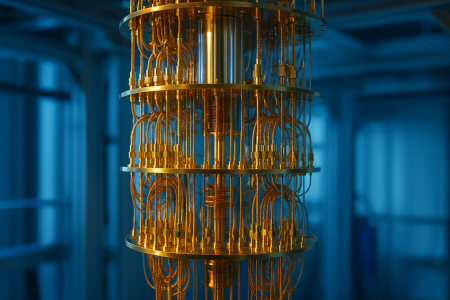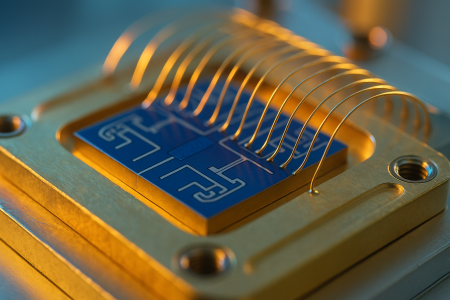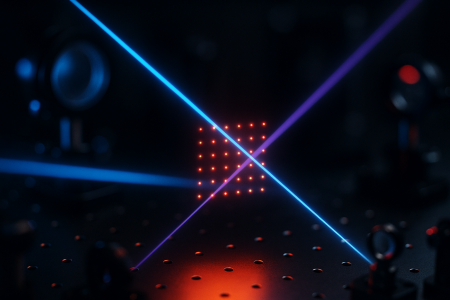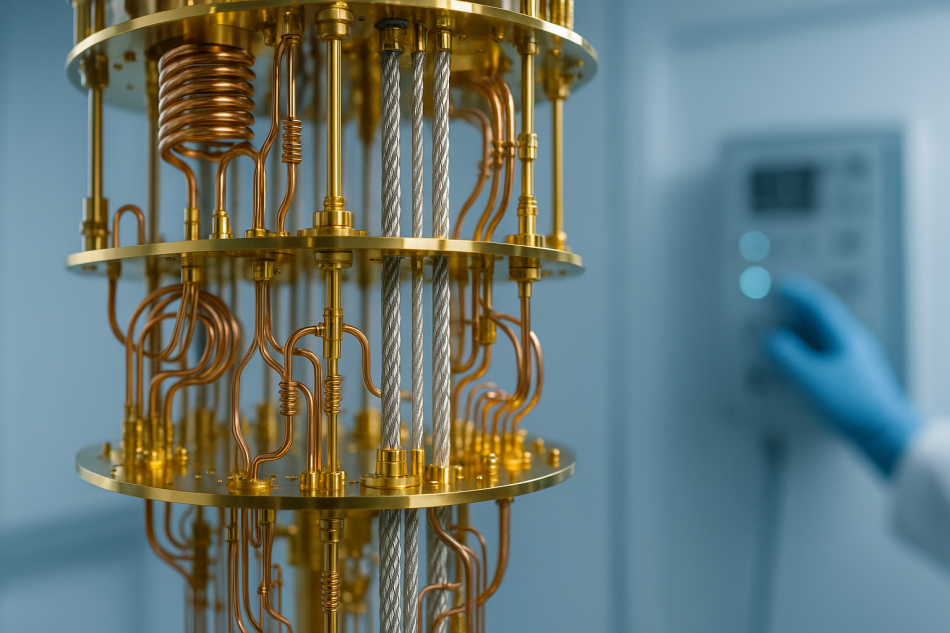

Every few months a quantum computing company unveils a chip with more qubits than the last, and the number lands in headlines as if it settles the matter. A thousand qubits sounds twice as good as five hundred. In practice, the qubit count is one of the least informative things you can know about a quantum processor. A machine with fewer, cleaner qubits can run circuits that a larger, noisier one cannot finish.
What a qubit count leaves out
A qubit is only useful if it holds information long enough and behaves predictably when you manipulate it. Three properties matter far more than raw count. The first is gate fidelity, which measures how often an operation does what you intended. A two-qubit gate with 99.9 percent fidelity is in a completely different league from one at 99 percent, because errors compound across the thousands of operations in a real algorithm. The second is coherence time, the window before a qubit forgets its state. The third is connectivity, meaning which qubits can talk directly to which others. A grid where every qubit only connects to its neighbors forces extra shuffling operations, and each of those introduces more chances to fail.
Put those together and you start to see why a 1,000-qubit chip can be less capable than a 100-qubit one. If your error rate is high, you spend your qubits and your gates fighting noise instead of computing. The useful question is not how many qubits exist on the die, but how deep a circuit you can run before the answer dissolves into static.
The industry's quiet shift to better metrics
The serious players know this, which is why several have pushed metrics that try to capture quality rather than quantity. IBM popularized quantum volume, a single number that reflects qubit count, error rates, and connectivity at once. It later began reporting circuit layer operations per second, or CLOPS, to capture speed, because a machine that is accurate but glacially slow is not practical for research that needs millions of runs. Quantinuum's trapped-ion systems routinely post very high quantum volume figures with relatively modest qubit counts, precisely because their gate fidelities and all-to-all connectivity are excellent.
This is also where the distinction between physical and logical qubits becomes unavoidable. The qubits on today's chips are physical, fragile, and error-prone. The long-term goal is the logical qubit, an error-corrected unit built from many physical qubits working together to detect and fix their own mistakes. A future machine advertised as having 100 logical qubits would be vastly more powerful than one with 100,000 physical qubits, because logical qubits can sustain the long computations that commercial applications demand. When a company talks about a number, the first thing to ask is which kind of qubit they mean.
How to read a quantum announcement
For anyone trying to cut through the marketing, a few habits help.
- Look for two-qubit gate fidelity. This is the number that most directly limits what a device can do, and reputable groups publish it.
- Check whether the qubits are physical or logical, and how many physical qubits are needed per logical one.
- Ask about connectivity. All-to-all coupling, common in ion traps, avoids the routing overhead that slows down fixed-grid superconducting chips.
- Notice whether the figure comes with a benchmark like quantum volume or a documented algorithm result, or whether it stands alone.
None of this means qubit count is meaningless. Scaling up is a genuine engineering challenge, and you eventually need both quantity and quality to reach error-corrected machines. Companies like Google, IBM, IonQ, PsiQuantum, and Quantinuum are all wrestling with the same trade-off between making more qubits and making better ones, and their roadmaps reflect different bets about which problem to solve first. Google has emphasized driving error rates down on smaller arrays to prove error correction works before scaling. Others have pushed for larger devices to learn the manufacturing lessons that come with size.
The number that will eventually matter
The metric worth watching is not the size of the chip but the moment a machine runs a useful computation that a classical computer cannot match, reliably and repeatably. That milestone depends on fidelity, error correction, and speed far more than on a qubit tally. Until then, treat the next record-breaking count the way you would treat a car sold purely on its engine displacement. It tells you something, but not whether the thing actually drives.