
Ask ten engineers what a quantum computer should be made of and you may get ten different answers. Unlike the classical computing industry, which standardized on silicon transistors decades ago, the quantum field is still running an open competition between fundamentally different ways to store and manipulate a qubit. Each approach has loud champions, real hardware in the lab, and a list of stubborn problems it has not solved. Understanding the contenders is the fastest way to understand why the industry's roadmaps look so different from one another.
Superconducting circuits: fast but fussy
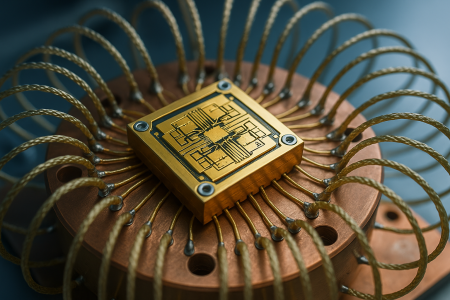
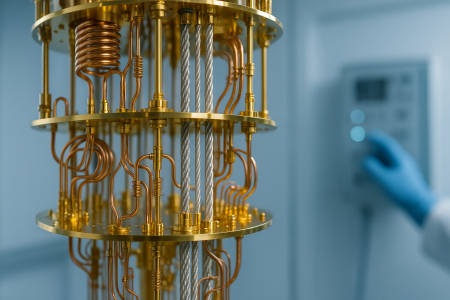
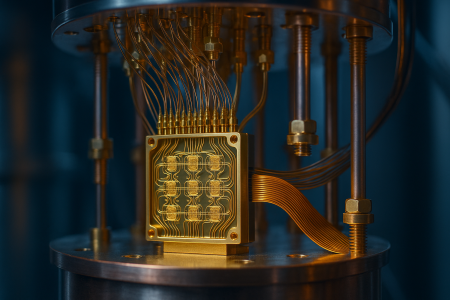
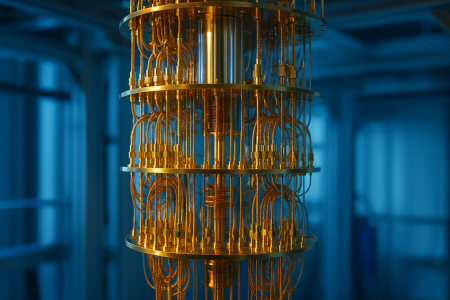
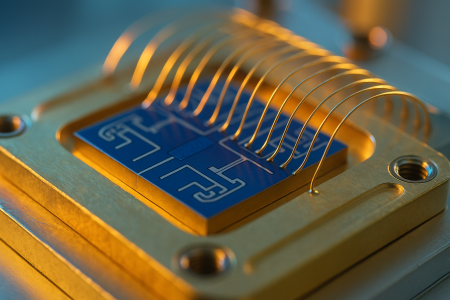
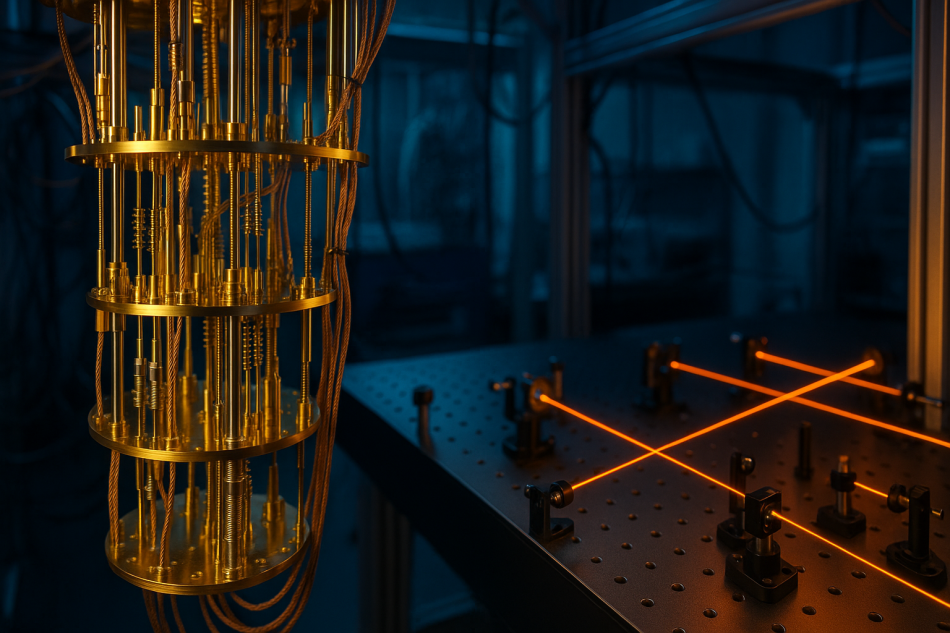
The most visible approach uses tiny superconducting loops cooled to a fraction of a degree above absolute zero. IBM and Google have both bet heavily here. The appeal is speed: gate operations happen in tens of nanoseconds, and the chips can be fabricated with techniques borrowed from the semiconductor world. The drawbacks are equally real. The qubits are sensitive to electrical noise, they lose their quantum state quickly, and they demand enormous dilution refrigerators. Scaling up means wrangling thousands of microwave control lines into a cold environment that hates extra heat.
Trapped ions: patient and precise
Quantinuum and IonQ build their machines from individual atoms held in place by electromagnetic fields and nudged with lasers. Trapped ions are nature's identical parts, so every qubit behaves the same way, and they hold their quantum state far longer than superconducting qubits. They also boast some of the best gate fidelities anyone has measured. The catch is speed. Laser-driven operations are slower, and shuttling ions around a chip to connect distant qubits takes engineering gymnastics. Getting from dozens of high-quality ions to thousands without the system grinding to a crawl is the central challenge.
Neutral atoms: the dark horse that surged
Companies like QuEra and Pasqal arrange neutral atoms in grids using lasers known as optical tweezers, then excite them into so-called Rydberg states to make them interact. A few years ago this approach was a curiosity. Now it is taken seriously, partly because the atoms can be packed into reconfigurable arrays of hundreds, and partly because the geometry lends itself to certain error-correction schemes. The technology is younger than its rivals, and the control systems for moving and reading out so many atoms are still maturing.
Photons: room temperature, long distance
PsiQuantum and Xanadu pursue qubits made of light. Photons barely interact with their environment, so they resist the noise that plagues other platforms, and much of the hardware can run at or near room temperature instead of inside a giant fridge. The trade-off is that photons also barely interact with each other, which is exactly what you need them to do to compute. Photonic approaches lean on clever measurement-based schemes and demand single-photon sources and detectors of almost unreasonable quality. PsiQuantum's strategy of manufacturing in a conventional chip foundry is a bet that volume can solve what physics makes hard.
Silicon spins: betting on the existing industry
A quieter group, including Intel and several university spinouts, encodes qubits in the spin of single electrons trapped in silicon. The dream is seductive: if you can make a qubit that looks like a transistor, you can borrow the trillion-dollar manufacturing base that already exists. Silicon spin qubits are tiny and could in principle be packed at extreme density. But controlling individual electrons with the uniformity needed for a large processor has proven brutally difficult, and the field trails the leaders in qubit count.
Why the contest stays open
No platform is winning on every metric, and that is the whole point. Superconducting chips lead on raw qubit numbers and gate speed. Trapped ions and neutral atoms lead on fidelity and connectivity. Photonics promises easier scaling if the components cooperate. Silicon promises manufacturability if the physics cooperates. The metric that ultimately matters is not how many physical qubits a company can announce, but how many reliable logical qubits survive after error correction. That number depends on a tangle of factors, including how often qubits make errors, how well they connect, and how fast they operate.
For now the smart money is spread across several horses. Investors and national labs are funding multiple approaches because nobody can yet prove which one reaches a large, fault-tolerant machine first. It is entirely possible that different architectures will win different jobs, with one platform handling chemistry simulations and another tackling optimization. The competition that looks messy today is the same process that, in classical computing, eventually produced the chip in your pocket.