
If you log into a quantum computer through a cloud service from IBM, Google, or Rigetti, odds are you are talking to a chip made of superconducting circuits. Trapped ions, neutral atoms, and photons all have their champions, but the superconducting transmon has quietly become the workhorse of the field. It powers many of the largest publicly available processors and most of the headline gate-fidelity results. The reasons have less to do with physics being settled and more to do with a fortunate marriage between quantum mechanics and the manufacturing world we already know how to operate.
An artificial atom etched in metal
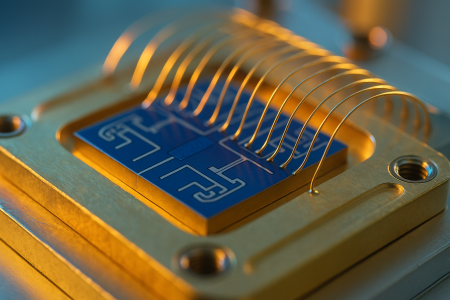
A transmon is, at heart, a tiny electrical circuit that behaves like an atom. Build a loop from a superconductor, interrupt it with a Josephson junction (a sliver of insulator sandwiched between two superconducting layers), and pair it with a capacitor, and you get a system with discrete, quantized energy levels. Cool it to around 10 to 20 millikelvin and the lowest two levels become a usable qubit. The clever part is the design choice that gives the transmon its name: it is built to be insensitive to electrical charge noise, the gremlin that wrecked earlier superconducting designs. That tweak traded away some other sensitivity but made the qubit far more stable and reproducible.
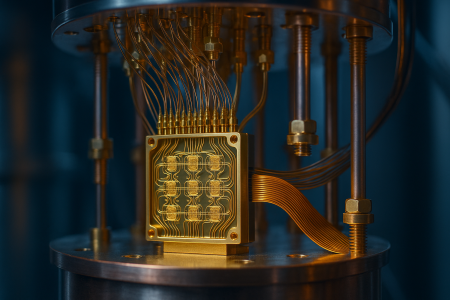
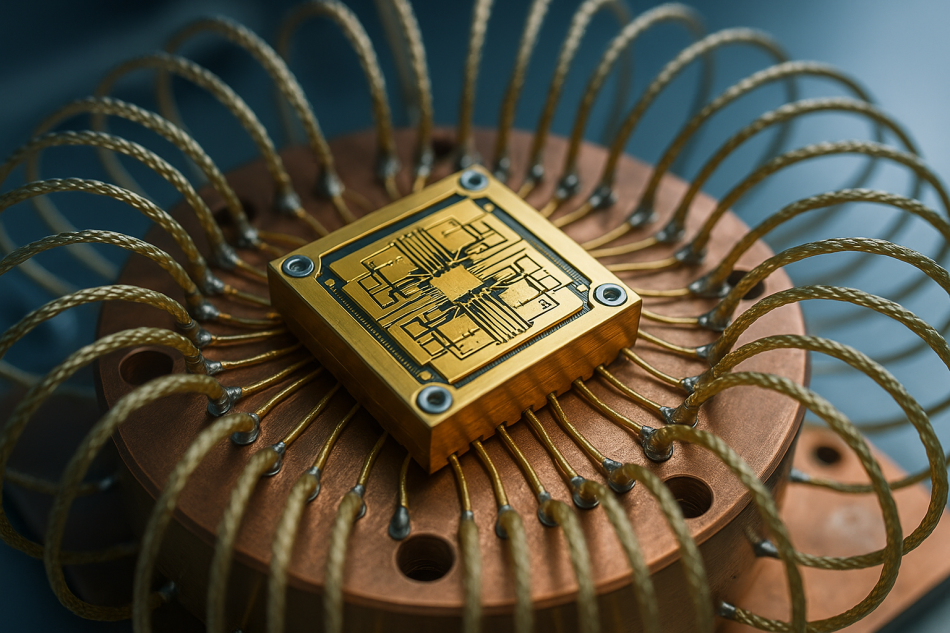
Because these qubits are lithographed onto chips, they inherit decades of semiconductor fabrication know-how. You can pattern dozens or hundreds of them on a wafer using the same broad family of tools that print conventional integrated circuits. Control comes from microwave pulses, the same frequency range as Wi-Fi and mobile phones, delivered through coaxial lines. That familiarity is a genuine advantage. Engineers can lean on existing electronics, existing materials science, and existing intuition.
Speed is the headline feature
Transmons operate fast. Two-qubit gates run in tens of nanoseconds, orders of magnitude quicker than the microsecond-scale operations typical of trapped ions. In a world where every qubit is slowly losing its quantum information, doing more operations before that information decays matters enormously. A transmon's coherence time is modest, often in the range of tens to a few hundred microseconds, but its blistering gate speed means it can still squeeze in a large number of operations within that window.
This speed also makes transmons attractive for the kind of fast, repeated cycles that quantum error correction demands. Google's demonstrations of error suppression on its Sycamore-lineage chips, and IBM's steady scaling of its Eagle, Osprey, and Heron processors, both rest on superconducting hardware. The ability to run many measurement-and-correction rounds quickly is part of why the platform stays competitive in the logical-qubit race.
The price of cold and crowded chips
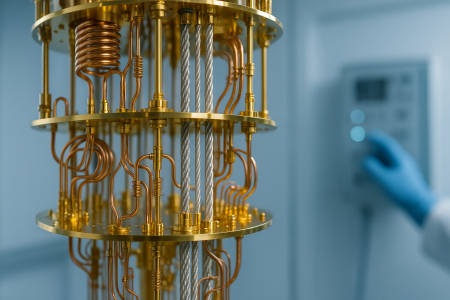
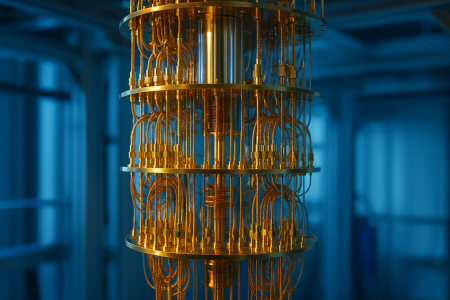
Nothing about the transmon is free. The chips must live at the bottom of a dilution refrigerator, wrapped in shielding and fed by carefully filtered wiring. Every qubit needs control and readout lines, and as chips grow, that wiring becomes a physical and thermal headache. The signals are microwaves, so neighboring qubits can crosstalk if frequencies are not carefully allocated. Fabrication variation means no two qubits come out identical, forcing extensive per-qubit calibration.
Coherence remains the nagging limitation. Compared with ions or neutral atoms, which can hold quantum states for seconds, transmons forget quickly. Researchers have clawed out steady improvements by purifying materials, redesigning junctions, and hunting down stray two-level defects in the oxide layers that cause energy loss. Each incremental gain is hard won, but the trend line has moved in the right direction for years.
Why it still leads
The honest summary is that no qubit technology has won, and superconducting circuits are not obviously the long-term victor. What they offer is a credible path right now: fast gates, manufacturable chips, and a maturing toolchain for control and error correction. That combination has let superconducting companies put real machines in front of users and iterate publicly.
The next stretch is about scaling without drowning in wiring and calibration overhead, which is pushing builders toward modular designs and better cryogenic control electronics. Whether the transmon carries the field to fault tolerance or eventually yields to a rival, it has already done something important. It turned the quantum computer from a tabletop physics experiment into a device you can program from a laptop, and that shift is hard to overstate.