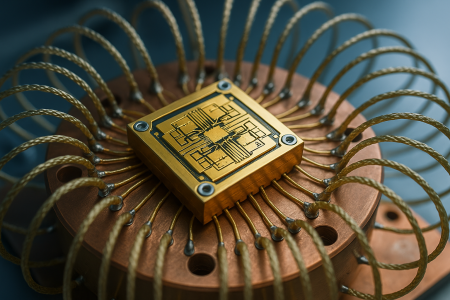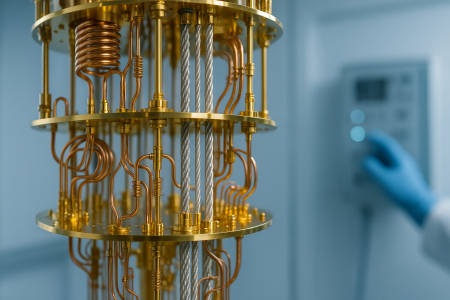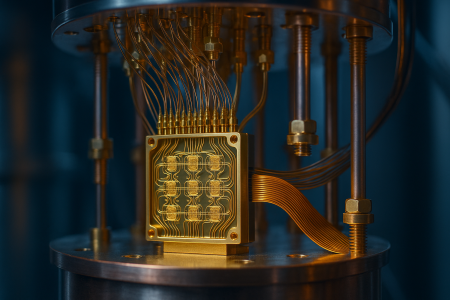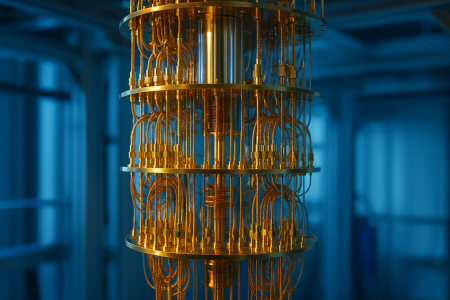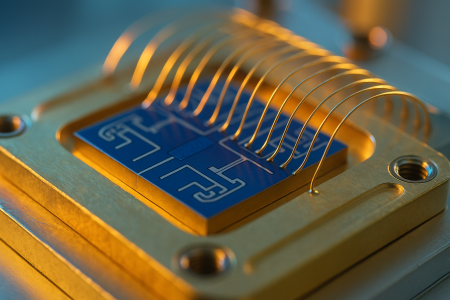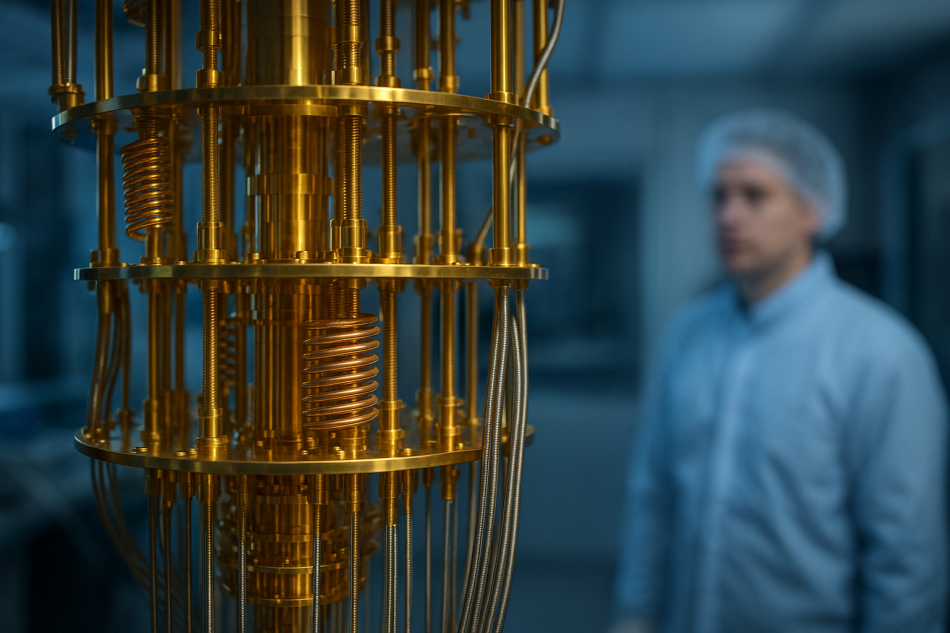

The photographs are familiar by now: a golden chandelier of brass plates and coiled tubing, hanging in a lab while engineers in clean-room gear look on. People assume the gold thing is the quantum computer. It isn't. The actual processor is a fingernail-sized chip bolted to the bottom, smaller than the bolt holding it in place. Everything above it is plumbing. That plumbing is a dilution refrigerator, and the companies that build it have quietly become one of the most important links in the quantum supply chain.
What the fridge actually does
Superconducting qubits, the kind IBM, Google, and Rigetti build, only behave themselves near absolute zero. Above a few thousandths of a degree, stray thermal energy jostles the qubits and scrambles their fragile quantum states. A dilution refrigerator gets the chip down to roughly 10 to 15 millikelvin, colder than interstellar space, and holds it there indefinitely.
It does this with a clever trick involving two isotopes of helium. A mixture of helium-3 and helium-4 separates into two phases at very low temperatures, and forcing helium-3 atoms across the boundary between them absorbs heat, much as evaporating sweat cools your skin. The process runs continuously in a closed loop. The result is a machine that can stay frozen for months at a time, which matters when an experiment takes weeks and warming up and cooling down again costs days.
A small club of suppliers
Almost everyone in superconducting and certain spin-qubit research buys their fridges from a handful of firms. Bluefors, a Finnish company, has become the dominant name, supplying many of the big quantum labs and processor makers. Oxford Instruments in the UK has been in the cryogenics business for decades and remains a major player. Japan's Toshiba and a scattering of smaller specialists round out the field. In the United States, newer entrants such as Maybell Quantum have started pitching higher-density designs aimed specifically at the scaling problem.
This concentration is a vulnerability the industry talks about more openly now. A quantum hardware startup can design a brilliant chip and still wait many months for a fridge to put it in. When demand spikes, lead times stretch. The cryostat has become a gating item the same way advanced lithography tools gate semiconductor manufacturing.
The helium-3 problem
There is a deeper constraint lurking inside the machine. Helium-3 is genuinely rare. Most of the world's supply is a byproduct of tritium decay in nuclear weapons stockpiles, which means the market is small, governed by national stockpile decisions, and not designed to scale with a booming commercial industry. Each large dilution refrigerator needs a meaningful charge of the isotope. Multiply that across hundreds of planned machines and the arithmetic gets uncomfortable. Suppliers recycle and reclaim aggressively, and researchers have explored designs that reduce the helium-3 inventory, but it remains a quiet bottleneck few outside the field appreciate.
Why scaling makes it harder
The roadmaps everyone publishes call for thousands and eventually millions of qubits. The fridge doesn't scale the way the chip does. Every qubit needs control and readout lines threaded down through the temperature stages, and each line carries a little heat into the coldest part of the system. A modern processor already pushes hundreds of coaxial cables into the mixing chamber. The cooling power at the bottom stage is measured in microwatts. Pour in too much heat from too many wires and the whole thing warms past the point where the qubits work.
This is why the fridge makers and the processor makers are increasingly designing together. Some efforts focus on enormous custom cryostats, like the large-bore systems built for next-generation IBM and Google ambitions. Others bet on connecting several smaller fridges with cryogenic links, mirroring the modular approach the chip designers have embraced. There is also work on moving control electronics into the cold, so signals don't have to travel up and down a long thermal gradient.
The unglamorous infrastructure layer
None of this generates the headlines that a new qubit count or an error-correction milestone does. But a quantum computer is a system, and the system is only as capable as its weakest support layer. The refrigerator is not an accessory bolted onto the interesting part. For superconducting machines, it is the environment that makes the interesting part possible at all. The companies bending brass tubing in Helsinki and Oxford are, in a real sense, building quantum computers too. The field's progress depends on whether their machines can grow as fast as the chips inside them.