
For years the quantum hardware conversation came down to two camps: superconducting circuits, championed by IBM and Google, and trapped ions, refined by IonQ and Quantinuum. A third approach has been climbing the ladder more quietly, and it now sits among the serious contenders. It uses individual neutral atoms, held in place by beams of laser light, as qubits. Companies including QuEra, Pasqal, and Atom Computing have built machines around this idea, and the platform has gone from physics-lab curiosity to commercial roadmap in a remarkably short stretch.
What a neutral-atom qubit actually is
The qubit here is a single atom, often rubidium or cesium, cooled until it barely moves. To trap it, researchers use what are called optical tweezers: tightly focused laser beams that act like microscopic tractor beams, each one cradling a single atom in space. Arrange hundreds of these tweezers in a grid and you have a register of qubits that can be reconfigured almost like pixels on a screen.
The quantum information lives in the atom's internal energy levels. By shining precisely tuned lasers, operators flip and rotate those states to perform single-qubit gates. The clever part is how atoms are made to interact. Pump an atom into a highly excited condition known as a Rydberg state and it swells enormously in size, so much that it can sense and block a neighbor from being excited too. That Rydberg blockade is the mechanism that creates entanglement between atoms, the raw ingredient of any quantum computation.
Why the approach is attracting attention
A few features make neutral atoms appealing. First is identicality. Every rubidium atom is exactly like every other rubidium atom, so there is no manufacturing variation to calibrate away, unlike the fabricated junctions in superconducting chips that each behave slightly differently. Second is scale. Optical tweezer arrays can hold large numbers of atoms in a compact footprint, and adding more is closer to a problem of optics and laser power than of etching new circuitry. Atom Computing has publicly described systems in the range of a thousand or more atomic qubits, a figure that turned heads precisely because raw site counts in other platforms grew more slowly.
There is also a structural advantage that matters for error correction. Atoms can be physically picked up and moved during a computation, shuttled from one zone to another. That mobility lets engineers reshuffle which qubits talk to which, a flexibility that simplifies the connectivity required by the error-correcting codes everyone is chasing. Quantinuum exploits something similar with trapped ions, and the neutral-atom crowd argues their arrays push that idea further.
The honest limitations
None of this means the problem is solved. Neutral-atom machines tend to run gates more slowly than superconducting processors, where operations finish in nanoseconds. Loading the atoms into their tweezers is probabilistic, so some sites start empty and have to be refilled, which adds overhead. Atoms can also be lost mid-run if a stray collision or a photon knocks them out of the trap, and detecting and replacing them is an active area of engineering. Measuring qubits without disturbing their neighbors is delicate work too.
And the platform still has to prove it can stack the depth of error correction needed for genuinely useful computation. Demonstrations of logical qubits on neutral-atom hardware have been encouraging, including work showing that errors can be suppressed as code size grows, but going from a research demonstration to a reliable, programmable machine is a long climb that every modality faces.
Where it fits in the bigger picture
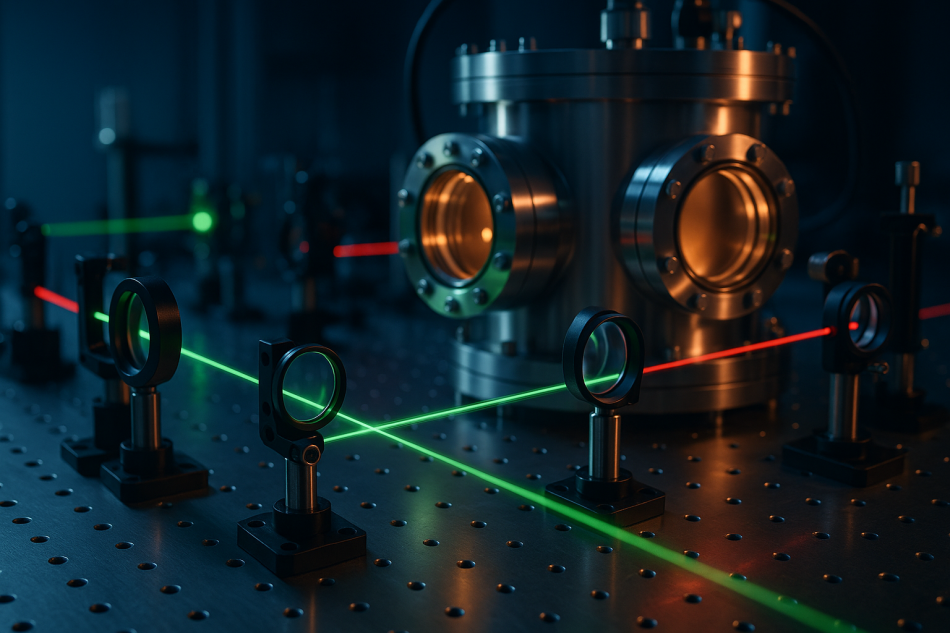
What is striking is how different the neutral-atom bet looks from its rivals. There is no dilution refrigerator chilling a chip toward absolute zero; the atoms are cold, but the surrounding apparatus is a room-temperature tangle of lasers, vacuum chambers, and optics. That changes the engineering and the failure modes entirely.
- QuEra, spun out of academic work at Harvard and MIT, has pushed analog and digital modes of operation and made hardware available through cloud platforms.
- Pasqal, based in France, has pursued both gate-based computing and analog quantum simulation aimed at materials and optimization problems.
- Atom Computing has focused on scaling qubit counts and demonstrating long coherence in its atomic registers.
It is too early to crown any single technology. But the neutral-atom approach has done something important: it has shown that the question of how to build a quantum computer is still genuinely open, and that lasers holding single atoms in midair are a serious answer rather than a footnote.