
For years the public story of quantum computing has been about one number climbing upward: the count of qubits packed onto a single chip. But the engineers building these machines have quietly accepted something the headlines rarely mention. You cannot keep making one chip bigger forever. At some point the wiring, the cooling, the control signals and the manufacturing yield all collide, and the path to a useful machine stops being a single processor and becomes a network of them.
Why one big chip hits a wall
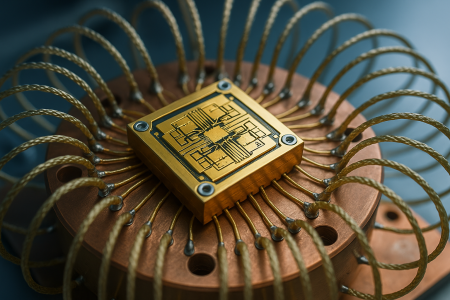
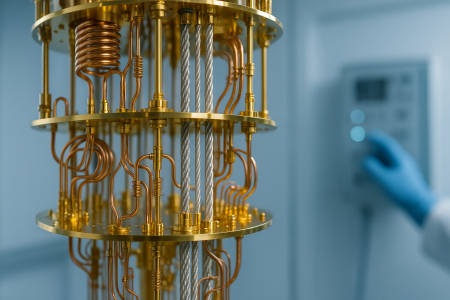
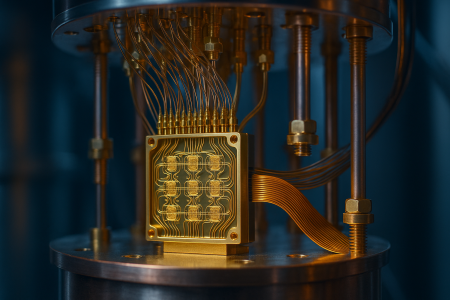
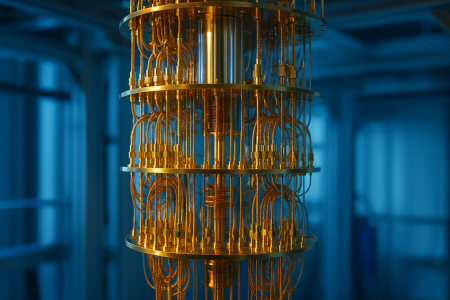
A superconducting quantum processor lives at the bottom of a dilution refrigerator, colder than the space between stars. Every qubit needs control lines running from room-temperature electronics down through several cooling stages into the chip. Add more qubits and you add more wires, more heat leaking in, and more cables crammed into a space that is physically finite. The fridge itself has limits on how much can be threaded through it before the cooling power simply cannot keep up.
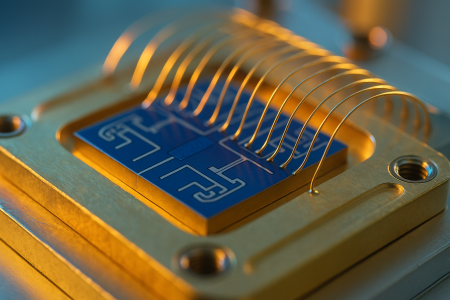
Manufacturing is the other ceiling. A chip with thousands of qubits is only as good as its worst regions. The larger the die, the higher the chance of defects, and the harder it becomes to keep every qubit performing to spec. Scaling a single monolithic processor toward the millions of physical qubits that error correction will eventually demand starts to look less like engineering and more like wishful thinking.
The modular bet
The response across much of the industry is modularity: build processors of a manageable size, get them working reliably, then connect many of them so they behave like one larger machine. It is the same logic that turned single-processor supercomputers into vast clusters of linked nodes, applied to a far more fragile kind of hardware.
IBM has made this explicit in its roadmap. Its Quantum System Two is designed as a platform that can host multiple chips and link them with couplers, and the company has talked publicly about chip-to-chip connections and longer-range links between separate cryostats as the route to large-scale systems. The plan leans on smaller, repeatable processors rather than one ever-growing slab of silicon.
Trapped-ion companies face the same arithmetic from a different starting point. Quantinuum's architecture moves ions around a chip and is built with the idea that separate trap modules can eventually be connected, including through photonic links that carry quantum information between distant processors. IonQ has likewise pointed to networking multiple cores as part of its scaling story.
Then there is PsiQuantum, whose entire approach is photonic and built from the start around connecting many chips through optical fiber. For a company aiming at a million-plus qubit machine, the assumption is that the system will be a room full of interconnected modules, not a single heroic chip.
The hard part is the link
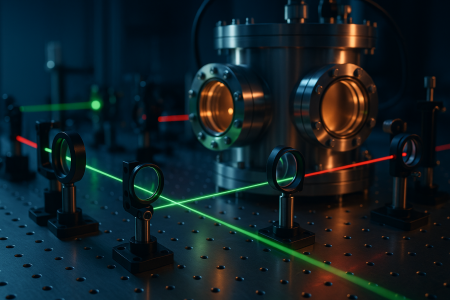
Connecting two quantum processors is far trickier than running a network cable. Inside a chip, qubits can interact through engineered couplings with high fidelity. Sending quantum information between separate modules means creating entanglement across the gap, often by converting a qubit's state into a photon, shuttling it, and reabsorbing it on the other side. Every step introduces loss and error. A modular machine is only worth building if those links are good enough that they do not poison the whole computation.
This is why interconnect fidelity has become one of the most closely watched metrics in the field. The dream is a high-quality link that lets two modules behave, for computational purposes, almost as if they were one. Researchers have demonstrated entanglement between separated systems, but doing it fast, repeatedly, and with low error at the scale a real computer needs is still unfinished work.
What it means for the roadmaps
The shift to modularity reframes how to read company promises. A target of a million qubits no longer implies a single fantastical chip. It implies thousands of modules and the plumbing to connect them, with error correction stitching logical qubits across the whole fabric. Progress will show up not just in qubit counts but in the quality of the couplers, the speed of inter-module operations, and how gracefully a system degrades when one module underperforms.
It also changes the engineering culture. Building one perfect chip is a physics problem. Building, cooling, calibrating and networking hundreds of them is a logistics and systems-integration problem, closer to data center engineering than to a lab bench. The companies that win the next phase may be the ones that treat quantum computing as infrastructure rather than as a single dazzling device.