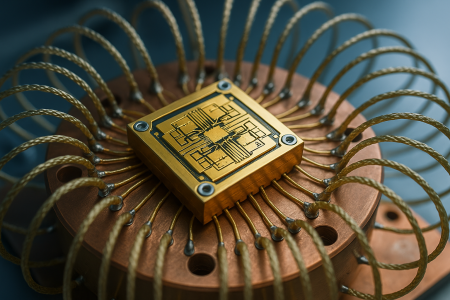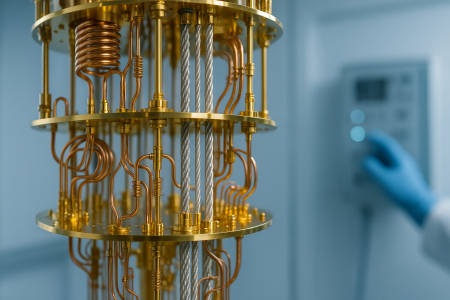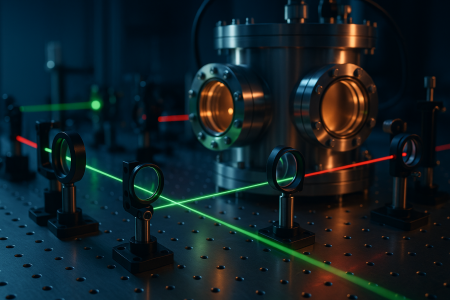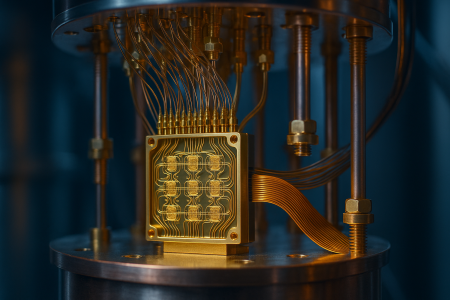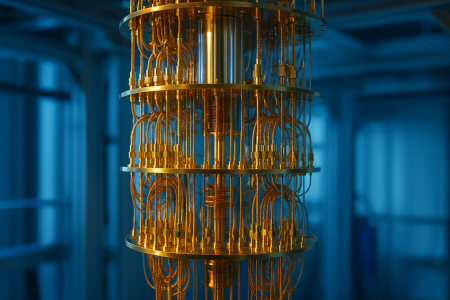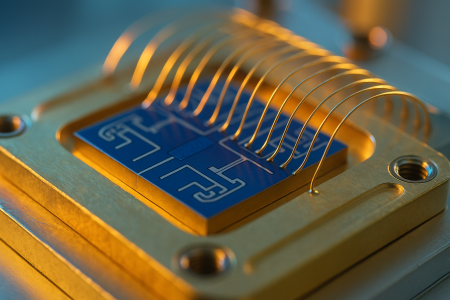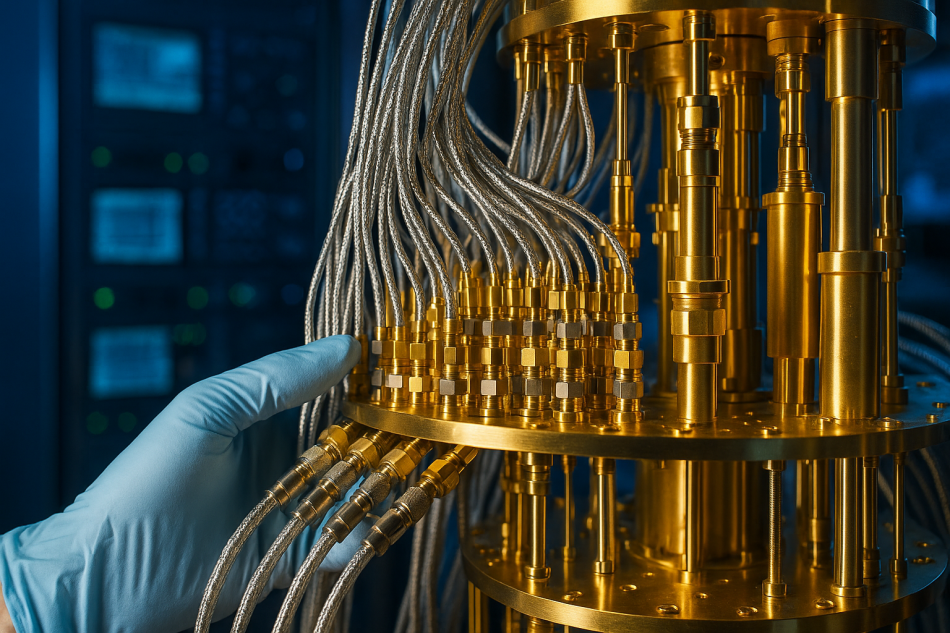

Photographs of quantum computers usually show the same thing: a golden chandelier of plates and tubes hanging inside a refrigerator, looking like a steampunk sculpture. It is a striking image, and it has become shorthand for the whole field. What the picture leaves out is just as important. Surrounding that elegant cold stage is a far less photogenic mess of coaxial cables, racks of microwave electronics, signal generators, and amplifiers. This control layer is where a lot of the real engineering pain now lives.
Every qubit needs a leash
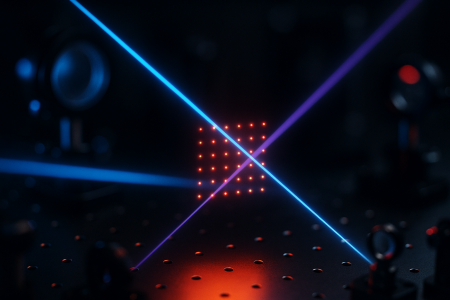
To run a calculation, each qubit has to be addressed individually. In superconducting machines, that means sending carefully shaped microwave pulses down dedicated lines, then reading the faint response back up through more lines. Trapped-ion systems rely on precisely tuned lasers and radio-frequency fields. Whatever the technology, the pattern repeats: every qubit, or small group of qubits, demands its own control and readout channels.
With a few dozen qubits, this is manageable. Wiring a chip with 50 or 100 qubits is tedious but doable. The trouble starts when roadmaps call for thousands and eventually millions of physical qubits to support error correction. If each one needs a couple of cables threaded from a room-temperature rack down into a cryostat, the math turns grim quickly. You cannot fit a million coaxial cables into a refrigerator, and even if you could, each cable carries heat down with it, fighting the very cooling the machine depends on.
Heat, space, and money
The control problem is really three problems wearing one coat. The first is thermal. Cables and electronics dump heat, and the coldest stages of a dilution refrigerator have a cooling budget measured in microwatts. Every wire is a small thermal leak. The second is physical space. There is only so much room on the cold plates and only so many ports through the fridge walls. The third is cost. Commercial microwave control hardware is expensive, and scaling it linearly with qubit count would push the price of a large machine into territory no customer would accept.
None of this gets the attention that qubit counts or error rates do, but engineers across the industry treat it as a first-order constraint. A processor you cannot wire is not a processor.
Pushing the brains into the cold
The most promising fix is to stop sending so many signals up and down the fridge and instead move control electronics closer to the qubits. Several groups are developing what is broadly called cryo-CMOS: conventional silicon chips redesigned to operate at cryogenic temperatures, sitting inside the refrigerator rather than in a rack across the room. If a control chip can live at a few kelvin, it can talk to qubits over short connections and communicate with the warm world using far fewer, more efficient digital links.
Intel has been public about its cryogenic control chip work, and other companies and academic labs are chasing similar ideas. The challenge is brutal. The electronics must dissipate almost no power, behave predictably at temperatures where ordinary transistor models break down, and not introduce noise that wrecks the delicate quantum states nearby. Getting all three at once is hard, which is why this remains an active research area rather than a solved problem.
Other routes around the jam
Cryo-CMOS is not the only path. Some designers are working on multiplexing, where one line controls or reads several qubits by separating their signals in frequency. Photonic approaches that carry signals on light rather than electrical cables offer another way to cut down on bulky wiring. Architectures that group qubits into tiles or modules, each with its own local control, aim to keep the wiring problem from exploding as systems grow.
What unites these efforts is a shift in how the field thinks about progress. For years the headline number was how many qubits a company could announce. Increasingly the harder questions are about everything wrapped around those qubits: can you address them all, read them all, and keep them cold while doing it.
The chandelier in the photo will probably stay the public face of quantum computing for a while. But whether these machines reach the scale their roadmaps promise may depend less on the glittering cold stage and more on the unglamorous cables, racks, and control chips that almost never make it into the frame.