
Most people don't associate thermostats and jet engine controls with quantum computing. Yet one of the most quietly influential quantum hardware makers in the world grew out of exactly that pedigree. Quantinuum, the company behind the H-series trapped-ion machines, traces half its DNA to Honeywell, the sprawling industrial conglomerate, and the other half to Cambridge Quantum Computing, a British software house. The two combined in 2021, and the result was a company that builds both the metal and the code.
Two halves of one machine
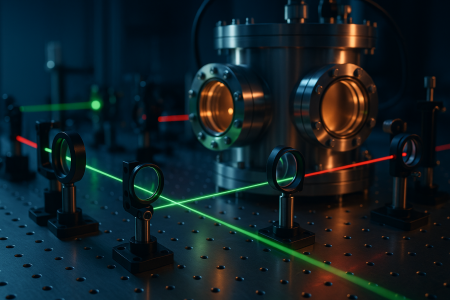
Honeywell's quantum group was an unlikely player. The company had spent decades building precision control systems, vacuum hardware, and lasers for aerospace and industrial use, and it turned out those exact skills matter enormously for trapped-ion computers. Ions need ultra-high vacuum chambers, stable laser sources, and finely tuned electrode voltages to behave. Cambridge Quantum, meanwhile, had built a compiler and a stack of quantum algorithms without owning any hardware at all. Merging the two produced a rare full-stack outfit: qubits at the bottom, software at the top.
The shuttle-and-store approach
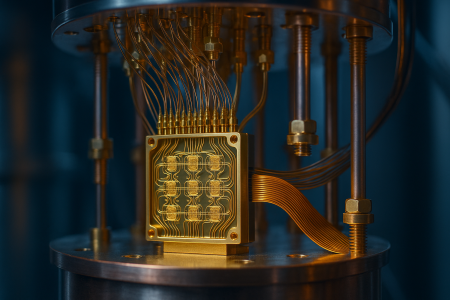
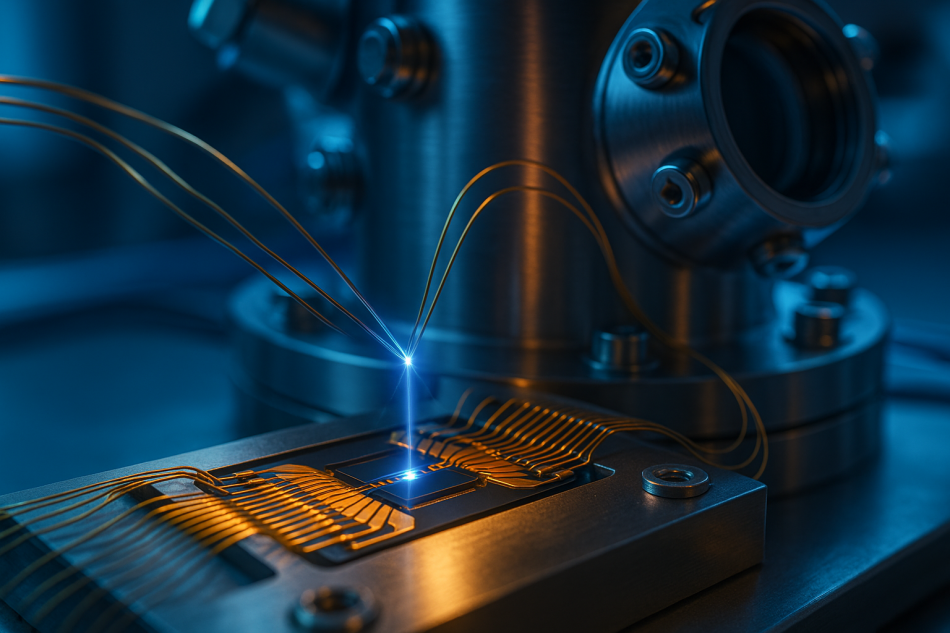
Quantinuum's hardware bet is a design called QCCD, short for quantum charge-coupled device. Instead of packing every ion into one fixed spot and hoping they all stay well-behaved, the architecture physically moves ions around a segmented trap. Voltages on tiny electrodes act like conveyor belts, ferrying charged atoms between zones where they are stored, cooled, entangled, or measured. When two ions need to interact, the machine brings them together; when they need to sit quietly, it parks them elsewhere.
This shuttling gives QCCD machines something rival designs struggle to match: any qubit can be paired with any other qubit, because you simply move them next to each other. That all-to-all connectivity avoids the routing headaches that plague chips where qubits can only talk to fixed neighbors. The trade-off is speed. Moving ions takes time, and each transport step is an opportunity for the delicate quantum state to degrade, so the engineering effort goes into making those moves fast and gentle.
Chasing fidelity over qubit count
Quantinuum has consistently argued that the number of qubits is the wrong headline figure. A machine with a few dozen extremely clean qubits can outperform one with hundreds of noisy ones, because errors compound with every operation. The company leaned into that philosophy by chasing gate fidelities among the highest reported for any platform and by publicizing its quantum volume, a benchmark that rewards depth and quality rather than raw qubit tallies. For a stretch, its machines set record after record on that particular yardstick.
That quality focus also made the H-series a favorite testbed for error-correction experiments. Researchers have used the machines to demonstrate logical qubits, mid-circuit measurement, and qubit reuse, all techniques that lean on the platform's precision and flexible connectivity. Trapped ions are slow compared to superconducting chips, but for probing the mechanics of fault tolerance, the cleanliness matters more than the clock speed.
The software side of the wager
The Cambridge Quantum inheritance shows up in TKET, an open-source compiler that rewrites quantum programs to run efficiently on real hardware, including machines Quantinuum doesn't build. Keeping that tool hardware-agnostic was a deliberate move. It positions the company as a supplier of the plumbing that the whole industry uses, not just a seller of its own boxes. The strategy hedges the bet: even if a rival's hardware wins, the software layer still has customers.
Why the bet still matters
Trapped ions are not guaranteed to win. Superconducting chips run faster, silicon spin qubits promise fab-line manufacturing, and neutral-atom arrays scale to more qubits per system. What Quantinuum offers is a coherent argument that fidelity, connectivity, and a mature software stack together buy you more useful computation today than any single flashy metric. The Honeywell heritage gave it deep pockets and industrial discipline; the Cambridge side gave it algorithms and a compiler. Whether that combination carries the company to a genuinely fault-tolerant machine is still an open question, but few competitors can claim to have wagered so completely on quality over quantity, and to have built both the hardware and the software to back the bet.