
Roughly a hundred years ago, chemists learned to pull nitrogen out of the air and turn it into fertilizer. The Haber-Bosch process feeds a large share of humanity, but it is a blunt instrument. It squeezes nitrogen and hydrogen together at hundreds of degrees Celsius and pressures many times that of the atmosphere, and it burns through something like one to two percent of the world's energy supply to do it. Meanwhile, soil bacteria pull off the same trick quietly, at ordinary temperature and pressure, using an enzyme called nitrogenase.
At the heart of that enzyme sits a cluster of iron, sulfur, and molybdenum atoms known as FeMoco, the iron-molybdenum cofactor. Chemists have known its rough shape for decades, but they still cannot fully explain how it grabs an inert nitrogen molecule and splits its famously stubborn triple bond. If someone could map the exact sequence of electronic states the cluster passes through, it might point the way to a catalyst that makes fertilizer without the furnace. That prize is why FeMoco keeps showing up in talks about what quantum computers are actually for.
Why classical computers stall
Predicting how molecules behave means solving the equations that govern their electrons. For small, well-behaved molecules, classical chemistry software does a fine job using clever approximations. The trouble with FeMoco is that its electrons are strongly correlated. The many iron atoms carry electrons that are entangled in ways that refuse to be treated one at a time. The number of possible electronic configurations explodes, and the standard approximations that work for a water molecule fall apart.
Chemists describe the hardest part of such a problem as the active space, the set of orbitals that genuinely need the full quantum treatment. For FeMoco that active space is estimated to run past fifty electrons in fifty or more orbitals. That is comfortably beyond what exact classical methods can handle. You can throw a supercomputer at it and get useful partial answers, but a definitive, reference-quality calculation of the reaction pathway stays out of reach.
What a quantum computer would do differently
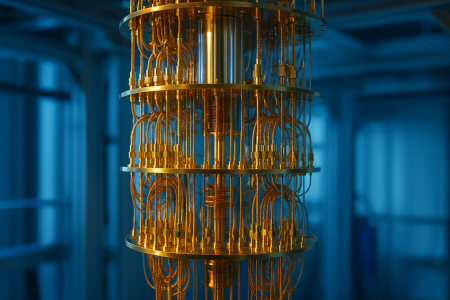
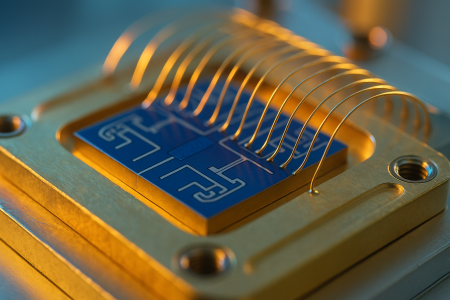
A quantum computer stores electronic states in qubits directly, so the exponential blowup that drowns a classical machine becomes, in principle, a manageable amount of hardware. The favored technique is quantum phase estimation, which extracts the energy of a molecular state to high precision. Feed it a good starting guess for FeMoco's ground state, run the algorithm, and out comes an energy accurate enough to distinguish between competing reaction mechanisms.
That is the dream. The reality check came in a widely cited 2017 analysis by a group including Markus Reiher and Microsoft researchers, who estimated the resources a fault-tolerant machine would need to compute FeMoco energies to chemical accuracy. Their numbers were sobering: on the order of a hundred to two hundred logical qubits, but with a runtime that could stretch for days and require billions of high-quality operations. Later work has trimmed those estimates considerably through better algorithms, yet the conclusion holds. This is a job for an error-corrected machine, not the noisy processors available today.
Why it stays on the list anyway
You might ask why chemists keep pointing at a target they cannot hit yet. The answer is that FeMoco is close to an ideal benchmark. The active space is large enough to defeat classical computers but small enough to fit inside a plausible early fault-tolerant device. The molecule is static, so there is no messy solvent or protein wobble to simulate. And the payoff is easy to explain to anyone who eats food.
It also sets a clear yardstick for hardware progress. When a company publishes a roadmap promising a few hundred logical qubits, the FeMoco calculation is one of the concrete things people ask whether that machine could do. Groups building superconducting, trapped-ion, and neutral-atom systems all cite catalysis and molecular chemistry as a leading first application, precisely because the value does not depend on beating a classical computer at a contrived game. It depends on answering a question chemists genuinely want answered.
None of this means fertilizer factories will change soon. Even a perfect simulation of FeMoco would only tell scientists how nitrogenase works, not hand them a finished industrial catalyst. But the enzyme has become a kind of north star. It marks the point where a quantum computer stops being a physics demonstration and starts doing chemistry that no other machine can.