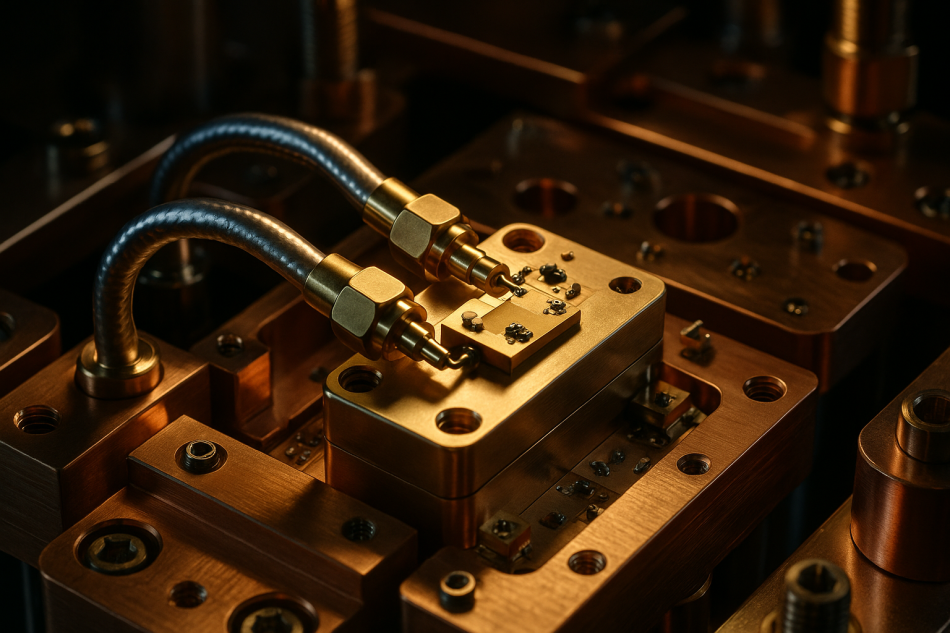

Picture trying to hear a single person whisper from across a stadium, with the crowd roaring. That is roughly the challenge of reading out a superconducting qubit. When a quantum processor measures its qubits, it sends a faint microwave tone bouncing off a readout resonator, and the way that tone comes back reveals whether the qubit is a 0 or a 1. The trouble is the returning signal carries almost no power, often just a handful of microwave photons. By the time it climbs out of the dilution refrigerator and reaches room-temperature electronics, ordinary amplifiers would have buried it under their own electronic hiss.
Why amplification is the weak link
Every amplifier adds noise. That is not a design flaw; it is a consequence of quantum mechanics. A conventional semiconductor amplifier, the kind used in radio and radar, adds the equivalent of tens of photons of noise to whatever it boosts. For a signal that is itself only a few photons strong, that is fatal. You would have to repeat the measurement many times to average out the mess, which slows everything down and, worse, gives the fragile qubit more chances to decohere before you get your answer.
So the first amplifier in the chain has to be exquisitely quiet. In the language of the field, it needs to be close to the standard quantum limit, the theoretical floor set by the uncertainty principle itself. You cannot get below that floor without clever tricks, but getting right up against it means adding only about half a photon of noise. That is the difference between reading a qubit in a single fast shot and not reading it reliably at all.
The Josephson trick, again
The workhorse for this job is the Josephson parametric amplifier, or JPA. It leans on the same tiny superconducting element that makes the qubits themselves possible: the Josephson junction, a thin insulating gap between two superconductors that behaves like a nonlinear inductor. Feed that nonlinearity a strong microwave pump tone and it starts trading energy between frequencies. A weak incoming signal rides along and gets amplified by the pump's power rather than by a noisy transistor. Because the amplification comes from a nearly lossless, reactive element rather than from resistive components, the added noise drops close to the quantum limit.
JPAs come in two broad flavors. One trusts the nonlinearity alone and works over a narrow band of frequencies, which is fine when you only need to read a qubit or two. The other, built around a tunable loop of junctions called a SQUID, can shift its sweet spot and handle more. Both sit on the cold plate of the fridge, wired right next to the processor, because keeping the whole chain cold is the only way to stop thermal noise from creeping back in.
From one qubit to the whole chip
The narrow-band problem is where the newer cousin enters: the traveling-wave parametric amplifier, or TWPA. Instead of a single resonant cavity, a TWPA strings together a long chain of junctions so the signal travels down a kind of nonlinear transmission line, gaining strength as it goes. The payoff is bandwidth. A single TWPA can amplify a wide swath of frequencies at once, which matters enormously now that engineers pack a dozen or more qubits onto one readout line and distinguish them by tuning each to a slightly different note. One quiet, broadband amplifier can boost all of those tones together, which keeps the wiring, and the heat load, under control as processors grow.
These amplifiers are finicky. They need their pump tones carefully tuned, they can saturate if the signal gets too strong, and they occupy precious real estate on the coldest, most crowded shelf of the refrigerator. Some designs reflect the pump back in ways that have to be isolated with bulky microwave components. Shrinking all of that, and making it reproducible across hundreds of channels, is an active engineering fight.
Why it quietly decides the pace
Readout fidelity is one of the numbers that governs everything a quantum computer tries to do. Error correction depends on measuring many qubits fast and getting the right answer nearly every time. A quiet, fast amplifier shortens the measurement window, which means less time for errors to sneak in before the verdict lands. It rarely makes headlines, because it is not a qubit and not a chip. But without the amplifier that turns a whisper into a signal you can trust, none of the louder achievements would be legible at all.







