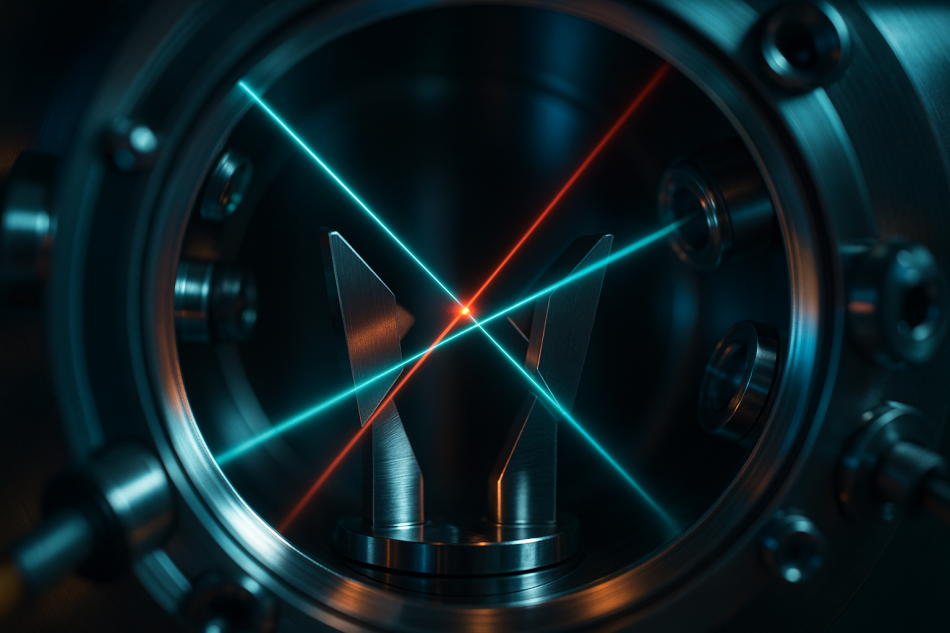

Every trapped-ion quantum computer begins with a choice that most users never see: which atom to use. The qubit is a single charged ion held in place by electric fields, and the species of that ion decides what wavelengths of laser light you need, how cleanly you can read it out, and how easily the machine can eventually talk to others over optical fiber. IonQ built its first commercial systems around ytterbium. More recently it has been moving toward barium. The switch looks like a detail. It is closer to a change of foundation.
Why the atom matters
A trapped-ion qubit stores its zero and one in two long-lived internal energy levels of the ion. To do anything useful, you fire lasers at the ion to prepare it, nudge it between states, entangle it with neighbors, and finally measure it. Measurement works by shining a laser that makes the ion fluoresce if it is in one state and stay dark if it is in the other. A camera or detector counts the photons. The more photons you catch, and the easier they are to catch, the more confidently you can tell a one from a zero.
This is where the color of the light becomes decisive. Ytterbium ions do their key work in the ultraviolet, around 369 nanometers. UV light is harsh on optics. It scatters, it degrades coated surfaces over time, and it does not travel well through ordinary optical fiber. Building and maintaining a UV laser system is demanding, and every mirror and lens in the path has to tolerate a wavelength that slowly eats away at materials.
Barium's advantage
Barium ions, by contrast, do much of their business in visible light. The main transitions sit near 493 nanometers in the blue-green and 650 nanometers in the red. Visible light is far friendlier. The optics are cheaper and more rugged, commercial components are abundant, and crucially, visible photons travel efficiently through standard telecom-adjacent fiber once shifted in wavelength. That matters for the long game of linking many ion traps into a larger machine.
The payoff that IonQ has emphasized most is readout. Because barium fluoresces brightly in a convenient color, detectors collect its photons more efficiently, and the machine can distinguish the two qubit states with fewer mistakes. State preparation and measurement errors, often lumped together as SPAM, are a stubborn source of noise in trapped-ion systems. Cutting them improves the quality of every circuit the machine runs, not just a favored few. Higher measurement fidelity also helps with the mid-circuit measurements that error correction depends on, where you read some ions partway through a program without disturbing the rest.
The cost of changing horses
Swapping the working ion is not free. Years of engineering, control software, and laser hardware were tuned for ytterbium. Barium requires its own lasers, its own carefully chosen isotope, and a re-tuned recipe for every gate and calibration routine. There is also a subtlety in which barium you use. Some isotopes carry a nuclear spin that provides a clean, magnetically insensitive pair of states ideal for storing quantum information, but those isotopes are rarer and can require sourcing or generating the right material. The engineering overhead is real, which is why the transition has been gradual rather than a single clean break.
The networking bet
The deeper motivation points past any single processor. IonQ, like several trapped-ion rivals, expects to scale by connecting modules rather than cramming ever more ions into one trap. Linking modules means converting an ion's internal state into a photon, sending that photon down a fiber, and interfering it with a photon from another module to create entanglement at a distance. Visible-light ions give you a better starting point for that chain, because the photons are easier to collect and to shift toward the low-loss wavelengths that fiber prefers. In that sense, barium is less about today's single chip and more about the day many chips need to behave as one.
None of this makes barium a magic bullet. Trapped-ion machines still fight heating of the ions' shared motion, still run gates slower than superconducting chips, and still face the hard climb toward fault tolerance. But the move from ultraviolet to visible light is a reminder that in quantum hardware, choices made at the level of a single atom ripple all the way up to the architecture. Pick the right ion, and the lasers, the optics, the readout, and the future network all get a little easier.







