
Every qubit suffers two basic ways of going wrong. It can flip its value, swapping a 0 for a 1, the way a classical bit does when a cosmic ray or a stray photon nudges it. And it can lose its phase, scrambling the delicate relationship between its two states that gives a quantum computer its power. Most designs treat these two failures as roughly equal problems and throw error correction at both. The French company Alice & Bob took a different view. What if you could build a qubit that almost never flips, and spend all your correction budget on the other kind of mistake?
What a cat qubit actually is
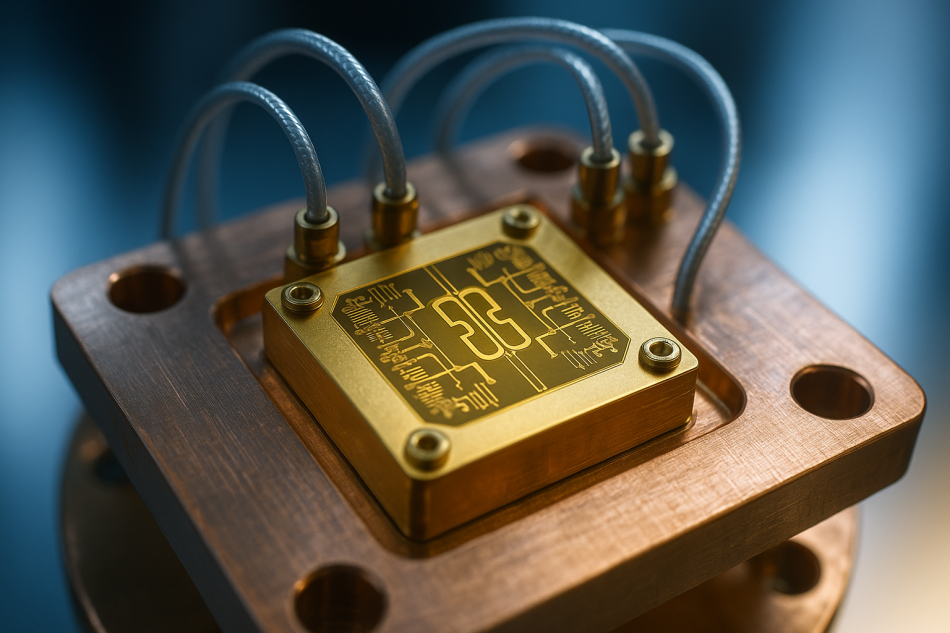
The trick lives inside a superconducting microwave resonator, a small cavity that holds oscillating electromagnetic energy. Instead of encoding information in the lowest energy levels of a single artificial atom, a cat qubit stores it in two coherent states of that oscillator, two waveforms that are mirror images of each other, pointing in opposite directions. The name comes from Schrödinger's thought experiment: the qubit lives in a superposition of two large, classical-looking states, the mathematical cousin of a cat that is both alive and dead.
Here is why that matters. To flip such a qubit from one coherent state to the other, the system has to hop across a wide gulf in phase space. The bigger you make the states, by pumping more photons into the cavity, the wider that gulf becomes and the more exponentially unlikely a bit-flip gets. Phase-flips, meanwhile, get a little more common. So the designer gets a dial. Crank up the photon number and one error type all but vanishes while the other stays manageable.
Why lopsided errors are a gift
A qubit that fails in only one direction is a much easier thing to protect. General-purpose error-correcting codes like the surface code assume both flavors of error are equally likely, and they pay for that assumption in overhead, needing hundreds or thousands of physical qubits to build one reliable logical qubit. If bit-flips are already suppressed by the hardware, you can reach for a far leaner code that only has to catch phase-flips. The repetition code, the simplest error-correcting scheme there is, suddenly becomes viable again because it only has to guard against one thing.
The upshot is a potentially dramatic saving. Alice & Bob has argued that biasing the noise this way could cut the number of physical qubits required for a fault-tolerant machine by a large factor compared with unbiased approaches. The company folded that reasoning into its roadmap, naming chip generations after cat breeds and pointing toward logical qubits assembled from a modest number of cat qubits rather than a sprawling grid.
The catch, and the competition
None of this is free. Keeping a cat alive requires constant work. The two coherent states are not naturally stable, so the hardware has to continuously pump the resonator to hold them in place, a technique called two-photon dissipation that quietly drains away any leakage back toward the middle. Building the components that do this pumping cleanly, without introducing fresh noise, is the hard engineering problem the field is still chewing on. And while bit-flips shrink beautifully, the phase-flip rate has to stay low enough that the repetition code can keep up. If it does not, the savings evaporate.
Alice & Bob is not alone in finding cats attractive. Amazon's quantum hardware group has pursued the same bosonic idea, publishing work on a chip that pairs cat qubits with a repetition code to demonstrate the lopsided-error strategy on real silicon. That convergence from an independent, well-funded team is a useful signal. When a scrappy startup and a cloud giant land on the same unusual qubit, it suggests the physics is worth taking seriously rather than being a single company's idiosyncrasy.
A different shape of the same race
The cat qubit is a reminder that scaling a quantum computer is not only about piling up more qubits. It is about choosing where in the stack you spend your effort. Transmon-based machines push most of the burden up into software and enormous error-correcting codes. The cat approach pushes some of that burden down into the physical device, letting the hardware absorb one whole category of failure before correction ever begins. Whether that trade pays off depends on numbers that are still being measured: how large the cats can grow, how quiet the pumping stays, and how stubborn those remaining phase-flips prove. If the biased-noise bet holds, the road to a fault-tolerant machine could turn out to be shorter, and stranger, than the qubit counts alone suggest.







