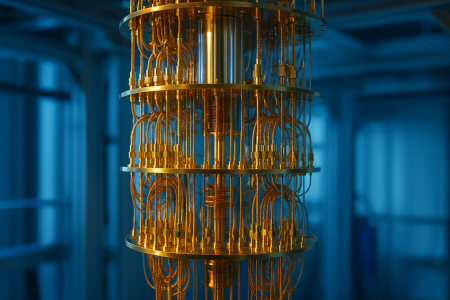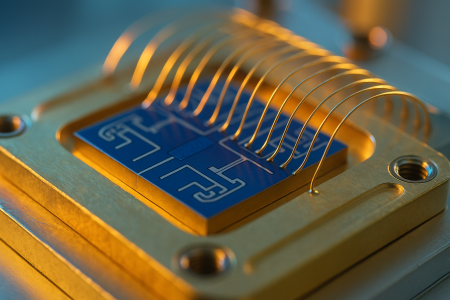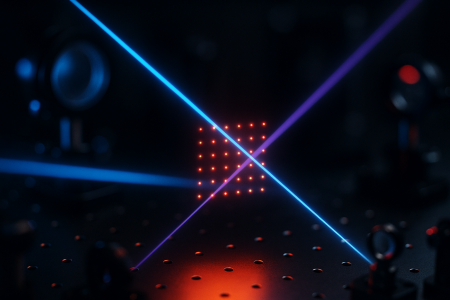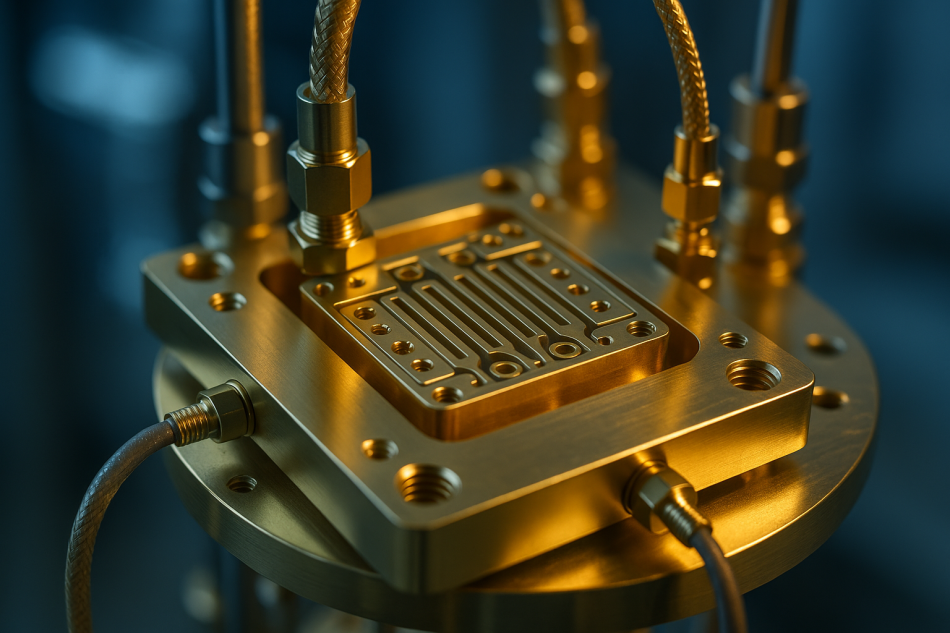

Quantum computers make mistakes constantly. A single qubit can lose its delicate state in microseconds, and the standard fix is brute force: surround one useful "logical" qubit with hundreds or thousands of physical ones, then use error-correcting codes to vote out the noise. It works in principle, but the overhead is brutal. A machine that needs a million physical qubits to run a useful algorithm is a machine that may take a decade to build.
So a handful of companies are chasing a different idea. Instead of correcting every type of error after the fact, what if you could design a qubit that physically resists one of the most common errors in the first place? That is the promise of the cat qubit, and it is one of the more interesting hardware bets in the field right now.
What a cat qubit actually is
The name comes from Schrodinger's famous thought experiment, where a cat is imagined to be alive and dead at once. A cat qubit stores quantum information not in a single particle but in a microwave resonator holding many photons at once, in a state that is a superposition of two opposite-phase oscillations. Think of it as the light equivalent of the cat being in two states simultaneously.
Errors in qubits come in two flavors. Bit flips swap a 0 for a 1. Phase flips scramble the relationship between the two states. Cat qubits are engineered so that bit flips become extraordinarily rare, because flipping the encoded value would require the system to jump across a large energy gap that grows as you add more photons. Researchers have demonstrated bit-flip times that stretch into seconds or longer, while ordinary superconducting qubits flip in microseconds. The trade is that phase flips happen more often, roughly in proportion to the photon count.
Why lopsided errors help
At first that sounds like a wash. You crushed one error and made another worse. The advantage is that error correction gets dramatically simpler when you only have to worry about one kind of mistake. The famous surface code spends most of its qubits guarding against both bit and phase flips at once. If the hardware already suppresses bit flips by design, you can swap in a much leaner code, often a repetition code, that only watches for phase errors. That can cut the number of physical qubits per logical qubit from thousands to dozens.
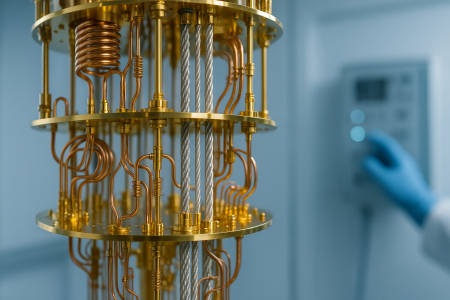
That arithmetic is the whole pitch. Fewer physical qubits per logical qubit means a smaller machine, less wiring, less cryogenic plumbing, and a shorter path to something useful.
Who is building them
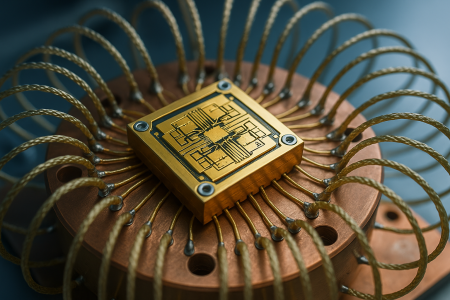
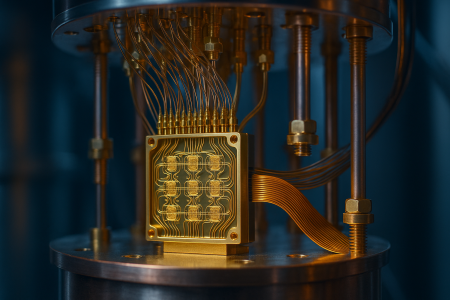
The Paris-based startup Alice and Bob has built its entire roadmap around cat qubits, arguing that the photon-suppressed design lets it skip much of the overhead that weighs down rival approaches. Amazon's quantum hardware group has pursued the same physics, publishing work on a prototype chip that combines cat qubits with a repetition code to demonstrate hardware-efficient error suppression. Academic groups, including teams that trace back to Yale's pioneering work on superconducting cavities, have pushed the underlying science for years.
The shared thesis is that error correction should not be purely a software and architecture problem layered on top of generic qubits. Some of the work can be pushed down into the physics of the device itself, so the rest of the system has less to clean up.
The catch
None of this is free. Keeping a cat state stable requires constantly pumping energy into the resonator through a carefully tuned nonlinear element, and that machinery introduces its own failure modes. Suppressing bit flips to the level the theory promises while still performing fast, accurate gates is hard, and the gates themselves can reintroduce the very errors the design tried to avoid. Demonstrations so far involve small numbers of qubits, and scaling them up while preserving the lopsided error rates is an open engineering question.
There is also a broader uncertainty. Cat qubits compete not only with conventional surface-code machines but with other clever shortcuts, such as erasure qubits that convert errors into easily detectable losses, and bosonic codes of other flavors. It is far from settled which approach, if any, will dominate.
What makes the cat qubit worth watching is the philosophy behind it. Rather than accepting noisy hardware and paying for it with overwhelming redundancy, it tries to bake resilience into the device. If that bet pays off, the road to a useful, fault-tolerant quantum computer could be considerably shorter than the million-qubit projections suggest. If it does not, it will still have taught the field a lot about how far hardware design can carry the burden that error correction usually shoulders alone.