
When people talk about protecting qubits, they almost always mean the surface code, the checkerboard arrangement that has become the default plan for nearly every superconducting machine. But it has a quieter relative that trades a little robustness for a lot of convenience. It is called the color code, and its central promise is that a quantum computer built on it can perform more of its logic the cheap way, without the costly detours the surface code demands.
Three colors, two jobs
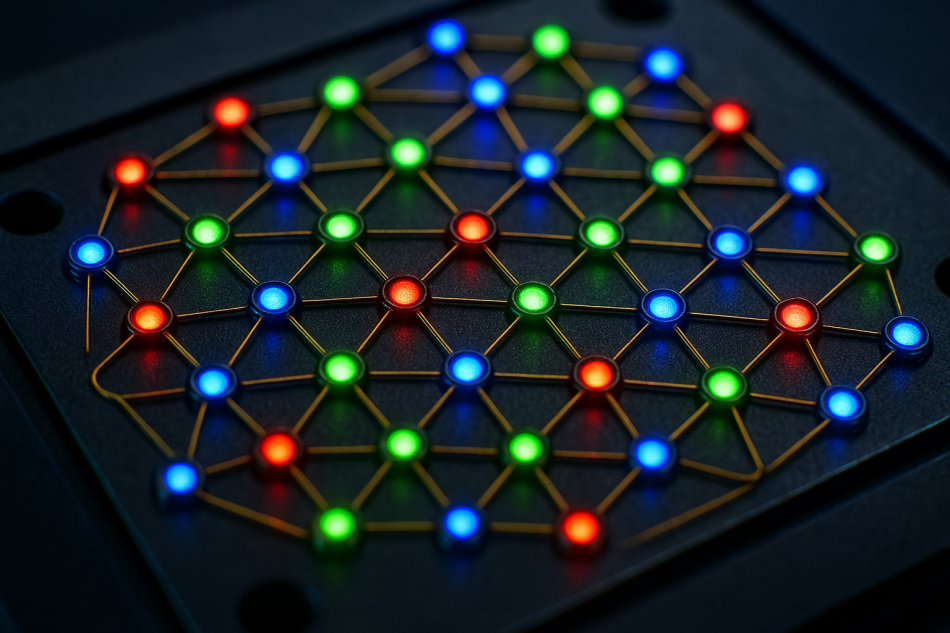
The color code lays its qubits out on a lattice whose tiles can be colored with three shades, red, green, and blue, so that no two touching tiles share a color. A common version uses hexagons and triangles. On each tile sits a group of parity checks, the measurements that sniff out errors without disturbing the stored information.
Here is the first twist. In the surface code, any given check watches for only one kind of mistake, either a bit-flip or a phase-flip, and the two types live on separate plaquettes. The color code asks every tile to do both jobs at once. Each colored face carries both an X-type and a Z-type stabilizer, overlapping on the very same qubits. That doubling is what gives the code its unusual powers, and also what makes it harder to run.
The payoff: transversal gates
The reason physicists keep returning to the color code is a property called transversality. A transversal gate is the gentlest way to operate on a protected qubit: you apply the same simple operation to each physical qubit in the block, independently, with no qubit talking to another inside the block. Because mistakes stay put rather than spreading, these gates are naturally fault-tolerant.
The surface code can only do part of its logic this way. To complete a universal set, it leans on magic state distillation and a maneuver called lattice surgery, both of which burn enormous numbers of qubits and clock cycles. The color code, by contrast, supports the entire Clifford group transversally. That includes the Hadamard and the phase gate and, crucially, the T-adjacent machinery that the surface code has to import at great expense. In two dimensions the color code still needs magic states to reach true universality, but it hands you a much larger chunk of the toolkit for free, and some three-dimensional variants push even further.
Why it isn't everywhere already
If the color code offers cheaper gates, why hasn't it swept the field? The answer is in the plumbing. Because each tile hosts both kinds of check and those checks overlap, the stabilizers are heavier. A single measurement may need to gather information from six qubits instead of four, and it does so through longer, more tangled sequences of two-qubit operations. More operations mean more chances for noise to creep in during the measurement itself.
That weight shows up in the numbers that matter most. The error threshold, the noise level below which adding more qubits actually helps rather than hurts, is lower for the color code than for the surface code. Where the surface code tolerates physical error rates around one percent, the color code typically demands cleaner hardware. For devices that are still fighting to cross any threshold at all, that gap has been decisive, and it explains why the surface code grabbed the early spotlight.
The gap is narrowing
Recent work has chipped away at the color code's disadvantages. Better decoders, the classical algorithms that interpret the stream of check results and guess what went wrong, have closed much of the performance distance. Matching-based and tensor-network decoders now wring far more accuracy out of the same raw measurements than the early attempts managed. Trapped-ion and neutral-atom machines, which can shuffle qubits around and connect distant pairs more freely than a fixed superconducting grid, are especially comfortable with the heavier connectivity the color code wants.
None of this makes the color code a guaranteed winner. The likely future is a mixed one, where a machine stores most of its information in a surface-code memory and switches to a color-code patch when it needs to run a batch of Clifford gates cheaply. Error correction is turning into a question of logistics as much as physics, and the triangular lattice gives architects one more lever to pull when the bill for fault tolerance comes due.







