
Most of the errors that plague a superconducting quantum computer are local and boring in a useful way. One qubit drifts, a control pulse is a hair too strong, a stray photon nudges a state. Error-correcting codes are designed around exactly that assumption: that faults strike here and there, scattered across the chip, so a good decoder can vote them away. Then a cosmic ray comes through and breaks the assumption.
A particle from very far away
The upper atmosphere is constantly bombarded by high-energy protons and nuclei from deep space. When they collide with air molecules they spray out showers of secondary particles, mostly muons, that rain down on the ground at a rate of roughly one per square centimeter per minute. Add to that the low-level radioactivity in ordinary materials, the concrete of the building, the solder on the board, trace uranium and thorium in the silicon itself, and you have a steady drizzle of energetic particles passing through everything, including a quantum chip chilled to a few thousandths of a degree above absolute zero.
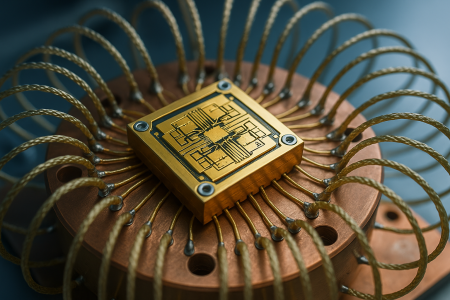
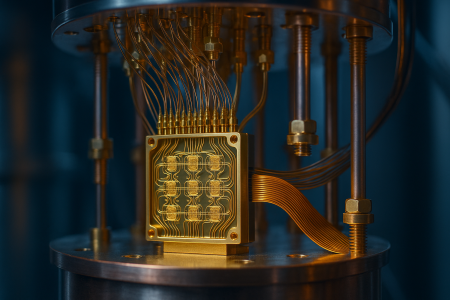
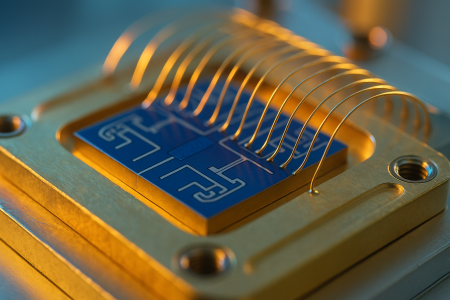
When one of these particles strikes the silicon or sapphire substrate that a superconducting processor sits on, it dumps energy into the crystal. That energy spreads as a burst of phonons, tiny vibrations rippling outward through the material. The phonons slam into the superconducting film and break apart Cooper pairs, the paired electrons that make superconductivity work. The broken pairs create a flood of stray excitations called quasiparticles.
Why one hit ruins everything
Quasiparticles are poison to a superconducting qubit. They sap its energy and scramble its state. A single cosmic ray event does not touch one qubit; the phonon burst races across the whole chip in a fraction of a millisecond, so a large fraction of the qubits on the processor degrade at the same instant. Researchers at Google measured exactly this a few years ago, watching coherence times across an entire device collapse together every ten seconds or so, then slowly recover as the quasiparticles drained away.
That correlated, chip-wide behavior is the real danger. Quantum error correction leans hard on the idea that errors are independent. When dozens of qubits fail simultaneously, the code has no majority left to trust. A single strike can overwhelm a logical qubit that was carefully built from hundreds of physical ones. For a machine meant to run for hours on a hard problem, an event every few seconds is not a nuisance, it is a wall.
Fighting back at every layer
There is no way to switch off the sky, so the countermeasures work at the level of physics and packaging. Several lines of attack are being pursued at once.
- Shielding and location. Lead housings around the coldest stage can absorb some background gamma rays, and there is serious interest in operating processors deep underground, where mountains of rock block the muon flux. Groups in Italy and the United States have run cryogenic qubit tests in underground labs to measure just how much the radiation background falls.
- Gap engineering. By layering superconductors with slightly different energy gaps, designers can steer quasiparticles away from the sensitive junctions, herding them into regions where they do less harm.
- Phonon traps and downconversion. Adding normal-metal pads or specially patterned structures on the chip can soak up the phonon burst before it reaches every qubit, blunting the correlated hit into something more localized.
- Detect and discard. Some architectures aim to sense a strike as it happens, flag the affected window, and simply throw out the corrupted stretch of computation, the way a camera might drop a ruined frame.
An engineering problem, not a dead end
What makes the cosmic ray problem interesting is that it is a genuinely new failure mode, invisible until qubits got good enough that a rare event became the limiting one. For years the dominant errors came from imperfect materials and control. Now that coherence times have climbed, the background radiation of the planet has emerged as a ceiling that has to be engineered around before million-qubit machines can run long calculations without interruption.
It is also a reminder that a quantum computer is a physics experiment wearing the costume of a computer. The same sensitivity that makes a superconducting circuit useful as a qubit makes it an excellent particle detector, whether you want one or not. Taming that sensitivity, so a stray muon from an exploding star light-years away does not crash your chemistry simulation, is one of the less glamorous but unavoidable tasks standing between today's processors and the fault-tolerant machines on every company roadmap.