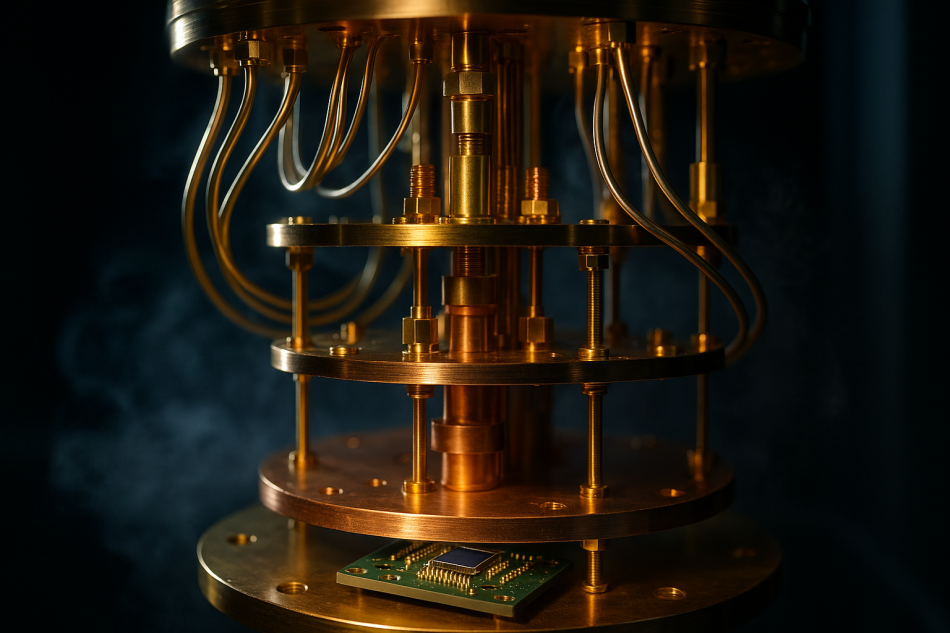

A quantum processor is the star of the show, but it cannot do anything alone. Each qubit needs a steady diet of carefully shaped microwave pulses to rotate it, entangle it with a neighbor, and read out its state. Those pulses are generated by conventional electronics: arbitrary waveform generators, mixers, amplifiers, and digitizers, most of them sitting in equipment racks at room temperature. For a machine with a few dozen qubits, that arrangement works. For a machine with a million, it becomes a nightmare of cables, heat, and cost.
The signal that has to travel too far
Picture the problem physically. The qubits live at the bottom of a dilution refrigerator, colder than deep space. The control electronics live in a rack beside it, at ordinary room temperature. Between them runs a bundle of coaxial cables, one or more per qubit, threading down through the fridge's temperature stages. Every cable carries heat inward and takes up space, and every stage of the fridge can only absorb so much warmth before it stops cooling. This is the wiring bottleneck that hardware teams talk about constantly.
Cryo-CMOS is one proposed way out. The idea is to take the control and readout electronics that normally sit at room temperature and rebuild them as silicon chips that can operate at cryogenic temperatures, then place those chips inside the fridge, close to the qubits. If the electronics live at 4 kelvin or lower, you no longer need a separate cable running all the way from the warm world to each qubit. You need far fewer wires crossing the temperature stages, because the signals are generated and processed locally.
Why ordinary chips do not just work in the cold
Standard CMOS, the same transistor technology in your laptop, does not automatically behave when you plunge it to a few degrees above absolute zero. Transistor thresholds shift, some devices misbehave, and the models engineers use to design circuits stop matching reality. So building cryo-CMOS is not simply a matter of relocating existing chips. It means characterizing how transistors act in the cold, building new design libraries, and laying out circuits that generate clean microwave tones and low-noise readout while surviving the environment.
There is also a brutal constraint that room-temperature designers never worry about: heat. The coldest stage of a dilution fridge can remove only a tiny amount of power, measured in microwatts to milliwatts. A room-temperature control board might happily burn tens of watts. Any cryo-CMOS controller has to sip power, because whatever it dissipates has to be pumped back out by the fridge. That single fact shapes every design choice. The chips have to be efficient enough that adding qubits does not overwhelm the cooling budget.
Who is chasing it
Intel has been one of the most visible players here, drawing on its long experience as a chipmaker. Its cryogenic control effort, publicly discussed under the Horse Ridge name, was pitched as a way to replace many separate instruments with a single integrated controller running in the cold. The logic fits Intel's broader strategy, since the company is also betting on silicon spin qubits fabricated in a chip foundry. If both the qubits and their controllers can come off similar manufacturing lines, the whole stack becomes something a semiconductor company already knows how to scale.
Other groups, academic and industrial, are exploring their own cryo-CMOS controllers and readout chips. The common thread is a belief that you cannot reach very large qubit counts by adding more room-temperature racks and more cables. Something has to move into the cold.
The catch
Cryo-CMOS is not a settled win. Placing active, heat-producing electronics near delicate qubits raises the risk of noise and interference, exactly the things a quantum processor is least forgiving about. The controllers must be quiet as well as efficient, and proving that at scale is hard. There is also the question of where to put them. The very coldest stage of the fridge has almost no cooling headroom, so many designs aim for an intermediate stage at around 4 kelvin, warmer and roomier, then run shorter cables the rest of the way down.
None of this replaces the qubits or the error correction they need. It is plumbing, in a sense, but plumbing that could decide whether a design ever scales past the lab. The teams betting on cryo-CMOS are wagering that the machine which eventually runs a million qubits will not have a million cables trailing out of its fridge. It will have its brain tucked inside, kept as cold as the qubits it commands.







