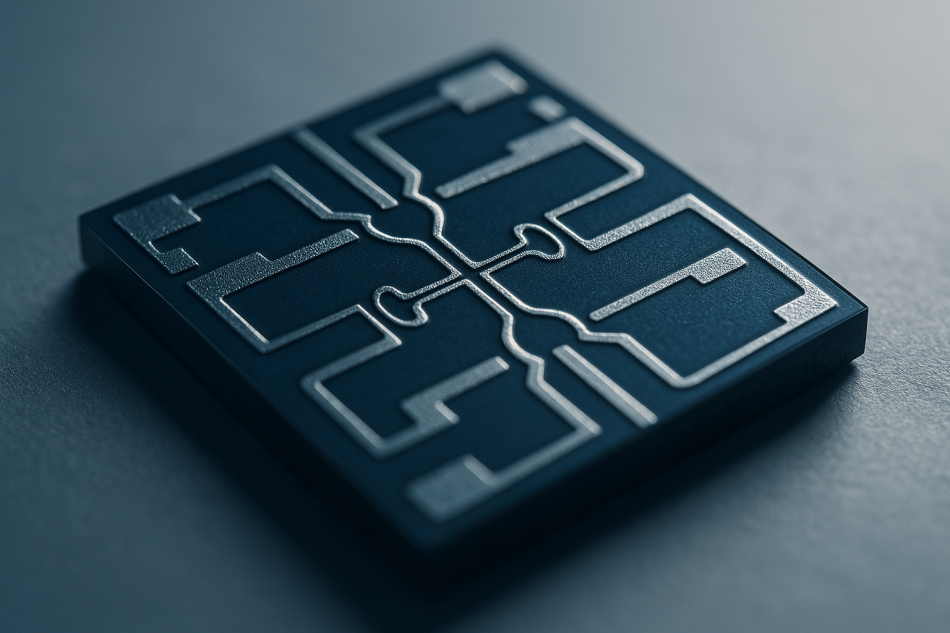

Strip a superconducting quantum computer down to its most essential part and you arrive at something almost comically small: a gap in a wire. Two pieces of superconducting metal, usually aluminum, are separated by an insulating barrier only a nanometer or two thick, thinner than a virus. Electrical current should not cross an insulator. In this case it does, and the strange way it crosses is the entire reason a transmon qubit exists.
Why a gap matters
In an ordinary circuit, current flows in proportion to voltage. Double the push, double the flow. That linear behavior is useless for a qubit, because a qubit needs two energy levels you can address on their own, cleanly separated from all the others. A plain circuit made of a capacitor and an inductor behaves like a perfect pendulum: its energy levels are evenly spaced, like rungs on a ladder set exactly the same distance apart. Nudge it to jump from rung zero to rung one and the same nudge will happily carry it to rung two. You cannot keep the system confined to just two states.
The Josephson junction breaks that even spacing. Named after Brian Josephson, who predicted the effect as a graduate student in the early 1960s, the junction lets a supercurrent tunnel through the insulating barrier without any voltage across it. The crucial point for qubit makers is that this current does not depend linearly on anything. It depends on the sine of the phase difference between the two superconductors. That sine is a nonlinear function, and nonlinearity is exactly what bends the energy ladder.
The anharmonicity payoff
Because the junction acts like a nonlinear inductor, the rungs of the energy ladder are no longer evenly spaced. The jump from the ground state to the first excited state costs a slightly different amount of energy than the jump from the first to the second. That difference, called anharmonicity, is small but decisive. It means a microwave pulse tuned to the zero-to-one transition will not accidentally drive the one-to-two transition. Control engineers get a clean, addressable two-level system out of a circuit that would otherwise be a useless resonator. The lowest two rungs become the qubit; everything above is left alone.
This is why the junction, not the wiring or the fridge, is the beating heart of the design. The capacitor sets how sensitive the qubit is to stray charge. The junction sets the nonlinearity. Tune the ratio between the two and you get the transmon, the workhorse design behind machines from IBM and Google. Push the parameters in other directions and you get fluxonium, or the charge qubits that came before. All of them lean on the same tunneling trick.
The manufacturing headache
Here is the catch. A qubit's frequency depends exponentially on the thickness of that insulating barrier. A change of a single atomic layer across the junction can shift the frequency by hundreds of megahertz. When you are trying to build a processor with dozens or hundreds of qubits, all needing frequencies that avoid colliding with their neighbors, that sensitivity turns fabrication into a nightmare of precision. The standard recipe, a shadow-evaporation technique that grows a thin oxide of aluminum, is decades old and notoriously variable. Two junctions made side by side on the same chip can come out meaningfully different.
Groups across the industry have chased fixes. Some anneal the finished junctions with lasers to nudge their resistance, and therefore their frequency, toward a target after fabrication. Others are experimenting with more uniform barrier materials or cleaner deposition methods to shrink the spread from the start. The oxide barrier is also a suspected home for the two-level defects that quietly drain qubit coherence, so improving the junction touches both yield and lifetime at once.
A weak link that carries a field
It is worth sitting with the irony. The most fragile-sounding component in a quantum computer, a deliberately weakened spot in an otherwise perfect superconductor, is what makes the whole machine tractable. Without it, engineers would have a circuit that oscillates but cannot be pinned to two states. With it, they get a controllable artificial atom fabricated on a silicon wafer, addressable with microwave pulses and printable, in principle, by the thousand. Every roadmap promising a million qubits assumes that this nanometer-thick gap can be made reliably, over and over, across an entire wafer. The junction was a curiosity in 1962. It is now the linchpin of an industry.







