
Ask a trapped-ion company why its machines post such high two-qubit gate fidelities, and sooner or later the conversation lands on a piece of physics with an awkward name: the Mølmer-Sørensen gate. It is the workhorse entangling operation for most ion-based quantum computers, from Quantinuum's H-series to IonQ's processors. Understanding it explains a lot about why ions are slow but accurate, and why they behave so differently from a superconducting chip.
The problem with entangling two ions
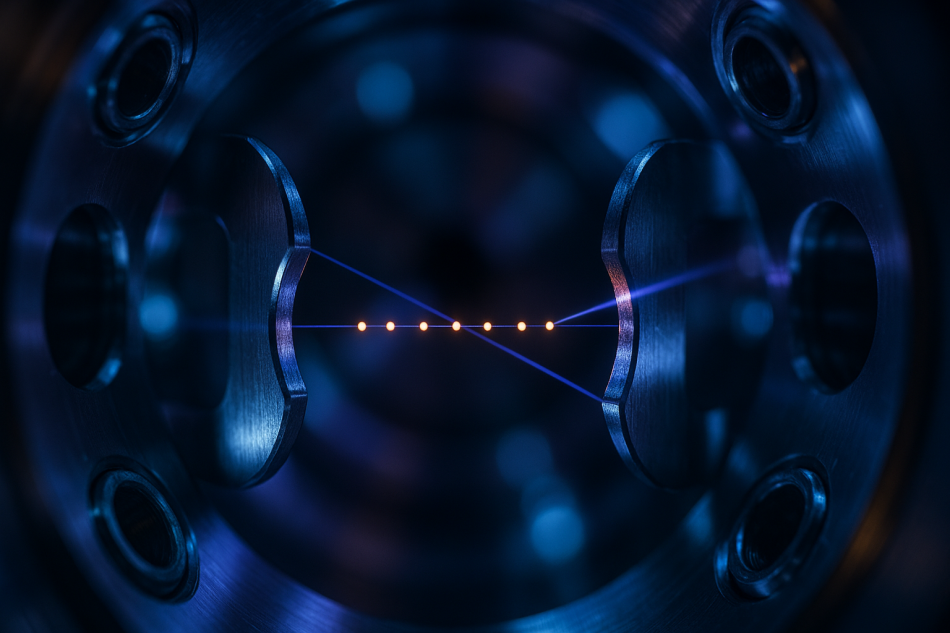
In a trapped-ion machine, each qubit is a single charged atom suspended in a vacuum by electric fields, its 0 and 1 encoded in two long-lived internal energy levels. Single-qubit gates are easy enough: point a laser or microwave field at one ion and rotate its state. The hard part is making two ions interact. They are held apart by their mutual repulsion, and their internal states do not naturally talk to each other at all.
What the ions do share is motion. Because they repel one another, a string of ions behaves like a row of balls connected by springs. Push one and the whole chain oscillates in a set of collective vibrational patterns, called motional modes. The Mølmer-Sørensen gate, proposed by Klaus Mølmer and Anders Sørensen in the late 1990s, uses that shared motion as a temporary messenger between the qubits.
Borrowing the wobble
The trick is to hit two chosen ions with laser beams tuned to a very specific pair of frequencies, straddling a motional mode. The laser nudges the ions' internal states, but it can only do so by briefly exciting the shared vibration of the chain. Because both ions are coupled to the same mode, the phase each one picks up depends on what the other is doing.
The elegant part is that the motion is only borrowed. The laser pulse is engineered so that at the end of the operation the vibrational mode returns exactly to where it started, with no leftover energy. If any motional excitation remained, it would carry away information about the qubits and scramble the result. Done correctly, the ions end up entangled while the chain's wobble is handed back untouched. This insensitivity to the exact starting temperature of the motion is one reason the gate is so robust, and why it tolerated real experimental conditions well enough to become the industry default.
Why it wins on fidelity
Two features make the Mølmer-Sørensen gate attractive. First, it acts on internal states through a virtual detour into motion, so it does not require the ions to sit in a perfectly cold, single motional state. Second, the mechanism can be applied to many ions in the same trap, since they all share the same modes. That gives ion machines their signature all-to-all connectivity: in principle any qubit can be entangled with any other, without the routing gymnastics that plague fixed-lattice superconducting chips.
The payoff shows up in the numbers that vendors quote. Leading trapped-ion systems report two-qubit gate fidelities in the neighborhood of 99.8 percent or better, among the highest of any platform. That accuracy is a direct consequence of a gate that is forgiving of motional heating and can be shaped with carefully pulsed laser envelopes.
The catch: speed and scale
Nothing is free. Because the gate works through a slow mechanical vibration rather than a fast electromagnetic coupling, Mølmer-Sørensen operations are sluggish, often taking tens to hundreds of microseconds compared with the tens of nanoseconds a superconducting gate needs. Ions compensate with far longer coherence times, but the raw clock speed remains a genuine disadvantage.
Scaling is the other headache. As you add ions to a single chain, the motional modes crowd closer together in frequency, making it harder to isolate the one you want and easier to accidentally excite the wrong wobble. Long chains also vibrate more sluggishly and are more fragile. This is exactly why architectures like Quantinuum's rely on shuttling ions between zones, breaking the machine into manageable groups rather than one enormous string. The gate itself does not need changing; the engineering around it does.
A quiet cornerstone
Most of the attention in quantum hardware goes to qubit counts and cryogenic plumbing. The Mølmer-Sørensen gate is a reminder that the entangling operation itself is a design choice with consequences that ripple through an entire roadmap. It buys trapped-ion companies their fidelity and their connectivity, and it charges them in speed and in the difficulty of stretching a single trap. Every headline about ion machines outperforming rivals on quality benchmarks traces back, in part, to two physicists' idea of letting atoms compute by borrowing each other's jiggle.