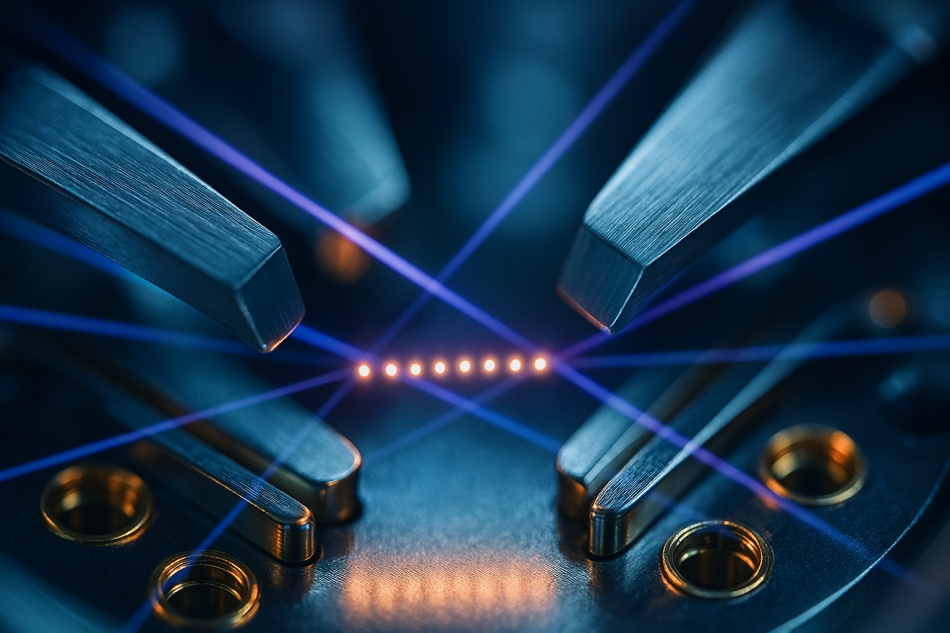

Every quantum computer needs a way to make two qubits talk to each other. In superconducting chips, that job falls to microwave gates like cross-resonance. In neutral-atom machines, it is the Rydberg blockade. For the trapped-ion processors built by companies like IonQ, Quantinuum, and Alpine Quantum Technologies, the entangling move of choice is the Molmer-Sorensen gate, named after Klaus Molmer and Anders Sorensen, who proposed it in the late 1990s. It is one of the quiet reasons trapped ions keep posting the highest two-qubit gate fidelities in the business.
The problem with touching ions
Ions in a trap are charged particles, and charged particles repel. Line up a handful of them in an electromagnetic cage and they settle into an evenly spaced row, each one hovering a few microns from its neighbors. The qubit itself lives in the internal electronic states of each ion, two carefully chosen energy levels that store the 0 and the 1. The trouble is that those internal states barely notice each other. You cannot simply park two ions side by side and expect their qubits to interact.
What the ions do share is motion. Because they are linked by their mutual repulsion, the whole chain behaves like a row of masses connected by springs. Push one ion and the entire line wobbles in coordinated patterns called motional modes. These collective vibrations, quantized into units called phonons, are the bus that carries information from one qubit to another. The Molmer-Sorensen gate is the trick that loads a qubit's state onto that bus and unloads it onto a partner.
Plucking the shared string
The gate works by hitting two target ions with laser beams tuned to a very particular pair of frequencies, one just above and one just below a motional sideband. Neither beam alone can drive a clean transition. Together, they push the ions through a looping path in motional space that depends on the internal state of each qubit. Think of it as temporarily nudging the shared vibration in a direction set by whether the ions are in 0 or 1, then nudging it back.
Here is the elegant part. By the end of the pulse the motion returns exactly to where it started, so the phonons are handed back untouched. But the round trip leaves behind a geometric phase, and that phase is conditional on the joint state of the two qubits. That conditional phase is entanglement. The qubits come out correlated even though they never physically approached each other, and even though the vibrational bus they borrowed is returned as if nothing happened.
Because the motion is given back cleanly, the gate is remarkably forgiving. It does not require the ion chain to be cooled to its absolute motional ground state, and it tolerates a surprising amount of thermal jitter. That robustness is a big reason it became the standard rather than earlier schemes that demanded perfectly cold, perfectly still ions.
Why it matters for the machine
Trapped-ion builders lean on a feature superconducting chips envy: all-to-all connectivity. Because every ion in a chain couples to the same shared modes of motion, a Molmer-Sorensen gate can in principle entangle any pair, not just nearest neighbors. That spares programs the costly shuffle of SWAP operations needed to drag distant qubits together on a fixed grid.
The downside scales with ambition. As chains grow longer, the motional spectrum gets crowded, modes sit closer together in frequency, and the gate takes longer or needs more careful pulse shaping to avoid exciting the wrong vibration. This is one reason companies have pursued architectures that break big registers into smaller zones and physically move ions between them, keeping the chains used for any single gate short enough to behave.
Engineers have spent two decades refining the pulses. Shaped laser amplitudes, multiple frequency tones, and clever timing now suppress residual coupling to unwanted modes and cancel sensitivity to small drifts. The payoff shows up in the fidelity numbers, with leading trapped-ion gates demonstrating error rates well below one in a thousand in laboratory settings. For a technology that still has to cross into full fault tolerance, every fraction of a percent earned at the gate level is fewer physical qubits burned on error correction later. The Molmer-Sorensen gate, borrowing motion it always returns, remains the engine making that possible.







