
Every superconducting quantum processor faces the same awkward bargain. You cannot compute with a qubit you cannot measure, so you wire each qubit to a small microwave cavity called a readout resonator. When you want to know whether the qubit is a 0 or a 1, you bounce a pulse of microwaves off that resonator and watch how the reflection shifts. The stronger you couple the qubit to the resonator, the faster and clearer the measurement. That is the good news.
The bad news is that the same coupling opens a trap door. A resonator is not a sealed box; it is deliberately connected to a transmission line so that signals can get in and out. Through that line, the qubit gains a brand new way to lose its energy. Left alone, an excited qubit will eventually relax to its ground state on its own, and that timescale is called T1. But when the qubit can dump its energy into the resonator and then out the line, it decays faster than it otherwise would. Physicists call this the Purcell effect, after Edward Purcell, who first described how an emitter's decay rate depends on its electromagnetic surroundings.
The tug-of-war between speed and lifetime
Here is the tension in a single sentence: harder coupling gives faster readout but shorter qubit life. The Purcell decay rate grows as you push the qubit frequency closer to the resonator frequency and as you crank up the coupling strength. So a designer who wants a snappy, high-fidelity measurement is, by default, sabotaging the very coherence times that make the qubit worth measuring. For years this was a real ceiling. You could have a good qubit or a fast readout, but the physics fought you when you asked for both.
The escape is a device that sounds almost too simple to work. The qubit sits at one frequency, typically somewhere around 4 to 5 gigahertz. The readout resonator sits at another, often near 6 or 7 gigahertz. Those are different tones. What if you inserted a microwave filter between the resonator and the outside line that says yes to the readout frequency and no to the qubit frequency? Signals near the resonator's tone pass through freely, so measurement stays fast. But the qubit's energy, which would have to leave at the qubit's tone, hits a wall and reflects back. That filter is the Purcell filter.
How the plumbing actually works
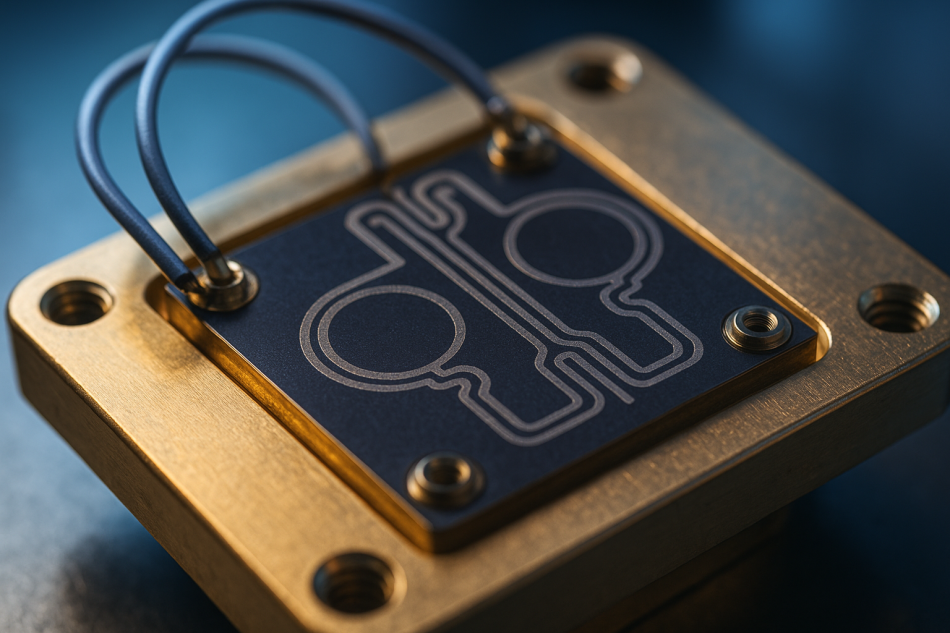
In practice a Purcell filter is another piece of superconducting metal patterned right onto the chip. It can be a small resonator of its own, tuned as a bandpass element centered on the readout frequency, or a stub of transmission line acting as a bandstop notch precisely at the qubit frequency. Either way, it engineers the electromagnetic environment the qubit sees. From the qubit's point of view, the escape route at its own frequency simply looks blocked. From the readout pulse's point of view, the door is wide open.
The payoff is measured in real numbers. A well-designed Purcell filter can suppress the qubit's leakage through the readout line by orders of magnitude, letting engineers use a strongly coupled resonator that resolves the qubit state in a few hundred nanoseconds while adding almost nothing to the qubit's decay budget. Fast, high-fidelity readout is not a luxury. It is a hard requirement for quantum error correction, where you must measure a lattice of ancilla qubits repeatedly, every microsecond or so, without disturbing the data qubits or waiting around while the answers drift.
Why it matters for the road ahead
As processors grow, the readout problem grows with them. Many qubits share readout lines through frequency multiplexing, packing several resonators onto one wire, and each of those channels needs its own protection from Purcell decay. Broadband Purcell filters that shield a whole band of readout frequencies at once are now a standard part of the design toolkit at companies building transmon machines. The filter rarely gets top billing next to flashy qubit counts or error-correction milestones, but it is quietly load-bearing.
The lesson of the Purcell filter is a recurring one in quantum hardware. A qubit is only as good as the environment you build around it. Give it an unguarded connection to the outside world and it will find that exit within microseconds. Shape the environment carefully, tone by tone, and you can have your measurement and your coherence too.







