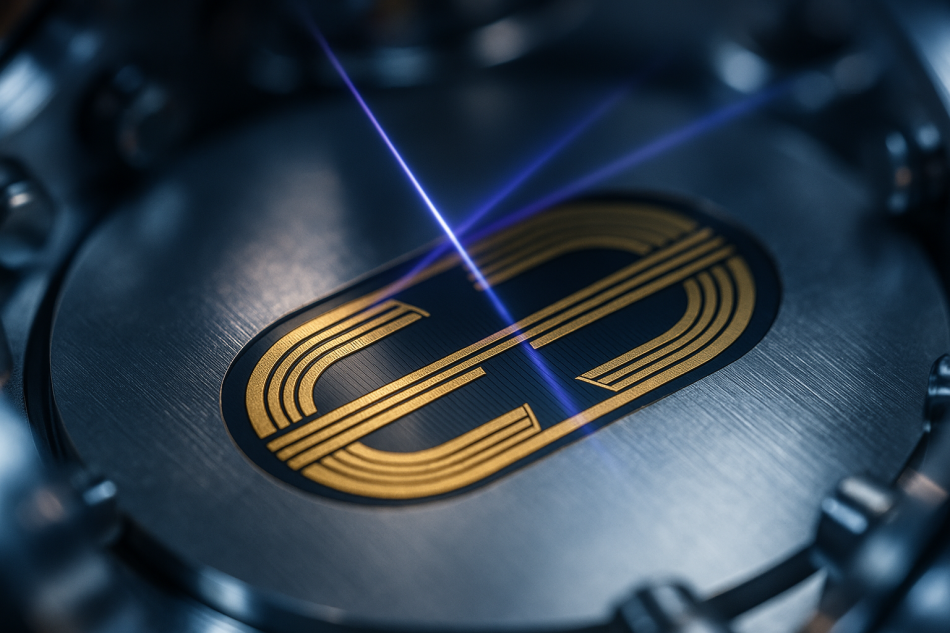

Most quantum computers freeze their qubits in place. A superconducting chip nails each one to a fixed spot on the silicon and wires it up for life. Quantinuum took a different path. Its H-series machines treat qubits like freight. The charged atoms that store the quantum information are picked up, steered through a maze of electrodes, and dropped off wherever the next operation needs to happen. The layout they move through is shaped like a racetrack, an elongated oval, and that geometry is doing more work than it looks.
The QCCD idea
The architecture has a name borrowed from old camera sensors: the quantum charge-coupled device, or QCCD. In a classical CCD, packets of electric charge are marched across a chip by carefully timed voltages. Quantinuum does the same thing with single ytterbium and barium ions held above a surface trap. By ramping the voltages on a grid of tiny electrodes, the machine can slide an ion from one region to another, split a pair apart, or merge two strings into one.
Why bother moving them? The answer is connectivity. In a fixed grid, a qubit can usually only interact with its immediate neighbors. To entangle two distant qubits, a program has to relay the information across a chain of intermediate swaps, and each hop is another chance for an error to creep in. Trapped ions dodge that problem by refusing to stay put. If qubit 3 needs to talk to qubit 40, the machine simply transports them both into the same gate zone and runs the operation there. Every qubit can reach every other qubit directly. That all-to-all connectivity is one of the biggest reasons Quantinuum's machines post such strong benchmark numbers despite modest qubit counts.
Zones with jobs
The racetrack is divided into specialized regions. Some zones are for storage, where ions wait quietly as strings. Others are gate zones, where lasers pulse to perform the entangling operations. There are junctions where paths cross, letting the machine reorder ions like train cars in a switching yard. A single quantum program becomes a choreography: shuttle, split, rotate, gate, recombine, measure, repeat. The classical control system plans this traffic in advance, scheduling thousands of transport operations so that the right ions arrive at the right zone at the right microsecond.
Keeping the lasers confined to dedicated zones brings a quiet benefit. Instead of flooding the whole chip with control beams and hoping they only hit their targets, the machine brings the qubit to a small, well-characterized region where the optics are tuned. That tends to produce cleaner, more uniform gates, which is part of why ion-trap gate fidelities have stayed among the highest in the field.
The price of motion
Nothing comes free. Every time an ion is hauled around a corner, it can pick up kinetic energy, heating up in a way that smears out the next gate. Quantinuum counters this with sympathetic cooling: barium ions ride alongside the ytterbium qubits purely to absorb that excess motion, chilled by lasers that never touch the data itself. The transport also eats time. Shuttling is slower than firing a microwave pulse at a fixed qubit, so ion-trap machines run at a more deliberate clock than their superconducting rivals. The trade is depth for speed. You get circuits with more reliable operations, run on fewer but better-behaved qubits.
Why the oval matters for scaling
The racetrack shape is not decoration. A closed loop means ions can keep circulating without ever reaching a dead end, and the junctions let the machine reshuffle the order of qubits freely. That reordering is what makes arbitrary connectivity practical at larger sizes. As Quantinuum grows its H-series toward more qubits, the plan leans on grids of traps and more junctions rather than cramming everything into one straight line. The company and its backers have described a path toward larger two-dimensional trap arrays, where the shuttling concept stretches from a single oval into a full road network.
It is a bet that moving qubits, not fixing them, is the cleaner route to a fault-tolerant machine. The racetrack is the proving ground for that idea, a place where charged atoms go in circles so the math doesn't have to.







