
Most companies describe their quantum ambitions as a list of qubit counts stretching off into the future. Google Quantum AI tells a different kind of story. Instead of a parade of ever-bigger chips, it has laid out six milestones that end at a single destination: a large, error-corrected machine capable of running useful algorithms that no classical supercomputer can touch. The qubit numbers matter, but they are a means to an end. The real ladder is about taming errors.
Why the ladder starts with a stunt
Milestone one was the famous 2019 Sycamore experiment, where a 53-qubit processor sampled from a random circuit in minutes that Google argued would take a classical machine an impractically long time. Critics picked at the comparison, and classical algorithms have since narrowed the gap, but the point of the exercise was never the specific task. It was a proof that a programmable quantum processor could be pushed into a regime where simulating it was genuinely hard. That is the floor you have to stand on before anything else makes sense.
The trouble is that a beyond-classical demonstration on noisy hardware does not get you a useful computer. Every gate leaks a little error, and in a long calculation those errors pile up until the answer is garbage. The remaining five milestones are Google's plan for burying that noise under layers of error correction.
The crucial second rung
Milestone two is the one that decides whether the whole project is viable. The goal is a logical qubit prototype that gets better as you make it bigger. In a surface code, you spread one logical qubit across a grid of physical qubits, and a classical decoder watches for errors and corrects them. The theory says that below a certain physical error rate, adding more physical qubits should reduce the logical error rate rather than adding more ways to fail.
Google claims to have crossed that line with its Willow chip, a 105-qubit processor. The team built surface codes of increasing size, known as code distances three, five, and seven, and reported that each step down in code distance roughly halved the logical error rate. That is the signature of being below threshold. It is the difference between a code that helps and a code that hurts. Willow also ran a fresh random-circuit benchmark that Google says would take a classical supercomputer an absurd stretch of time, but the error-correction result is what makes the chip significant.
The rungs still ahead
Milestone three asks for a single logical qubit that lives a long time, with an error rate pushed down toward one in a million per operation. That demands either more physical qubits per logical qubit, better components, or both. Milestone four moves from storing a logical qubit to computing with one: performing logical gates between protected qubits without wrecking them. This is where techniques like lattice surgery and magic-state distillation turn from blackboard ideas into engineering problems.
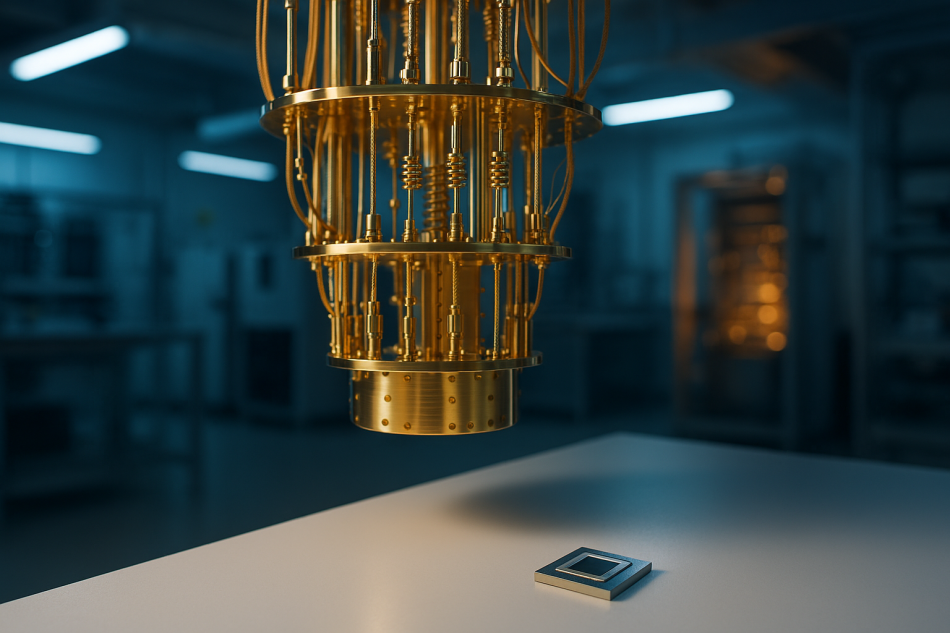
Milestone five is the least glamorous and arguably the hardest. It is pure scale-up: the wiring, the cryogenics, the control electronics, and the fabrication yield needed to build thousands of high-quality qubits that all work at once. A dilution refrigerator can only host so many coaxial cables before it runs out of room and cooling power, which is why Google and others are investing in cryogenic control chips and denser interconnects.
Milestone six is the finish line: a machine with on the order of 1,000 logical qubits, each built from roughly 1,000 physical qubits, for a total approaching a million. At that size, the long-promised applications in chemistry, materials, and certain optimization problems start to look reachable.
Reading the roadmap honestly
A roadmap is a statement of intent, not a guarantee, and the gap between milestone two and milestone six is enormous. Going from 105 physical qubits to a million is not a matter of patience; it requires components that do not fully exist yet and manufacturing discipline that the field is only beginning to develop. Google has not attached firm calendar dates to the later rungs, which is a reasonable kind of humility.
What the ladder does well is force honesty about sequence. You cannot skip to useful algorithms without first proving error correction scales, and you cannot prove it scales without a chip that sits below threshold. By framing its work this way, Google has made each result legible: every announcement can be checked against which rung it actually represents, rather than against a raw qubit tally that tells you almost nothing about whether the machine can compute.







