
The central promise of quantum error correction has always come with an asterisk. In theory, you can spread one piece of quantum information across many physical qubits, catch errors as they appear, and end up with a "logical" qubit far steadier than any of its parts. In practice, every extra qubit you add is one more thing that can go wrong. For years the gloomy reality was that scaling up a code often made matters worse, not better. Google's Willow processor is notable because it crossed the line where that stops being true.
What below threshold actually means
Error correction has a tipping point called the threshold. If your physical qubits are too noisy, wrapping them in a code and adding redundancy only pours in more errors than the code can mop up. Make a bigger patch and you get a worse result. That is being above threshold. Below threshold, the arithmetic reverses. Each time you enlarge the code, the correction machinery removes errors faster than the added hardware introduces them, and the logical error rate drops.
The surface code, the checkerboard arrangement most superconducting machines rely on, is measured by its distance. A distance-3 patch, a distance-5 patch, a distance-7 patch each use progressively more qubits to protect a single logical bit. The question Willow set out to answer was simple to state and brutal to achieve: does going from distance 3 to 5 to 7 make the encoded qubit better?
Halving the error, step by step
On Willow, it did. Google reported that each jump in code distance cut the logical error rate by roughly a factor of two. That suppression factor, often written as the Greek letter lambda, landed a little above two. It sounds modest until you realize what it implies. If every step down the ladder keeps shaving the error in half, you can reach an arbitrarily reliable logical qubit just by building a larger patch, without inventing better physics. That is the whole point of the threshold theorem, and Willow turned it from a slide in a lecture into a measurement on real silicon.
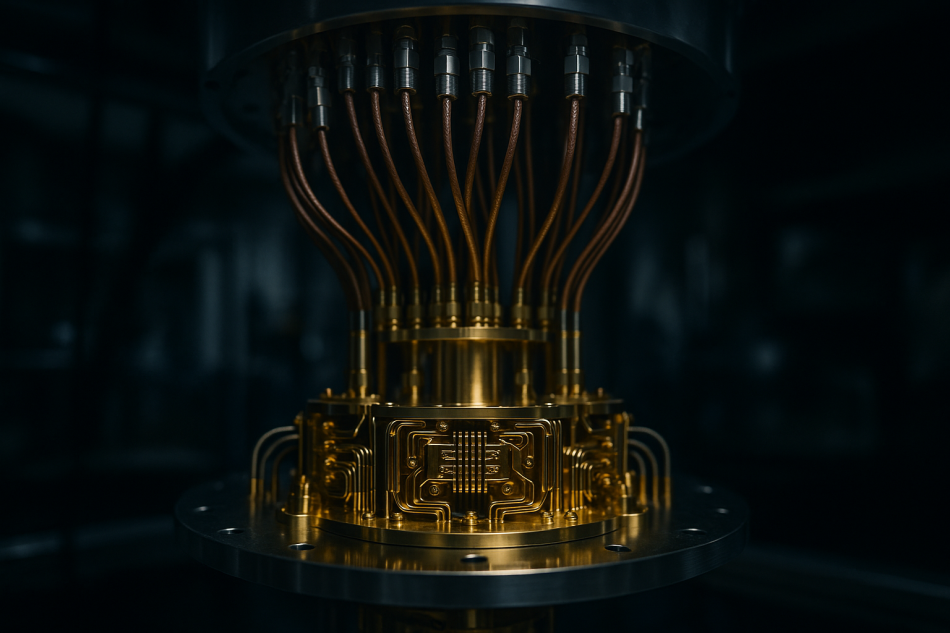
Willow is a 105-qubit superconducting chip, built with transmon qubits at Google's own fabrication facility. Getting below threshold was not only about the code layout. It leaned on cleaner qubits with longer coherence times, better readout that could measure the error-catching stabilizers without disturbing the data, and a fast classical decoder that could keep pace with the stream of measurements the chip produced.
Beating the best single qubit
There is a second milestone folded into the result. The largest logical qubit on Willow lived longer than the best individual physical qubit on the same chip. That is the break-even line that error correction has to clear before it earns its keep. A protected qubit that dies faster than its unprotected components is a science demo with no payoff. One that outlives them is, for the first time, memory worth building on.
Google paired the correction work with a separate benchmark, a random circuit sampling task the chip finished in minutes that would swamp a classical supercomputer for an impractically long time. That headline number grabs attention, but the error-correction result is the one that matters for the long road ahead. Sampling from random circuits is a stress test, not a useful computation. A logical qubit that gets steadier as you scale it is the foundation everything else must sit on.
What it does not yet prove
A single logical qubit that holds a value is not a computer. To run algorithms you need many logical qubits, and you need to perform gates between them, which is harder to protect than simply storing information. Willow demonstrated a memory, not a full fault-tolerant processor. The lambda of roughly two also has to grow. To reach the error rates that chemistry and cryptanalysis demand, machines will need far larger distances and thousands of physical qubits per logical one, which is why every roadmap in the field now counts qubits in the millions.
Still, the shape of the curve is what people were waiting to see. For the first time on a large superconducting device, the line bent the right way. Add more qubits, get fewer errors. That is the direction the entire industry has been betting on, and Willow is the clearest evidence so far that the bet can pay.







