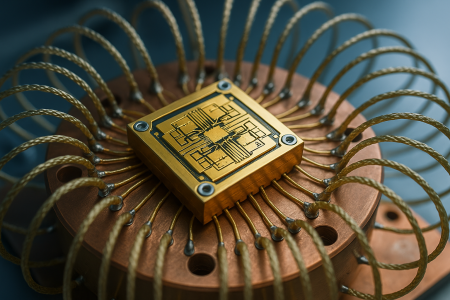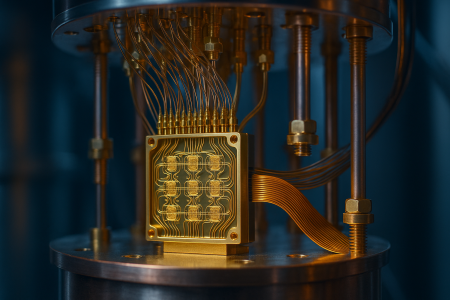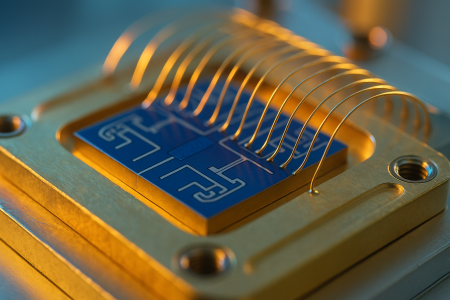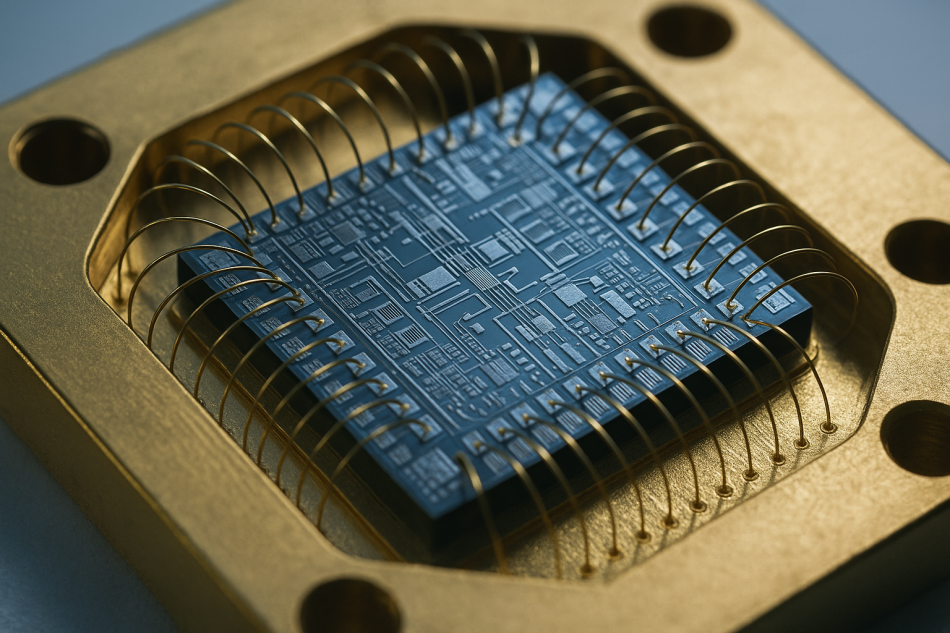

Walk through any pitch about quantum computing and you will hear about qubit counts climbing into the hundreds and thousands. What you rarely hear is a quieter, more stubborn truth: the qubits on a single chip are not the same as each other. Two transmons patterned a few hundred microns apart, etched in the same fabrication run from the same wafer, can have noticeably different frequencies, different coherence times, and different error rates. The chip is supposed to be an array of identical components. It almost never is.
This is the yield problem, and it haunts every hardware platform in different ways. In classical chip making, yield means how many functioning dies you get from a wafer. A few dead transistors out of billions are routine, and redundancy or binning hides the rest. Quantum processors do not have that luxury. A handful of bad qubits in a small array can render the whole device useless for a given algorithm, because the qubits you need to talk to each other are fixed by the chip's layout.
Where the variation comes from
In superconducting qubits, the troublemaker is usually the Josephson junction, the tiny insulating barrier that gives a transmon its quantum behavior. The junction's properties depend on its area and the thickness of an oxide layer measured in nanometers. Tiny variations in how that oxide grows shift the qubit's frequency by amounts that matter enormously. Fabricators can target a frequency, but they hit a distribution, not a single value. When two neighboring qubits accidentally land on the same frequency, they can interfere with each other or with the gates meant to drive them. Designers literally have to plan layouts to keep frequencies spaced apart, a process sometimes called frequency crowding.
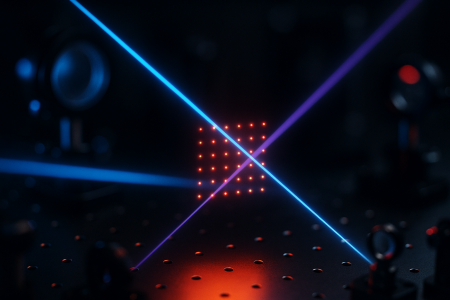
Trapped-ion machines sidestep some of this because their qubits are individual atoms, which really are identical by nature. An ytterbium ion is an ytterbium ion. But the variability moves elsewhere: into the trap electrodes, the laser beams that have to address each ion uniformly, and the stray electric fields that cause ions to heat up at different rates depending on their position in the chain. Neutral-atom systems face a related challenge in loading atoms into optical tweezers, where any given trap site is filled only probabilistically.
Why a few bad qubits hurt so much
Imagine an algorithm that needs a clean two-qubit gate between positions seven and eight on your chip. If qubit eight has half the coherence time of its neighbors, every operation that touches it carries more error. Because quantum errors compound across a circuit, one weak link can drag down the fidelity of an entire computation. There is no easy software fix to make a noisy qubit behave like a quiet one.
Error correction raises the stakes further. The whole premise of a logical qubit is that many physical qubits work together to suppress errors below a threshold. Those schemes assume the physical qubits are roughly uniform. A patch of degraded qubits can punch a hole in a surface code, forcing decoders to work around defects or forcing engineers to simply not use that region of the chip.
How teams fight back
- Tunable qubits. Many superconducting designs add a control knob that lets engineers shift a qubit's frequency after fabrication, dodging collisions instead of relying on perfect manufacturing.
- Laser trimming and post-processing. Some groups adjust junctions after the fact to nudge frequencies toward their targets, narrowing the spread.
- Layout-aware compiling. Software maps a circuit onto the best qubits available, routing around the weak ones, much as classical chip designers steer signals away from defects.
- Calibration per qubit. Each qubit gets its own tuned control pulses rather than a one-size-fits-all setting, which is part of why these machines need constant recalibration.
The scaling tension
The yield problem is why the headline qubit number can be misleading. A chip with 1,000 physical qubits where 5 percent are unusable behaves very differently from one where 0.5 percent are. As arrays grow, the odds that some qubit lands in a bad spot only increase, so uniformity has to improve just to hold the line. This is one of the unglamorous reasons companies invest so heavily in fabrication discipline and in modular designs that let them screen and combine good components.
Adding qubits is the part everyone can see. Making them alike is the part that quietly decides whether the chip is worth building at all.