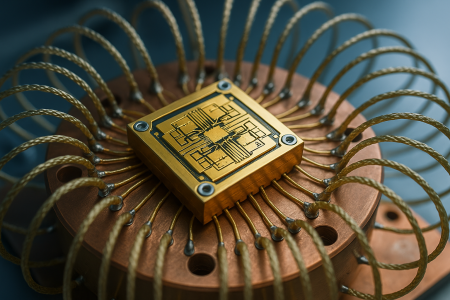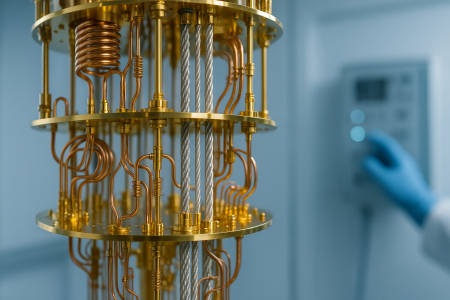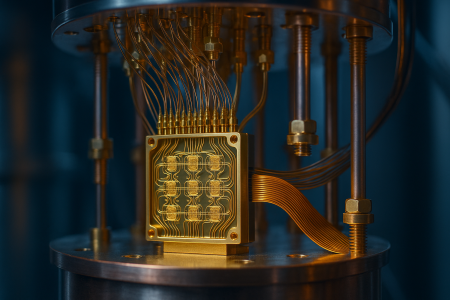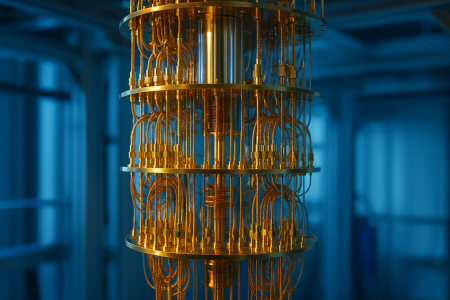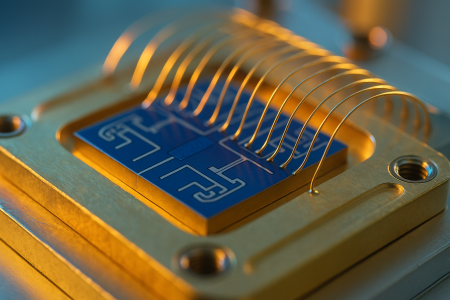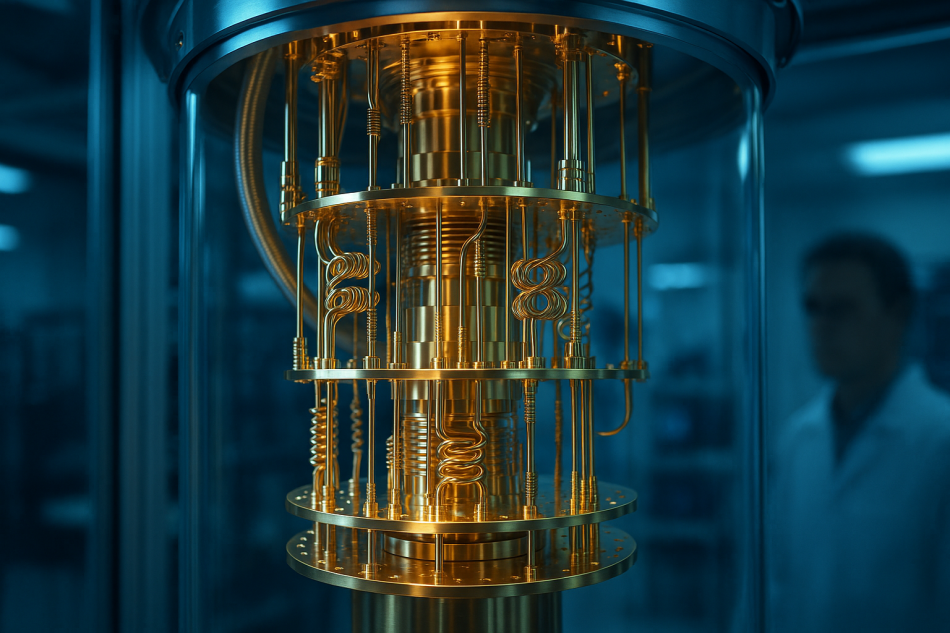

Walk into a lab that houses a superconducting quantum computer and the thing that grabs your attention is not a screen or a server rack. It is a gleaming metal chandelier of copper plates and coiled tubing, suspended inside a sealed cylinder. That structure is a dilution refrigerator, and its job is to chill a tiny chip down to roughly 15 millikelvin, a hair above absolute zero. That is colder than the empty space between galaxies, which hovers around 2.7 kelvin thanks to the leftover glow of the Big Bang.
The obvious question is why. A laptop processor runs hot and works fine. Why does a quantum chip demand a temperature that exists almost nowhere in the natural universe?
Qubits are exquisitely fragile
A classical bit is a sturdy thing. It is a one or a zero, represented by a voltage that is clearly high or clearly low. Small jolts of energy do not flip it. A quantum bit, or qubit, is the opposite of sturdy. In a superconducting machine, a qubit is a circuit that can hold a delicate blend of states at once, a property called superposition. That blend is what gives quantum computers their potential power, and it is also what makes them maddening to maintain.
Heat is, at the microscopic level, just random motion and stray energy. Even a faint trickle of thermal energy can knock a qubit out of its carefully prepared state, an event physicists call decoherence. When that happens, the computation is corrupted. Cooling the chip to millikelvin temperatures starves the system of the random energy that would otherwise scramble it, giving the qubits a fighting chance to stay coherent long enough to do useful work.
How the chandelier actually works
The layered plates you see are temperature stages. Each one is colder than the one above it, stepping down from room temperature at the top to the frigid bottom where the chip lives. The cooling is done with a mixture of two helium isotopes, helium-3 and helium-4. At very low temperatures the mixture separates into two phases, and forcing helium-3 atoms across the boundary between them absorbs heat, much as evaporating sweat cools your skin. It is a clever trick of physics that can reach temperatures no ordinary refrigerator approaches.
The tubing and wiring matter too. Control signals have to travel down to the chip and measurement signals back up, and every wire is a potential pipe for heat. Engineers use special cabling and filtering to carry information without carrying warmth, which is harder than it sounds.
Not every qubit needs the cold
Superconducting qubits, used by several of the best known efforts in the field, are the headline customers for these refrigerators. But they are not the only design. Trapped-ion computers hold individual charged atoms in place with electromagnetic fields and manipulate them with lasers. They still need vacuum and careful isolation, but they do not require the same near absolute zero plunge. Photonic approaches use particles of light and can operate closer to room temperature. Each path trades one set of engineering headaches for another.
That variety is a reminder that quantum computing is not a single settled technology. It is a collection of competing bets, each wrestling with the same enemy in a different way. The enemy is noise, and cold is one of the main weapons against it.
The deeper problem the cold cannot solve
Even at 15 millikelvin, qubits still make errors. They drift, they leak, they pick up disturbances from cosmic rays and microscopic material defects. This is why error correction has become the central preoccupation of the field. The idea is to spread the information of one reliable logical qubit across many physical qubits, so that errors can be detected and fixed faster than they accumulate.
The catch is the overhead. Building a single dependable logical qubit may require hundreds or thousands of physical ones, all kept cold and controlled at once. That is why current machines, impressive as their qubit counts sound, are still short of running the large algorithms people dream about.
- Cold reduces the random energy that destroys quantum states.
- Dilution refrigerators reach far below the natural temperature of space.
- Different hardware designs need different operating conditions.
- Even perfect cooling does not eliminate errors, so error correction is essential.
The cold, then, is not the destination. It is the price of admission. Keeping a chip colder than the void between stars buys enough quiet for fragile quantum states to survive, and that quiet is the foundation everything else is built on. The race now is to turn that hard won stillness into machines that can finally outperform the classical computers we already trust.