quantum processors

The Benchmark Wars: Why Quantum Computers Can't Agree on a Yardstick
 Rafayel
Ask a quantum computing company how good its machine is and you will get a number. The trouble is that no two companies quote the same number. One bra...
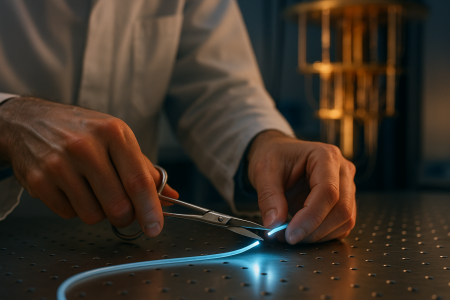
Circuit Knitting: Faking a Bigger Quantum Computer With Classical Glue
Every quantum processor has a hard ceiling: the number of qubits etched onto its chip. If your algorithm needs 40 qubits and your machine has 30, you...
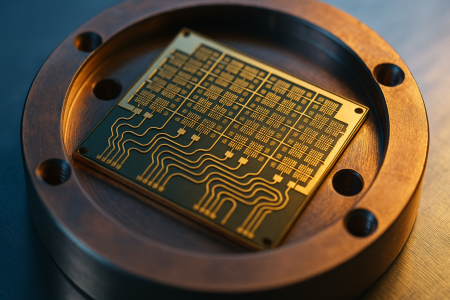
The Frequency Crowding Problem: When Qubits Run Out of Room on the Dial
Every fixed-frequency transmon on a superconducting quantum chip is a tiny resonator that answers to one particular pitch. Send in a microwave pulse a...
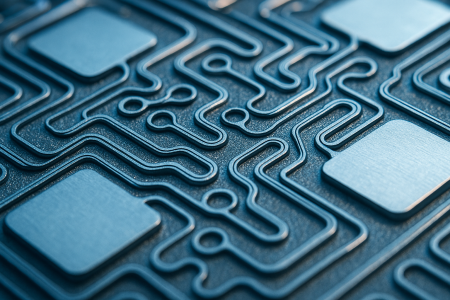
The Tunable Coupler: The On-Off Switch Between Two Qubits
Two qubits that need to talk to each other face an awkward problem: the wiring that lets them interact never really switches off. In a superconducting...
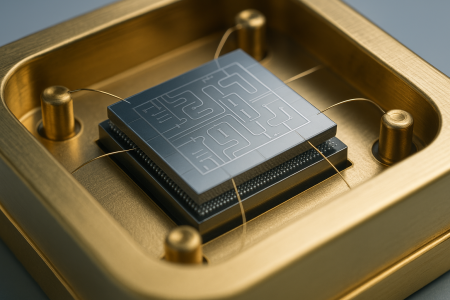
The Flip-Chip Stack: How Quantum Processors Went 3D
For years, a superconducting quantum processor was a fundamentally flat object. The qubits, the resonators that read them out, and the control lines t...
The Ion Shuttle: How Quantum Computers Move Atoms to Compute
Most pictures of a quantum computer show qubits fixed in place, wired up like transistors on a circuit board. Trapped-ion machines built on a design c...
The SWAP Tax: When Qubits Can't Talk to Each Other
Picture a quantum processor as a small town where every qubit is a house, and the roads between houses are the only paths along which information can...
The Qubit Count Trap: Why Bigger Numbers Don't Mean a Better Quantum Computer
Every few months a quantum computing company unveils a chip with more qubits than the last, and the number lands in headlines as if it settles the mat...