
Two qubits that need to talk to each other face an awkward problem: the wiring that lets them interact never really switches off. In a superconducting quantum processor, qubits are coupled through shared electrical circuits, and a coupling strong enough to run a fast two-qubit gate is also strong enough to cause trouble when the gate is over. The qubits keep nudging each other, energy drifts between them, and errors creep in even during the moments when the processor is supposed to be doing nothing. For years, this always-on coupling was one of the quiet limits on how well a chip could perform.
Why a permanent connection is a liability
Imagine wiring two pendulums together with a stiff spring. Tap one and the motion spills into the other, which is exactly what you want if you are trying to entangle them. But leave them connected and every small disturbance in one pendulum shows up in its partner. On a quantum chip, that unwanted exchange is a form of crosstalk. It shifts qubit frequencies, blurs the line between which qubit is being addressed, and makes calibration a moving target because every qubit's behavior depends on the state of its neighbors.
Designers can weaken the fixed coupling to reduce this leakage, but then two-qubit gates become slow, and slow gates give the qubits more time to decohere. You are stuck choosing between a fast gate that misbehaves at rest and a well-behaved chip that computes too slowly to matter. The tunable coupler breaks that tradeoff.
A knob between the qubits
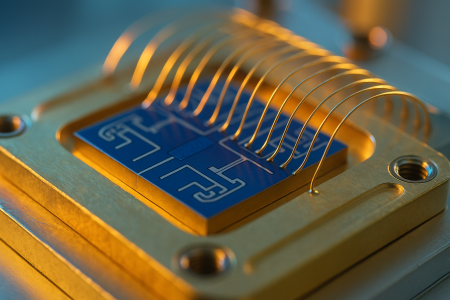
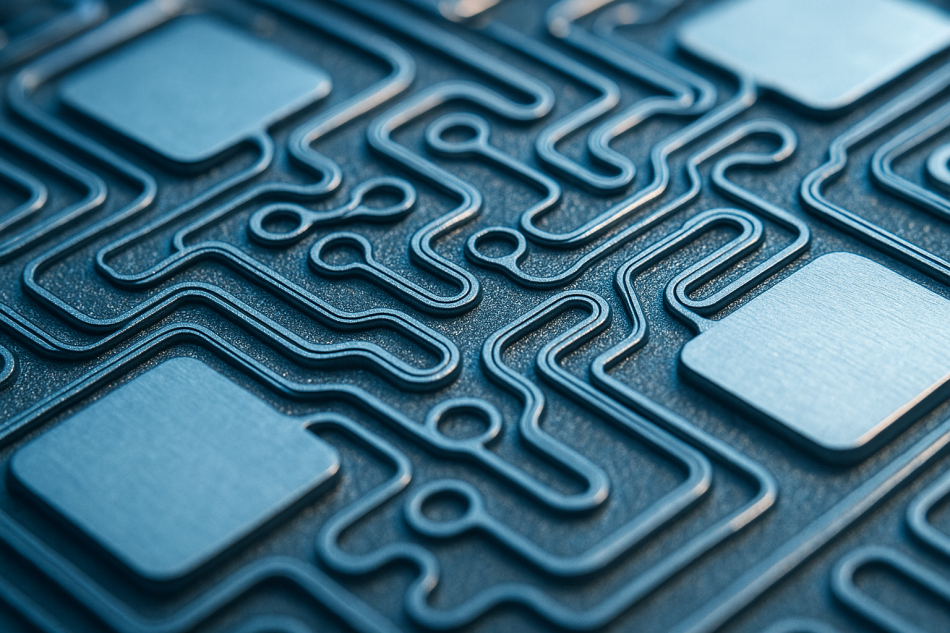
The idea is to insert a third element between two qubits and give it an adjustable frequency. This coupler is itself a small superconducting circuit, and its effective interaction with the qubits changes depending on how it is tuned. By threading a controlled amount of magnetic flux through a loop in the coupler, engineers can push the net coupling between the two qubits toward zero at a particular setting. Move away from that sweet spot and the coupling turns back on, strong enough to run a gate in tens of nanoseconds.
In practice this means a processor can idle with its qubits effectively disconnected, then briefly switch on a connection to entangle a specific pair, then switch it off again. The residual coupling at the off point can be pushed down by orders of magnitude compared with a fixed design. That translates directly into cleaner idle periods, less crosstalk, and gates that are both fast and high fidelity.
Why the big labs adopted it
Tunable couplers moved from clever demonstration to standard practice because they solve several headaches at once. Google leaned heavily on tunable couplers in its Sycamore-generation processors, using them to control interactions across a two-dimensional grid of qubits and to keep unwanted coupling in check during the experiments that drew so much attention. Other superconducting efforts have followed similar logic, since a grid of qubits with individually controllable connections is far easier to calibrate and operate than one welded together with fixed links.
The approach also plays nicely with error correction. Surface codes and their relatives assume you can run parallel two-qubit gates across many pairs of qubits without those operations bleeding into one another. Being able to activate a coupling only where and when it is needed is close to a prerequisite for stitching thousands of qubits into a working logical qubit.
The price of the extra part
Nothing on a quantum chip is free. Each tunable coupler is another circuit that needs its own control line, its own flux bias, and its own calibration. That adds wiring, adds heat load in the refrigerator, and adds more knobs to keep tuned as the chip drifts. Flux-tunable elements can also be sensitive to magnetic noise, which is its own source of decoherence if the design is careless. Engineers spend real effort making couplers that are adjustable enough to be useful but quiet enough not to become the dominant error source themselves.
The tunable coupler rarely shows up in headlines about qubit counts or quantum advantage. It sits between the qubits, doing the unglamorous work of deciding when two of them are allowed to meet. But the ability to say when a connection exists, rather than living with one that never sleeps, is part of what turned superconducting chips from fragile demonstrations into machines you can actually calibrate and scale.