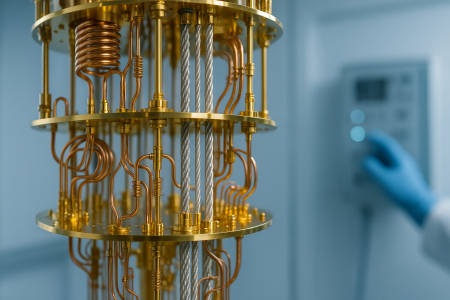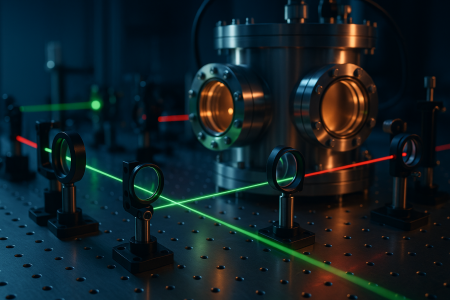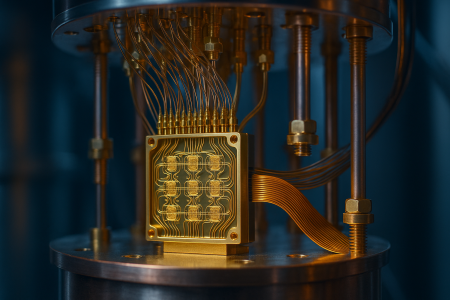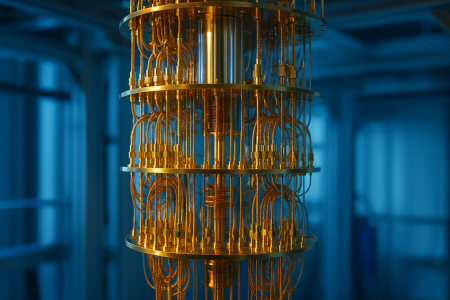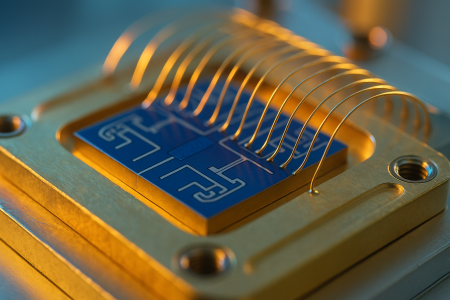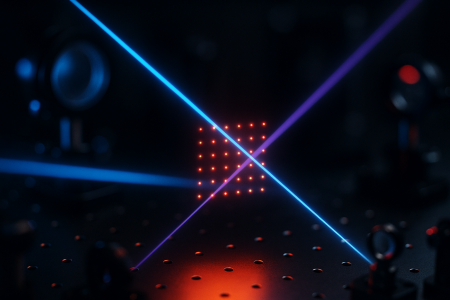

Nearly every quantum computer you read about shares one demanding requirement: brutal cold. Superconducting chips need dilution refrigerators that hover a hair above absolute zero. Trapped ions and neutral atoms need vacuum chambers and banks of lasers. So it is worth pausing on a stubborn outlier, a qubit that keeps working at room temperature and can, in principle, sit on a desk instead of inside a shed-sized cryostat. It is built from a defect in diamond.
A useful flaw in a perfect crystal
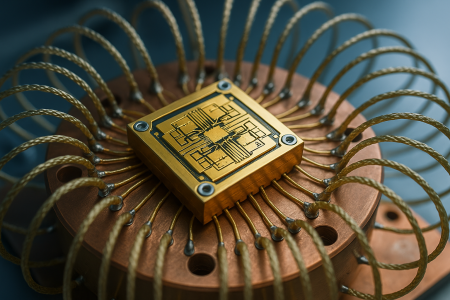
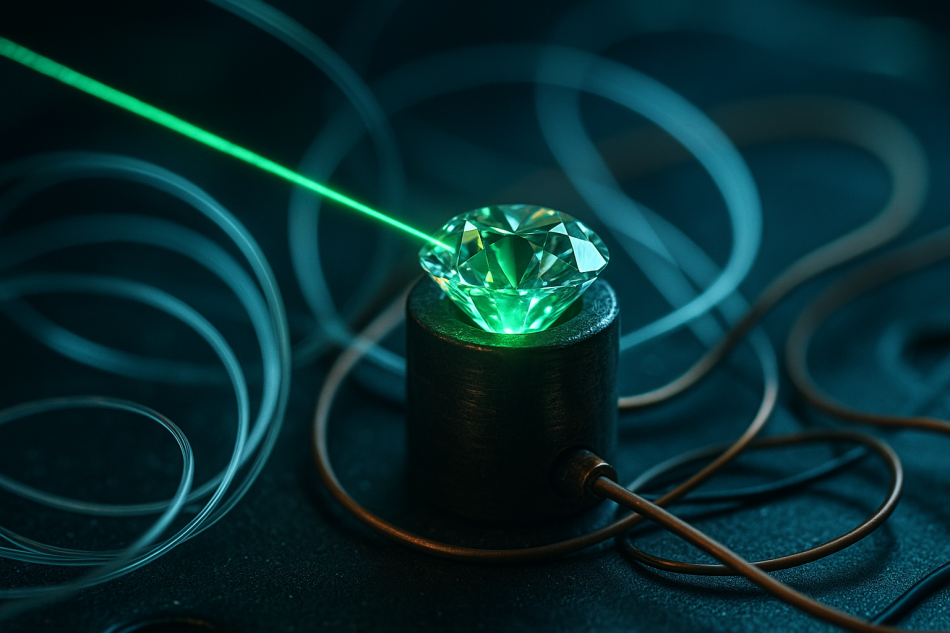
Diamond is a lattice of carbon atoms, and normally that regularity is what makes it valuable. But swap one carbon for a nitrogen atom, leave the neighboring lattice site empty, and you get what physicists call a nitrogen-vacancy center, or NV center. That tiny defect traps electrons whose collective spin behaves like a qubit. It can be pushed into a definite quantum state, nudged with microwaves, and read out with a green laser that makes it glow brighter or dimmer depending on the spin.
The reason this works at room temperature comes down to how well diamond shields its defect. The lattice is extraordinarily stiff, and if you build the crystal mostly from carbon-12, which has no nuclear spin, the qubit sits in a magnetically quiet neighborhood. That isolation lets an NV center hold a coherent quantum state for surprisingly long stretches even when the surrounding material is warm. Where a superconducting qubit needs to be colder than interstellar space to stop thermal noise from scrambling it, the diamond qubit shrugs off the heat.
Two qubits for the price of one defect
An NV center has a hidden bonus. The nitrogen nucleus and any nearby carbon-13 nuclei carry their own spins, and those nuclear spins make excellent memory qubits. They are harder to manipulate but hold their state far longer than the electron spin does. That gives each defect a small register: a fast, controllable electron spin doing the computing, and slower nuclear spins nearby storing information. Researchers have used this arrangement to run small error-correction demonstrations inside a single speck of diamond.
Why it hasn't taken over
If diamond qubits are so convenient, why isn't everyone building them? Because the very isolation that makes a single NV center behave so well makes it hard to connect many of them into a large machine. Two defects sitting side by side interact only weakly, and placing them close enough to talk while keeping them addressable individually is a fabrication nightmare. You cannot yet stamp out NV centers in precise, repeatable positions the way a chip fab lays down transistors. Ion implantation scatters them somewhat randomly, and yield remains a real problem.
The favored path to scale sidesteps direct contact entirely. Each diamond node emits a photon entangled with its spin, and those photons are routed through optical fiber and interfered to link distant nodes. Groups in the Netherlands have entangled NV centers separated by more than a kilometer this way, building the beginnings of a quantum network node by node. The catch is speed. The optical coupling is weak, so the process succeeds only occasionally, and gate operations that rely on it run slowly compared with the microwave gates inside a single chip.
Where it fits
Companies chasing this approach, most visibly Quantum Brilliance, have leaned into the portability rather than trying to out-scale the superconducting giants. The pitch is a compact accelerator that could slot into a data center rack or even a rugged mobile setting, running without cryogenics or a room full of laser tables. That is a different target from a fault-tolerant machine with a million qubits, and for now it is a more honest one.
The diamond qubit is a reminder that the field has not settled on a winner and may not for years. Superconducting circuits and trapped ions dominate the headlines because they scale most convincingly today. But coherence at room temperature is a genuine advantage that no fridge-bound platform can match, and diamond keeps it in play. Whether that edge translates into a competitive computer depends on solving the placement and interconnect problems that have dogged the technology since the first NV qubit was demonstrated. If those crack, quantum computing could shed one of its most expensive and least glamorous dependencies: the deep freeze.