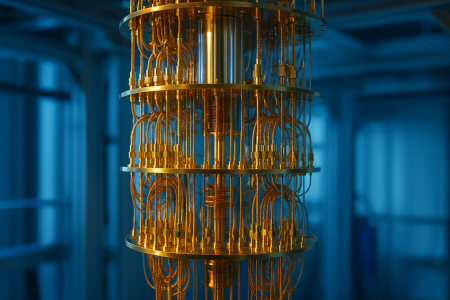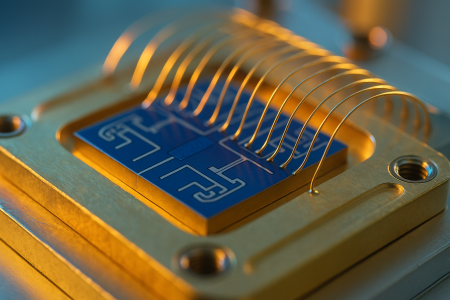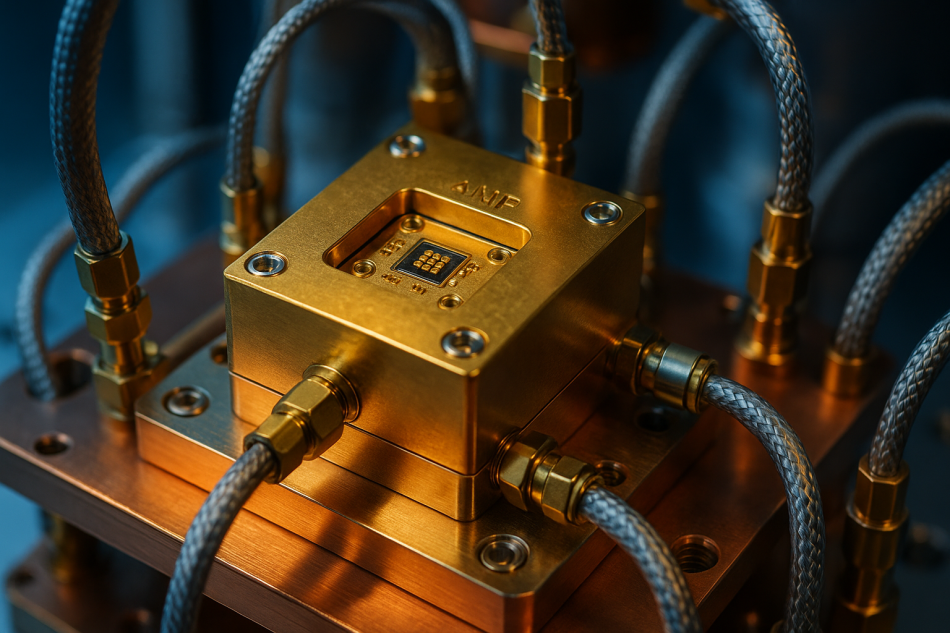

When a superconducting quantum computer measures a qubit, it does not read a bright, obvious signal. It reads a faint microwave tone reflected off a tiny resonator, a pulse so weak it carries energy comparable to a handful of photons. That signal has to travel up out of a refrigerator colder than deep space, through cables and connectors, and eventually reach room-temperature electronics that can digitize it. Along the way, ordinary amplifiers add so much noise of their own that the qubit's message would vanish entirely. Solving that problem is the job of one of the least celebrated components in the whole machine: the quantum-limited parametric amplifier.
Why reading a qubit is so hard
Most superconducting processors use what is called dispersive readout. Each qubit is coupled to a small resonator whose frequency shifts slightly depending on whether the qubit is in its 0 or 1 state. To find out which, the control system sends a probe tone at the resonator and listens to what bounces back. The phase and amplitude of the returning signal encode the qubit state. The catch is power. Push too many photons into that resonator and you disturb the qubit, sometimes knocking it out of its computational states entirely. So the probe has to stay faint, which means the returning signal is faint too.
A signal that weak is close to the fundamental limits set by quantum mechanics itself. The first amplifier it meets sets the noise floor for the entire measurement chain. If that amplifier is noisy, no amount of clever processing downstream can recover the lost information. You would need to average over many more repetitions of the experiment to be confident of the result, which slows everything down and eats into the already tight time budget of a quantum circuit.
Amplifying without wrecking the signal
The classic workhorse for the higher stages of a cryostat is the high-electron-mobility transistor amplifier, or HEMT, sitting around four kelvin. HEMTs are reliable and broad, but they add a fair amount of noise, far above the quantum limit. On their own they are not good enough to read a single qubit quickly.
The answer that emerged over the past decade is the Josephson parametric amplifier. It uses the same nonlinear element that makes the qubit itself work, the Josephson junction, but arranged as an amplifier. By pumping the circuit with a strong tone at a carefully chosen frequency, the device transfers energy into the weak signal, boosting it while adding almost no noise of its own. The best of these amplifiers approach the standard quantum limit, meaning they add roughly the minimum amount of noise that the laws of physics permit. Placed at the coldest stage of the fridge, right after the qubit, a parametric amplifier does the heavy lifting before the signal ever reaches the noisier HEMT above it.
The bandwidth bottleneck
Early Josephson parametric amplifiers had a serious limitation. They were narrowband, tuned to amplify only a small slice of frequency and easily saturated by too much power. That is a problem when a processor wants to read dozens of qubits at once by giving each a distinct readout frequency and measuring them all through a single line, a trick called frequency multiplexing. A narrow amplifier can only handle a few tones.
The traveling-wave parametric amplifier, or TWPA, was designed to fix this. Instead of a single resonant circuit, it strings thousands of junctions into a long transmission line, so the signal is amplified continuously as it travels through. The result is gain across a wide band, often several gigahertz, with enough dynamic range to read many qubits simultaneously. That capability is not a luxury. As processors grow, reading qubits one at a time would be hopelessly slow, and error correction in particular demands fast, parallel readout of large blocks of qubits every cycle.
Why it matters for the whole machine
The amplifier chain shapes numbers that quantum engineers care about deeply: readout fidelity and readout speed. High fidelity means you rarely misidentify a 0 as a 1. Speed matters because measurement is often the slowest step in a circuit, and error-correcting codes must measure and act within the qubit's coherence window. Better amplifiers let you shorten the probe pulse, use fewer photons, and still get a confident answer.
None of this shows up in the qubit-count headlines. Yet without quiet amplification at the bottom of the fridge, a processor with thousands of pristine qubits would still be effectively deaf. The parametric amplifier is the ear that lets the machine hear its own answers.