
Every superconducting qubit needs a babysitter. Somewhere outside the refrigerator sits a rack of signal generators, digital-to-analog converters, and timing electronics that fire precisely shaped microwave pulses down a cable to nudge the qubit and read it back. For a machine with fifty qubits, that arrangement is expensive but manageable. For a machine with fifty thousand, it collapses under its own cabling. This is why a quiet corner of the quantum industry is obsessed with a deceptively simple idea: build the controller into the fridge.
Why the rack has to shrink
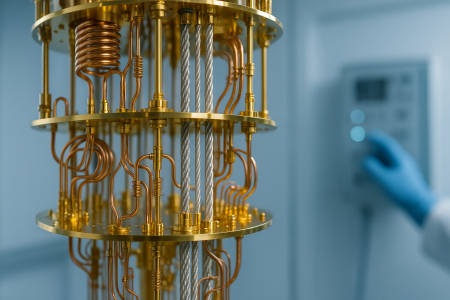
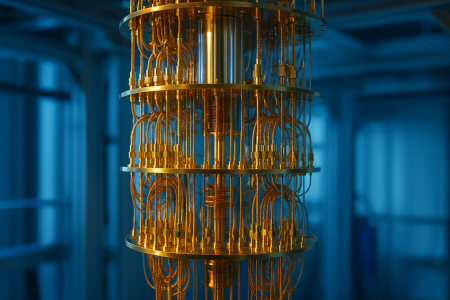
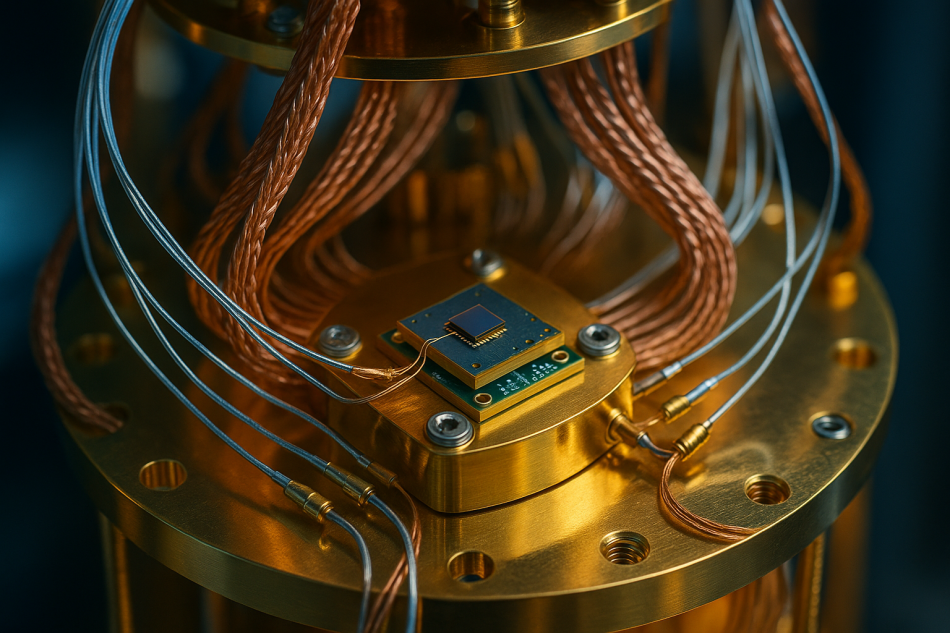
A single qubit typically needs several control and readout lines, each threaded through a dilution refrigerator's carefully engineered stages of cold. Every cable carries heat down from the warm world and takes up physical space in a canister barely wider than a trash can. Scale that to the hundreds of thousands of physical qubits that error correction demands, and the plumbing becomes impossible. You cannot fit a million coaxial cables through a fridge, and you cannot afford a million channels of room-temperature electronics either.
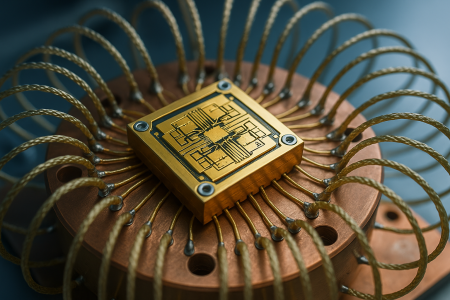
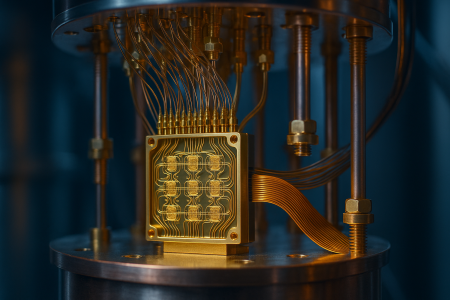
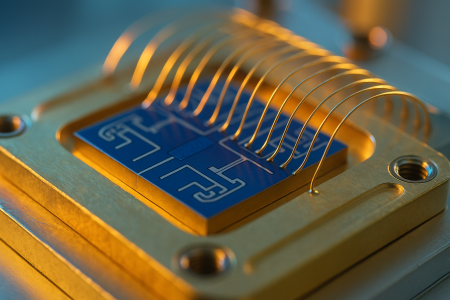
The obvious fix is to move the control circuitry closer to the qubits, ideally onto silicon chips that sit inside the cryostat. Instead of running raw analog waveforms from the top, you send compact digital instructions to a cold chip that generates the pulses locally. That collapses the cable count and shortens the distance a fragile signal has to travel. Intel demonstrated this idea publicly with a chip nicknamed Horse Ridge, a cryogenic controller meant to operate at around four kelvin. Startups such as SEEQC have pursued single-flux-quantum logic designed to run even colder, and Google and academic groups have published their own cryo-CMOS control experiments.
The heat budget is brutal
Here is the catch that makes this so hard. The qubits themselves live near ten millikelvin, at the coldest stage of the fridge, where the cooling power is measured in microwatts. A dilution refrigerator can only haul away a tiny trickle of heat at that temperature before the whole system warms up and the qubits lose coherence. Ordinary silicon electronics dissipate far too much power to sit next to the qubits. Even a modest controller chip would act like a space heater in a place that can barely tolerate a candle's worth of warmth.
So engineers compromise. Most cryo-controllers are placed at the four-kelvin stage, where the fridge has far more cooling headroom, sometimes a watt or more. That is warm enough to run specially designed CMOS transistors, and it is far closer to the qubits than a room-temperature rack. The remaining challenge is squeezing the power consumption of each control channel down to a few milliwatts while still producing clean, low-noise pulses. Transistors behave strangely at cryogenic temperatures, and the design libraries that chip designers rely on were never characterized for such cold. Teams have had to remeasure device physics almost from scratch.
Noise, timing, and trust
Getting the power down is only half the battle. A control pulse that carries too much electrical noise will introduce the very errors that error correction is supposed to suppress. A cold controller has to generate microwave tones with tight phase stability, keep thousands of channels synchronized to picosecond precision, and do it all without drifting as the fridge cycles. It also has to talk to the outside world over a thin digital link, which means some of the classical processing that decides what pulse to send may need to happen cold as well. That pulls the fast feedback loops of error correction toward the fridge, a trend that reinforces work on cryogenic decoders and control logic.
None of this is settled. Some companies still favor keeping generation warm and simply multiplexing signals more cleverly, arguing that cryo-CMOS trades one hard problem for another. Others see integrated cold control as the only credible path to a million-qubit machine, the same way classical computing eventually had to put logic and memory on the same chip rather than wiring them across a room.
The stakes are practical. If a controller can be fabricated on a standard chip line, sit inside the fridge, and drive dozens of qubits each while sipping milliwatts, the cabling nightmare eases and the whole system becomes something you could imagine mass-producing. The qubits get the headlines. The cold controller may decide whether there is ever a machine large enough to matter.