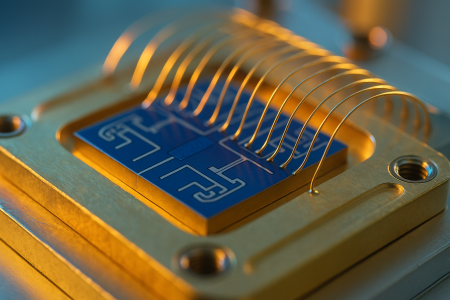

Every quantum processor has a hard ceiling: the number of qubits etched onto its chip. If your algorithm needs 40 qubits and your machine has 30, you are, in the most literal sense, out of room. For years that limit meant one thing. Wait for bigger hardware. But a family of techniques known collectively as circuit knitting offers a different answer. Cut the problem into pieces small enough to fit, run the pieces, and reassemble the result on a classical computer afterward.
Cutting a circuit in two
A quantum circuit is a web of qubits linked by gates. Some links are weak. A pair of qubits might interact through a single two-qubit gate and otherwise go their separate ways. Circuit knitting looks for those thin connections and severs them, splitting one large circuit into two or more smaller sub-circuits that no longer share qubits.
There are two main ways to make the cut. A wire cut severs a qubit's timeline, effectively splitting one qubit's journey into a before and an after that run on separate fragments. A gate cut removes an entangling gate that bridges two halves of the circuit. Either way, the fragments are now independent. Each one fits comfortably on a modest processor, and each can be executed on its own.
The catch nobody can escape
Here is the part that makes circuit knitting a tradeoff rather than a free lunch. When you cut an entangling connection, you destroy quantum correlations that the full circuit depended on. To recover them, you cannot just run each fragment once. You have to run each fragment many times, under a carefully chosen set of different measurements and initial states, and then combine those results with classical post-processing.
The number of variations grows exponentially with the number of cuts. Cut one connection and you might multiply your total runs by a factor of a few. Cut ten and the multiplier balloons into the thousands or worse. This is the sampling overhead, and it is the central tax of the whole approach. You trade a hardware limitation you cannot beat for a runtime cost you can, at least sometimes, afford.
Because the overhead scales so steeply with the number of cuts, circuit knitting only works when a circuit has a naturally sparse structure. If everything is entangled with everything else, there are no thin connections to snip, and cutting anywhere means paying an enormous bill. But plenty of real problems do have block structure. A molecule might decompose into loosely coupled fragments. An optimization graph might split into clusters with only a few edges between them.
Why bother instead of buying a bigger chip
The obvious question is why anyone would go through this when qubit counts keep climbing. Part of the answer is that raw qubit count is not the only constraint. Larger circuits accumulate more noise, so even if you have the qubits, the errors may swamp the answer before it finishes. Splitting a circuit into smaller fragments means each fragment is shallower and less noisy. In some cases the classical stitching can even suppress certain errors, blurring the line between circuit knitting and error mitigation.
There is also a practical, near-term appeal. Circuit knitting lets a small, high-quality processor punch above its qubit weight without waiting for the next hardware generation. It also opens the door to spreading one job across several separate machines running in parallel, then combining the results. That is a very different vision from splicing chips together with a quantum interconnect, because the glue here is entirely classical.
A bridge, not a destination
Vendors including IBM have built circuit-cutting tools into their software stacks, treating knitting as a way to extend the reach of today's imperfect processors. Nobody pretends it scales forever. The exponential sampling cost guarantees that a large, densely entangled workload will always be better served by a single big, error-corrected machine.
Circuit knitting is best understood as a bridge across an awkward gap. Right now the machines are small and noisy, and useful problems are just a little too big. If you can find the seams, cut carefully, and pay the sampling tax, you can get an answer today that the hardware alone could not deliver. That is a modest promise, but modest promises are what carry a field from the lab toward something that works.