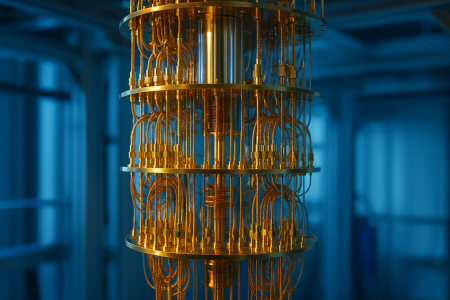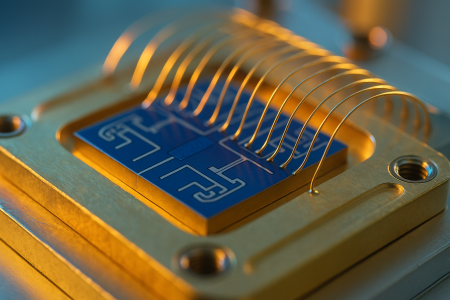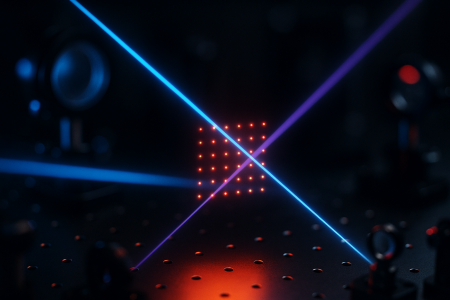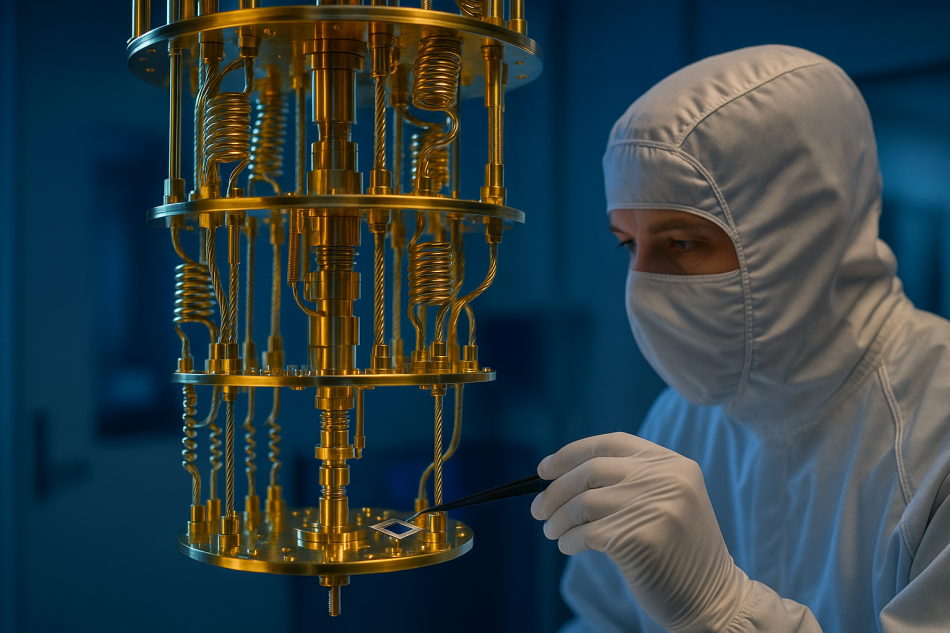

Nearly every quantum computer in operation today shares a frustrating trait: the information in its qubits is fragile. A stray vibration, a wandering magnetic field, or a cosmic ray can scramble the delicate quantum state in a fraction of a second. The mainstream answer is brute force. You build many physical qubits, spend enormous overhead detecting and correcting their errors, and hope the math stays ahead of the noise.
Microsoft has spent the better part of two decades betting on a different answer. Instead of fixing errors after they happen, it wants to build a qubit that is inherently resistant to them. The idea goes by the name topological quantum computing, and it is one of the boldest and most stubborn wagers in the field.
Hiding information where noise can't reach
The word topological comes from the branch of math concerned with properties that survive stretching and bending. A coffee mug and a doughnut are topologically the same because each has exactly one hole, and no amount of gentle deformation changes that count. The appeal for quantum computing is obvious once you frame it that way. If you could store quantum information in a property that only changes under a dramatic, deliberate operation, then small local disturbances would leave it untouched.
In a topological qubit, the information is not held in the state of a single particle. It is spread out, or delocalized, across a system in a way that no local poke can read or corrupt. A bit of noise in one spot simply doesn't have access to the whole picture. That built-in protection is what makes the approach so attractive. In principle, it could dramatically reduce the crushing overhead that error correction demands from superconducting and trapped-ion machines.
The elusive Majorana
To make this work, Microsoft has pursued an exotic ingredient: the Majorana zero mode, a quasiparticle that behaves as its own antiparticle. These aren't fundamental particles you find in a collider. They are emergent excitations predicted to appear at the ends of specially engineered semiconductor nanowires coupled to superconductors and chilled to a whisper above absolute zero.
The theory says that if you can create pairs of these modes, quantum information can be encoded in how they are braided around one another. The braiding is the computation, and because the stored information lives in the global arrangement rather than any single location, it should be remarkably stable.
The catch is that Majorana modes have been maddeningly difficult to confirm. Their experimental signatures can be mimicked by ordinary, boring effects in messy materials. The field has seen premature claims of detection, retracted papers, and years of painstaking work to separate a genuine Majorana signature from a look-alike. Skeptics have not been shy about pointing out that a qubit built on a particle you can barely prove exists is a risky foundation.
Why bother with the hard road
The obvious question is why any company would take the slow, uncertain path when rivals are already running cloud-accessible machines with dozens or hundreds of noisy qubits. The answer is scale. Building a fault-tolerant machine with today's leading qubits may require thousands of physical qubits for every logical, error-corrected one. That translates into enormous wiring, cooling, and control burdens.
A topological qubit, if it ever performs as advertised, would need far less of that overhead. Fewer physical qubits per logical qubit means a smaller, more manageable machine on the road to millions of useful operations. Microsoft's argument has always been that a harder start could pay off with an easier finish. Get the physics right once, and the engineering afterward becomes tractable.
A wager still being settled
Microsoft has reported progress toward reading out and controlling these devices, and it has laid out a roadmap that treats the topological qubit as a component to be scaled, not just a lab curiosity. Whether that vision holds depends on results that must be reproducible and unambiguous, the kind that convince a skeptical physics community rather than a press release.
For now, the topological bet sits apart from the rest of the industry. Companies with superconducting transmons, trapped ions, and neutral atoms are racing to squeeze useful work out of imperfect hardware right now. Microsoft is playing a longer game, wagering that the sturdiest qubit is one whose protection comes from geometry itself. If it wins, the payoff reshapes the timeline to a practical quantum computer. If it loses, it will stand as one of the most ambitious dead ends in the field's history. Either way, the outcome will teach the rest of the industry something about how far physics alone can carry you.