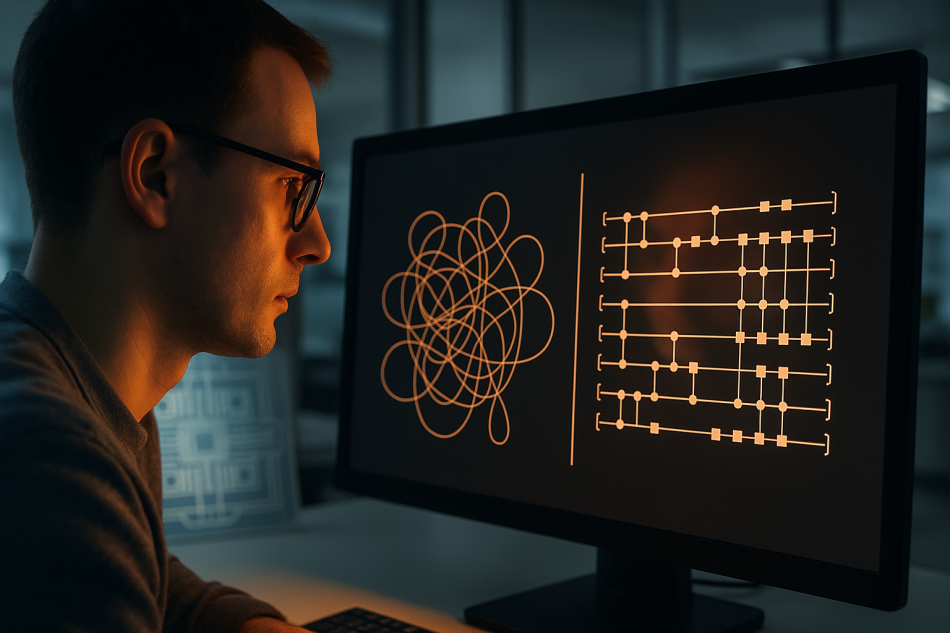

Write a quantum program and you are, in a sense, lying to yourself. You draw a tidy circuit with clean gates connecting any qubit to any other, using operations with friendly names like Toffoli and controlled-Z. No real machine can run that circuit as written. Before a single microwave pulse fires or a single laser flashes, a piece of software called a transpiler takes your idealized diagram and rewrites it, gate by gate, into something the hardware can actually execute. What comes out the other end often looks nothing like what you drew.
Translating into the machine's dialect
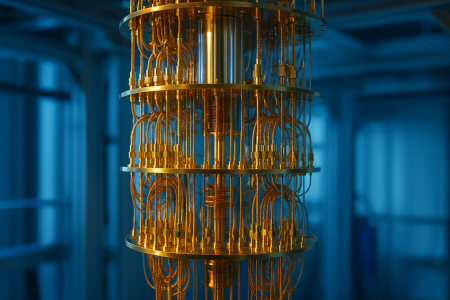
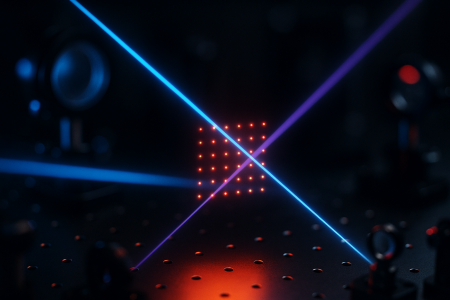
The first job is vocabulary. Every processor supports only a small set of physical operations, its native gate set. A superconducting chip might offer a handful of single-qubit rotations plus one two-qubit entangling gate. A trapped-ion machine speaks a different dialect entirely. Your elegant Toffoli gate does not exist on the metal, so the transpiler must decompose it into a sequence of native operations that produces the same mathematical result. A single high-level gate can explode into a dozen or more physical ones.
This decomposition is not unique. There are usually many valid ways to express the same logic, and they are not equal. Some sequences use fewer entangling gates, which matters enormously because two-qubit operations are the noisiest and slowest thing most machines do. A good transpiler hunts for the cheapest decomposition it can find, and a clumsy one can inflate a circuit until it is too long to finish before the qubits lose their coherence.
Fitting the wiring diagram
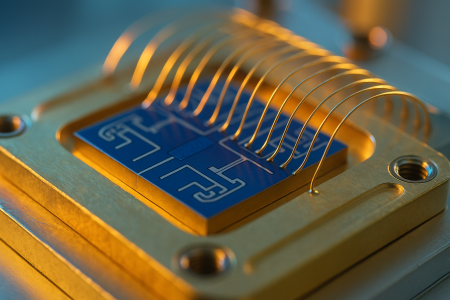
The harder problem is geography. Your circuit assumes any qubit can talk to any other. Real chips do not work that way. On a superconducting processor, a qubit is physically coupled only to a few neighbors laid out in a fixed pattern. If your program wants qubit 3 to interact with qubit 40 and they are on opposite sides of the chip, the transpiler has to build a bridge.
It does this with SWAP operations, which shuffle quantum states along the lattice until the two qubits that need to interact are sitting next to each other. Each SWAP is itself made of several entangling gates, so routing is expensive. The transpiler also decides the initial placement, mapping the abstract qubits in your program onto specific physical qubits on the device. A smart initial layout can slash the number of SWAPs needed; a poor one can bury a short circuit under hundreds of extra gates. Finding the optimal mapping is a genuinely hard computational problem, so transpilers lean on heuristics that get close in reasonable time.
Dodging the weak spots
Modern transpilers do more than satisfy the rules. They optimize against the machine's flaws. No two qubits on a chip are identical, and calibration data reveals which ones have long coherence, which two-qubit links have the best fidelity, and which readout channels are the most reliable. A noise-aware transpiler will steer your logical qubits onto the healthiest physical ones and route interactions through the strongest links, even if that means a slightly longer path. On a device where error rates vary from one qubit to the next, choosing where to run can change your success rate more than choosing which algorithm to run.
The software also prunes waste. Adjacent gates that cancel out get removed. Rotations that combine into a single operation get merged. Long idle stretches, where a qubit sits doing nothing and slowly decaying, can be filled with protective pulse sequences or rescheduled away. All of this happens automatically, and the difference between an aggressive optimization pass and a lazy one can be the difference between noise and signal in the final measurement.
Why it decides who wins
Because the transpiler sits between the programmer and the physics, it quietly shapes what today's noisy machines can accomplish. Two research groups running the same algorithm on the same hardware can get very different results depending on how well their circuits were compiled. That is why vendors invest heavily in these tools and why benchmark comparisons often come with fine print about which compilation settings were used.
As machines grow toward error correction, the transpiler's role expands again. It will need to translate logical operations into the choreography of lattice surgery and magic-state injection across thousands of physical qubits. The gap between the circuit you imagine and the circuit that runs is not going away. It is getting wider, and the software that spans it is becoming one of the most consequential layers in the entire stack.