
Ask most people to picture a quantum computer and they imagine a circuit: qubits marching through a choreographed sequence of logic gates, one operation after another, until a final measurement pops out an answer. That is the gate model, and it dominates the roadmaps of IBM, Google, Quantinuum and the rest. But there is an older, stranger idea running alongside it, and for a narrow class of problems it is already producing results that stretch the limits of classical supercomputers.
Letting the physics compute
The analog approach, usually called quantum simulation, throws out the gate sequence entirely. Instead of programming a circuit, you build a physical system whose natural behavior mimics the problem you care about. The machine does not step through instructions. It simply evolves, obeying the same equations that govern the target system, and you read off the state when it settles or at chosen moments along the way.
The idea traces back to Richard Feynman's famous suggestion that the best way to simulate quantum physics is with another piece of quantum physics. If you want to understand how electrons arrange themselves in an exotic magnet, you do not need a universal computer. You need a controllable system that behaves like that magnet. Tune the knobs, watch what happens, and you have your answer without ever writing a line of gate-level code.
Atoms in tweezers
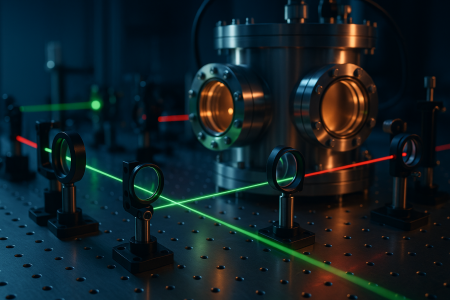
Neutral-atom platforms have become the poster child for this style of machine. Companies like QuEra and Pasqal, along with a cloud of academic labs, hold hundreds of individual atoms in optical tweezers, laser beams tightly focused to grip a single atom each. Arrange those tweezers into a grid, a chain, or a more baroque pattern, and you have sculpted the geometry of an interacting quantum system by hand.
The interactions come from the Rydberg blockade, where an atom nudged into a bloated high-energy state forbids its neighbors from doing the same. That single rule, repeated across hundreds of atoms, reproduces the mathematics of magnetism, of frustrated lattices where no arrangement satisfies every constraint, and of phase transitions that flip a whole system from one order to another. Researchers have used these arrays to watch quantum matter organize itself into patterns that are genuinely hard to compute any other way.
Superconducting and trapped-ion groups run analog experiments too. A chain of trapped ions can act as a programmable spin system, and researchers have used them to probe how quantum information scrambles and how many-body systems fail to reach equilibrium. The hardware overlaps heavily with the gate-model machines built by the same teams. What changes is how you drive it.
What you give up
The catch is generality. A gate-model processor, at least in principle, can run any algorithm you can compile. An analog simulator is tuned to a family of problems. Push it toward a task its physics does not naturally express and it has nothing to offer. There is no error correction in the fault-tolerant sense either. The system's imperfections feed directly into the answer, so results have to be cross-checked against theory, against smaller classical simulations, and against the machine's own repeated runs.
That makes the analog route a poor fit for the headline dreams of quantum computing, the code-breaking and the database searches that demand a universal, error-corrected machine. But it is a strong fit for exactly the problem Feynman had in mind: understanding quantum materials, chemistry, and the collective behavior of many particles. Those are questions where even the world's largest classical clusters choke on the exponential growth of quantum states.
A bridge, not a dead end
Some builders see analog simulation as a stepping stone. Neutral-atom hardware that runs analog experiments today can, with better control and the addition of gate operations, grow into a digital machine tomorrow. Several roadmaps explicitly describe this migration, treating the analog mode as a way to do useful science while the fault-tolerant version matures. The tweezers, the vacuum systems, and the laser control all carry over.
For now the two philosophies coexist. The gate model chases a universal machine that may take a decade of error correction to pay off. The analog camp aims narrower and reaches results sooner, extracting real physics from imperfect hardware. Both are quantum computers. They just disagree about whether you need to spell out every step, or whether it is enough to build the right system and let nature run the numbers.