
Every quantum computer needs to keep the outside world away from its qubits. Superconducting chips do it with cold, sealing themselves inside a dilution refrigerator. But the machines that use single atoms and ions as qubits face a different enemy: stray gas molecules. A single nitrogen atom drifting past a trapped ion at room temperature can knock it clean out of the trap or dump enough energy into it to scramble a calculation. So the makers of these machines do something that sounds absurd until you see the numbers. They build chambers emptier than the space between planets.
How empty is empty enough
Sea-level air sits at about 760 torr of pressure, packed with roughly 25 quintillion molecules per cubic centimeter. A good laboratory ultra-high vacuum reaches 10^-10 or 10^-11 torr, a factor of more than a trillion lower. At that point only a few hundred thousand molecules remain in each cubic centimeter, which sounds like a lot until you compare it to the density of molecules in interplanetary space. The best ion-trap systems, especially cryogenic ones, push into the 10^-12 torr range and below, genuinely rivaling or beating the vacuum of the solar system's outer reaches.
The reason is brutally practical. Quantum algorithms run in shots, and a long computation might need a particular ion to survive for seconds or even minutes of loading, cooling, gating, and measurement. Every collision with a background gas molecule is a chance to lose that ion or heat its motion. The rate of those collisions scales directly with pressure. Halve the residual gas and you roughly double the time an atom stays useful. In a machine that shuttles ions around a chip and reuses them across many operations, ion lifetime is not a nicety. It is throughput.
The plumbing behind the nothing
Getting to these pressures is a slow, unglamorous craft. You cannot simply pump the air out and call it done, because the walls of the chamber themselves leak. Metals and ceramics hold water and hydrogen in their surfaces, and that gas seeps out for weeks, a process called outgassing. To beat it, engineers bake the entire assembly at 150 to 250 degrees Celsius for days while pumping continuously, driving the trapped gas out of the material so it can be removed once and for all.
Different pumps handle different regimes. A turbomolecular pump, spinning blades at tens of thousands of RPM, does the rough work of clearing the bulk. Ion pumps take over at low pressure, ionizing the last stray molecules and burying them in a titanium electrode. Non-evaporable getter pumps chemically absorb reactive gases with no moving parts at all. Material choice matters too. Chambers are often made of low-carbon or titanium alloys chosen for low outgassing, and every window, feedthrough, and gasket is a potential leak that has to be checked with a helium leak detector.
The cryogenic shortcut
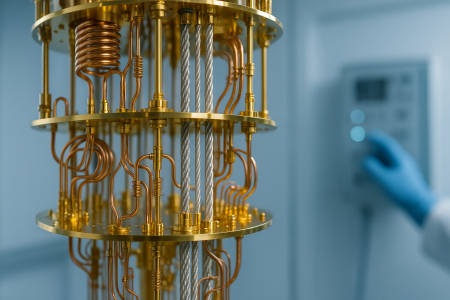
There is a clever way to cheat. Cool the chamber to a few kelvin and most residual gases simply freeze onto the cold walls, a trick called cryopumping. Many modern ion-trap systems run cold not only to reduce electric-field noise from the trap surface but to reach vacuum levels that would be nearly impossible at room temperature. The chamber becomes its own pump, and background collisions drop to the point where ions can survive for hours. The tradeoff is that you now need cryogenics anyway, blurring the old distinction that only superconducting machines require serious refrigeration.
Neutral atoms face the same tax
Optical-tweezer machines built from neutral atoms live under the same constraint. Atoms held in laser traps are barely bound compared to charged ions in a deep electric potential, so a single collision usually ejects them. The vacuum-limited lifetime of a trapped atom, often a handful of seconds at good pressures, sets a hard ceiling on how many operations you can perform before reloading. Groups building larger atom arrays have leaned hard into cryogenic vacuum chambers precisely to stretch that lifetime, because reloading hundreds of atoms into a perfect grid takes time the computation cannot spare.
Why the box is so big
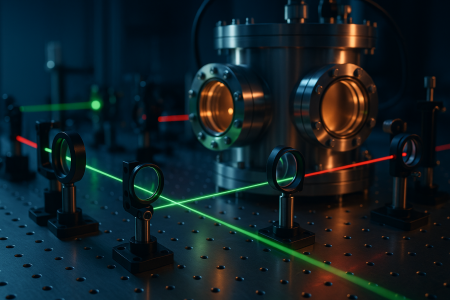
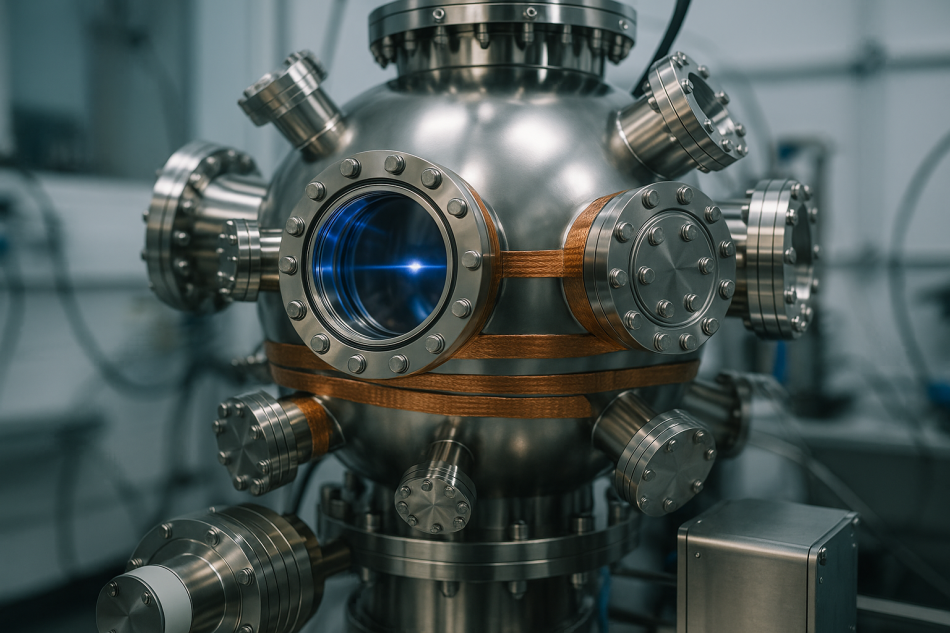
All of this is why an ion or atom quantum computer is not a chip you can hold. It is a stainless-steel vessel wrapped in pumps, bake-out heaters, and often a cryostat, threaded with optical windows for the lasers that do the actual cooling and gate operations. The qubit at the center might be a single ytterbium ion, invisible to the naked eye. Around it sits a machine whose main job is to guarantee that, for a fleeting moment, there is almost nothing else there at all. The emptiness is not a byproduct. It is the product.