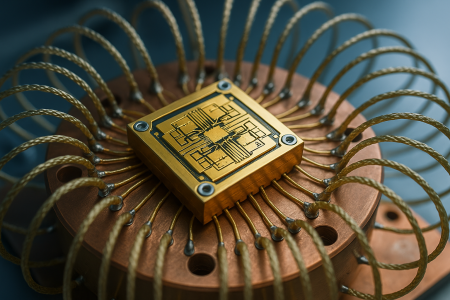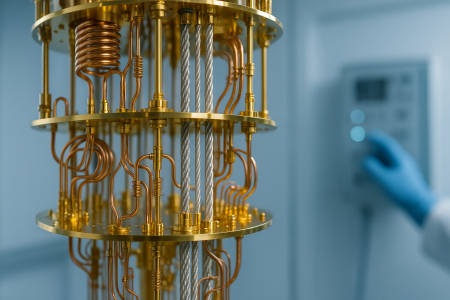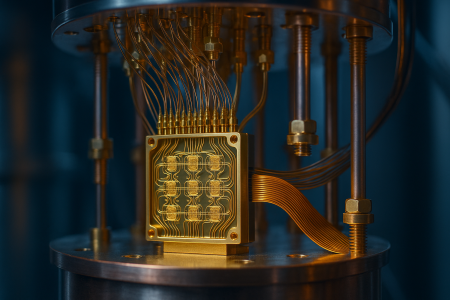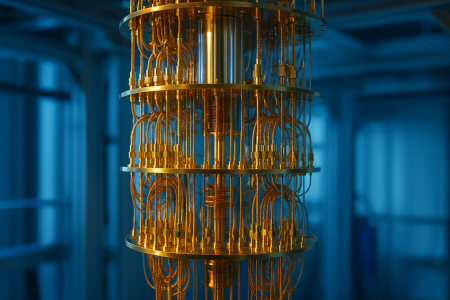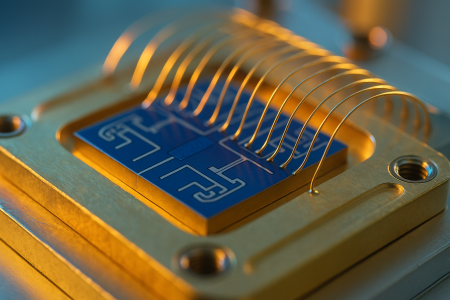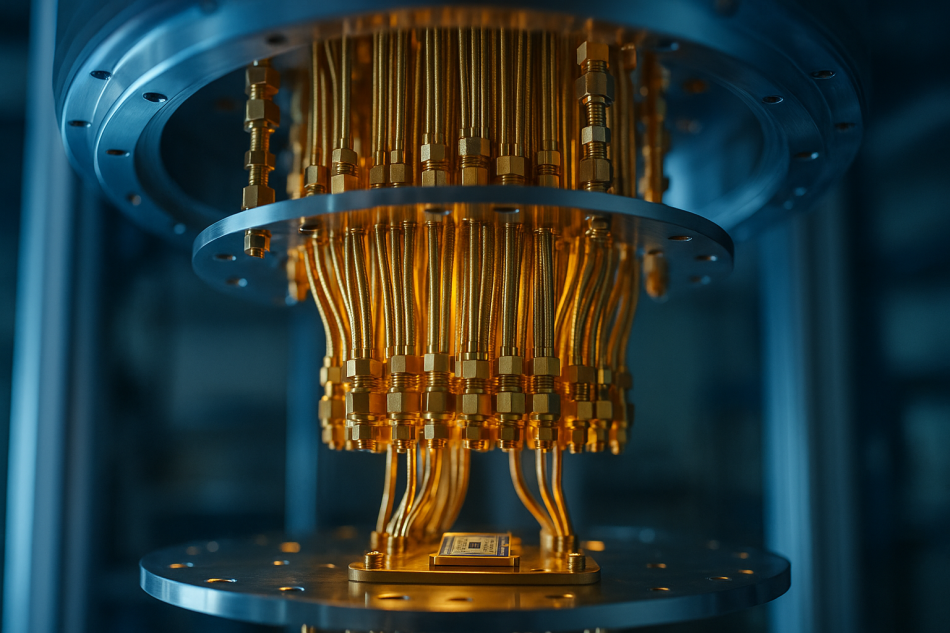

Open the door of a dilution refrigerator and you see the part nobody puts on the brochure: a dense forest of coaxial cables snaking down through gold-plated plates, each one carrying microwave signals to a single qubit or bringing its faint answer back up. The chip at the bottom might be the size of a postage stamp. The wiring feeding it can fill a rack. This is the wiring wall, and it is one of the quietest but most stubborn obstacles standing between today's machines and the million-qubit dream.
One qubit, several wires
A superconducting qubit is not a passive component. It has to be addressed, nudged, coupled, and read out, and each of those jobs tends to demand its own signal path. A typical transmon needs a drive line to run single-qubit gates, often a separate flux line to tune its frequency, and a readout line shared through a resonator. Tunable couplers add more. In practice, a processor with a few hundred qubits can require several hundred to a thousand cables threading the fridge.
Now multiply. Error correction assumes not thousands but millions of physical qubits to protect a useful number of logical ones. If each qubit still needs two or three dedicated lines running from room-temperature electronics down to roughly fifteen millikelvin, the cabling alone becomes physically impossible. You run out of space, you run out of connectors, and worst of all you run out of cooling power.
Heat is the real enemy
Cables are not just wires; they are thermal highways. A coaxial line running from a warm rack to the coldest stage carries heat down that path, and the fridge has to pump every joule of it back out. The coldest plate of a dilution refrigerator has a cooling budget measured in microwatts. Each cable, each attenuator, each connector leaks a little warmth. Pack in ten thousand lines and the refrigerator simply cannot keep the chip cold enough for the qubits to stay coherent. The machine defeats itself.
Engineers fight this with attenuators and filters staged at each temperature plate, with careful choices of cable material like stainless steel or superconducting NbTi that conduct signals better than they conduct heat, and with flexible ribbon cables that pack more lines into less volume. These help, but they are refinements on a fundamentally linear problem. More qubits, more wires, more heat.
Ways around the wall
The most talked-about escape is moving control electronics into the cold. Cryo-CMOS chips sitting at a few kelvin could generate and route signals near the qubits, replacing bundles of long coaxial runs with a handful of digital lines carrying instructions. The catch is that even a modest amount of cryogenic logic dissipates power, and the colder the stage, the less power budget there is. Placing controllers at four kelvin, where cooling is cheap, still leaves the last cold stretch to solve.
Other groups look at multiplexing. Frequency-division readout already lets several qubits share a single output line, each answering at its own frequency, and pushing that idea further could collapse many lines into few. Photonic links that carry signals as light rather than microwaves promise far less heat per channel. And some architectures rethink the geometry entirely, spreading qubits across modules connected by interconnects so that no single fridge has to host everything.
- Cryogenic control chips that shrink the number of wires crossing warm-to-cold boundaries.
- Multiplexed readout and drive lines shared among many qubits.
- Optical and microwave-to-optical links to move signals with less thermal cost.
- Modular systems that avoid cramming every qubit into one refrigerator.
Why it matters for the roadmaps
When a company promises a machine with tens of thousands of qubits by the end of the decade, the wiring wall is one of the first things that number has to survive. It is easy to fabricate more qubits on a wafer. It is far harder to talk to them all at once without boiling the fridge. That is why so much recent hardware work is quietly about plumbing and packaging rather than the qubits themselves.
The wiring wall is not a physics limit in the way decoherence is. It is an engineering constraint, and engineering constraints yield to enough clever people. But it is a reminder that a quantum computer is not just a chip. It is a system, and the boring cables running down into the cold may decide how big that system can ever get.