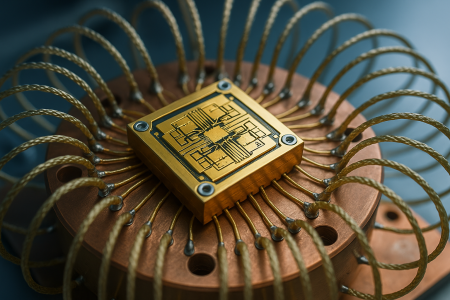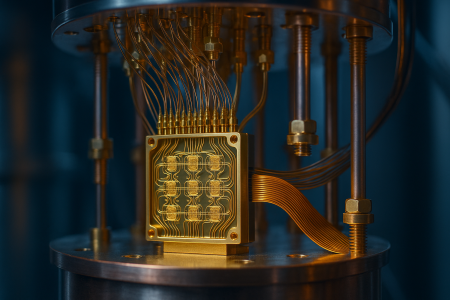

Every fixed-frequency transmon on a superconducting quantum chip is a tiny resonator that answers to one particular pitch. Send in a microwave pulse at that frequency and the qubit responds. Send the same pulse at a neighbor tuned slightly off, and ideally nothing happens. This is how a control system talks to one qubit at a time in a dense grid of hundreds. It works beautifully until the chip gets crowded, and then the whole scheme starts to strain against a problem that has nothing to do with noise or temperature and everything to do with real estate on the frequency dial.
A finite stretch of spectrum
Transmon qubits live in a narrow band, typically somewhere between four and six gigahertz. That sounds like a lot of room, but the usable slice is smaller than it looks. Qubits that sit too close together in frequency can accidentally exchange energy or respond to the same control pulse, so designers need to keep them separated by a comfortable margin. Two-qubit gates add another constraint: many schemes require neighboring qubits to have a specific frequency relationship, not too close and not too far. Readout resonators, coupling buses, and the pulses that drive them all claim their own reserved lanes. By the time you account for everything, the band that has to hold every distinct pitch on a large processor is genuinely tight.
This is what engineers mean by frequency crowding. As the qubit count climbs, the average spacing between assigned frequencies shrinks. Eventually two qubits that need to be different end up close enough to interfere, an event called a frequency collision. A single collision can render a pair of qubits unusable for gates, punching a hole in the connectivity of the whole chip.
Why fabrication makes it worse
The obvious fix is to design a chip where every frequency is neatly spaced. The trouble is that a transmon's frequency is set by the properties of its Josephson junction, and junctions come out of the fab with scatter. Aim for 5.0 gigahertz and you might land tens of megahertz off in either direction. That variability is the same gremlin behind the yield problem, and here it compounds the crowding: even a carefully planned frequency map gets scrambled by manufacturing spread, so two qubits meant to be safely apart can drift into collision.
The math is unforgiving. If each qubit's frequency wobbles by some amount and you are trying to fit many of them into a fixed band, the probability that at least one pair collides grows quickly with qubit count. A chip with a handful of qubits almost never collides. A chip with a few hundred, built with the same process, almost certainly has several bad pairs unless the makers do something about it.
The escape routes
Chipmakers have a few strategies, and most large processors use a combination.
- Tunable qubits. Add a magnetic flux loop and you can shift a qubit's frequency on the fly, steering it out of a collision. This buys enormous flexibility, but the same knob that moves the frequency also lets in flux noise, shortening coherence, so it is a trade.
- Post-fab trimming. Techniques like laser annealing let engineers nudge a finished junction's frequency after measuring where it actually landed, repairing collisions on an otherwise good chip.
- Tunable couplers. Putting the tunability in the coupling element between qubits, rather than in the qubits themselves, relaxes some of the frequency-matching constraints and gives designers more room to space qubits apart.
- Smart frequency planning. Rather than assigning frequencies arbitrarily, designers solve an allocation puzzle across the whole lattice, leaving the widest possible gaps given the connectivity pattern.
Why the lattice shape matters
Frequency crowding is one reason the connectivity graphs of superconducting chips look the way they do. A layout where every qubit touches many neighbors demands that all those neighbors have compatible, well-separated frequencies at once, which is a brutal constraint. Sparser layouts, where each qubit has fewer neighbors, are far easier to color with clashing-free frequencies. The engineering choice to give qubits fewer connections is partly a peace treaty with the spectrum.
None of this is a fundamental barrier. It is a scaling tax, the kind that stays invisible in small demonstrations and turns into a design headache the moment you try to build something big. As superconducting processors push toward thousands of qubits, deciding who gets which frequency becomes as important as making the qubits good in the first place.