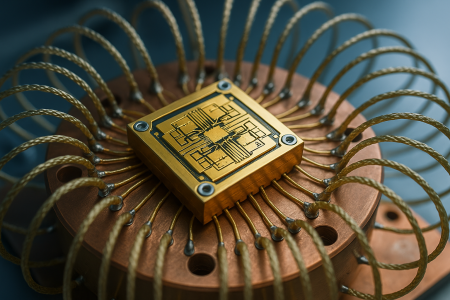

Almost every quantum computer you read about stores its information in matter. Superconducting chips freeze tiny circuits to a hair above absolute zero. Trapped-ion machines suspend charged atoms in electromagnetic fields. But a stubborn minority of companies and labs has bet on something that has no rest mass and refuses to sit still: the photon. Their qubits are individual particles of light, racing through waveguides at, well, the speed of light.
The appeal is easy to state. Photons barely interact with their environment, which is the same thing that makes them terrible messengers to lose and wonderful qubits to keep. A superconducting qubit lives in a noisy world of vibrating atoms and stray electromagnetic fields. A photon flying through a glass waveguide is largely oblivious to all of it. That gives photonic qubits naturally long coherence in transit and, in principle, a much easier path to networking chips together, since the qubits are already the kind of thing you send down a fiber.
The catch: photons ignore each other too
The same aloofness that protects a photon makes it maddening to compute with. Quantum logic requires qubits to interact, to become entangled, to condition one operation on another. Two photons crossing paths in ordinary glass simply pass through one another without a nod. There is no easy equivalent of the two-qubit gate that superconducting and ion machines rely on.
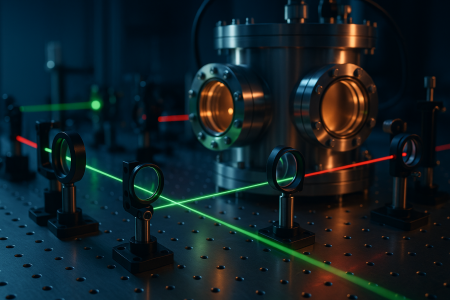
The workaround reshaped the entire field. Instead of forcing photons to interact directly, photonic designers lean on measurement. You send photons through beam splitters and phase shifters, then detect some of them. The act of measurement, combined with quantum interference, can entangle the photons that survive. The problem is that these gates are probabilistic. A given attempt might succeed only a quarter of the time or less, and you only learn whether it worked after you look.
That turns architecture into a numbers game. If a single gate succeeds one time in four, you need to run many attempts in parallel and stitch together the ones that land. This is the logic behind measurement-based quantum computing and its cousin, fusion-based quantum computing. Rather than building a long sequence of gates, you first manufacture a vast entangled resource, a so-called cluster state, and then compute by measuring pieces of it in a carefully chosen order. The computation is the measurement pattern.
What the hardware actually needs
Building a photonic machine comes down to three hard components, and none of them is easy.
- Single-photon sources that emit exactly one photon on demand, indistinguishable from every other, at high rates. Real sources are often probabilistic themselves, so builders use multiplexing tricks to turn many maybe-photons into a reliable stream.
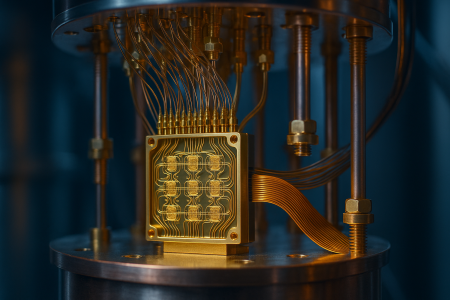
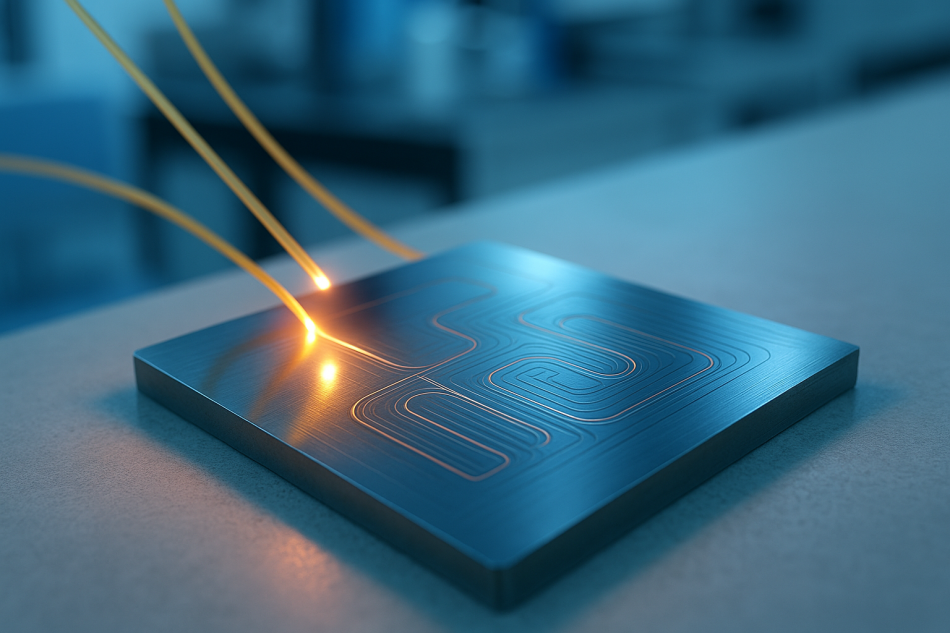
- Programmable optical circuits etched onto chips, routing light through networks of interferometers stable enough that a fraction-of-a-wavelength drift doesn't scramble the phase.
- Photon detectors good enough to count single particles of light with near-perfect efficiency. The best of these, superconducting nanowire detectors, ironically still demand cryogenic cooling. So the room-temperature dream is only partly real: the light path can be warm, but the counting hardware usually is not.
Loss is the villain that ties all three together. Every imperfect source, every lossy waveguide bend, every detector that misses a click removes photons from the calculation. In matter-based machines the dominant enemy is a qubit flipping the wrong way. In photonic machines the dominant enemy is a qubit simply vanishing. That happens to line up nicely with a class of error correction built around erasures, where a lost qubit at least announces its own absence, which is easier to handle than a silent flip.
Who is chasing it
PsiQuantum has staked its plan on manufacturing photonic chips in a conventional semiconductor foundry, arguing that leaning on existing silicon-photonics fabrication is the only way to reach the millions of components a useful machine will need. Xanadu has pursued a related path using squeezed states of light and has run cloud-accessible photonic processors. Academic groups and national labs continue to push single-photon source quality and on-chip loss ever lower.
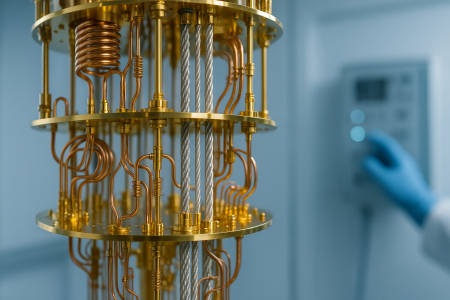
The honest status is that photonic machines have not yet demonstrated the kind of large, error-corrected logical qubits their backers promise. But the wager is a long one about manufacturing. If you can print photonic components on wafers the way the industry already prints transistors, the argument goes, you skip the exotic cryogenic plumbing and dilution refrigerators that dominate rival approaches, and you scale by adding chips linked with fiber. Whether light or matter wins is still unsettled, and it may be that different problems end up favoring different substrates.