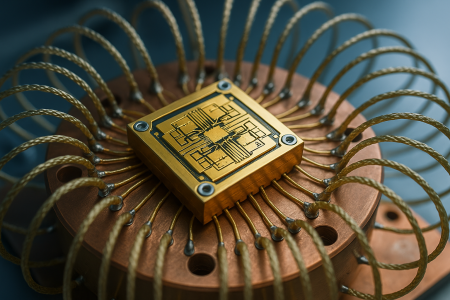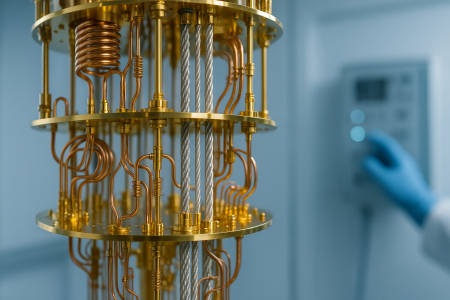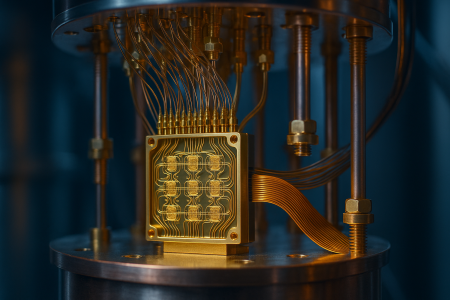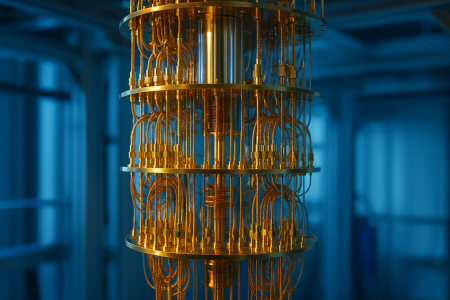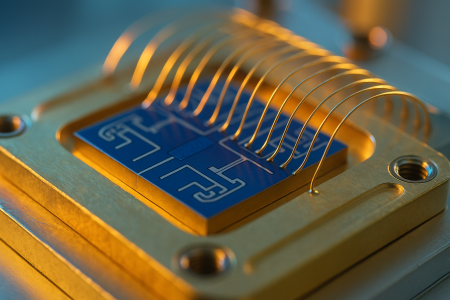

For years, a superconducting quantum processor was a fundamentally flat object. The qubits, the resonators that read them out, and the control lines that talked to them all lived on the same two-dimensional slab of sapphire or silicon. That worked beautifully when a chip held a handful of qubits. It stops working when you want dozens or hundreds, because every qubit needs its own wiring, and there is only so much room to route signals across a single plane before lines start crossing, crowding, and interfering with the very qubits they are meant to control.
The traffic jam on a flat chip
Picture a city where every building must connect to the outside world using roads laid on one level, with no bridges or tunnels. Add enough buildings and the roads either collide or have to take absurd detours. On a monolithic quantum chip, the equivalent problem is real. Control and readout lines have to reach qubits sitting in the interior of a growing grid, and on a single layer they either block each other or force the qubit lattice into sparse, awkward layouts. Crossovers built with tiny airbridges help, but they only go so far, and they add fabrication complexity and stray coupling.
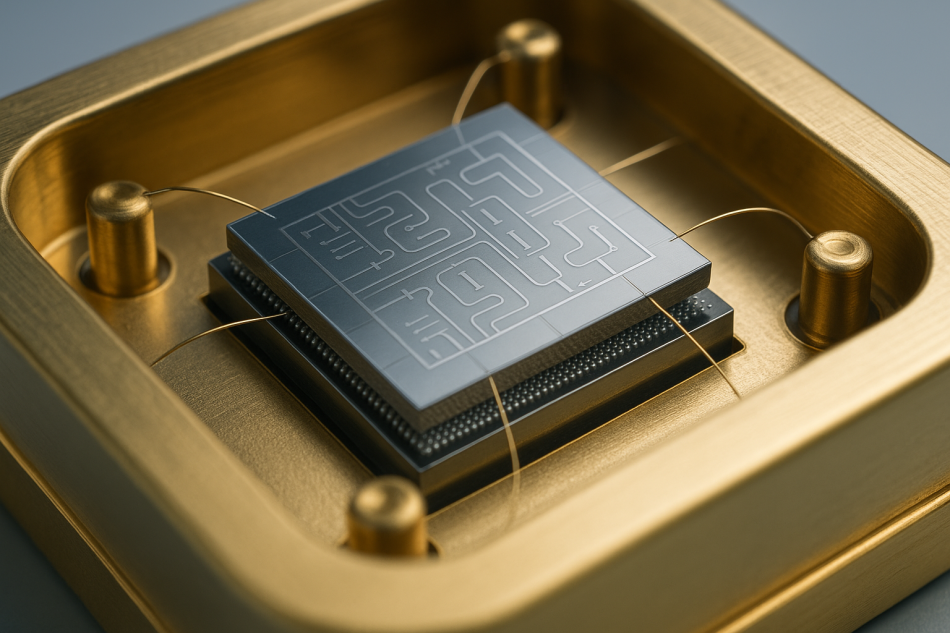
Flip-chip integration solves the geometry problem by adding a second story. Instead of cramming everything onto one wafer, engineers build two: one carries the qubits, the other carries the wiring, resonators, and readout circuitry. The two chips are then flipped face-to-face and bonded together with a forest of tiny metal bumps, usually made of indium because it stays soft and superconducting at the temperatures inside a dilution refrigerator.
How the two halves talk
Those indium bumps do double duty. Mechanically, they hold the two chips at a precise, controlled spacing, often just a few microns apart. Electrically, they carry signals across the gap, letting a control line on the interposer chip reach a qubit on the qubit chip without either line having to snake across a crowded surface. Because the wiring lives on its own layer, designers can route signals freely, almost the way a multilayer printed circuit board hides its traces on internal copper planes.
The payoff is a cleaner qubit layer. Keeping the noisy, dense wiring physically separated from the delicate qubits reduces the chance that a stray control line degrades a qubit's coherence. It also frees the qubit chip to use materials and fabrication steps optimized purely for qubit quality, while the interposer can be optimized for signal routing. Google's larger superconducting processors and several of IBM's designs rely on this kind of stacked construction, and it has become close to standard practice for anyone building superconducting arrays beyond a modest size.
New problems for old
Stacking is not free. The spacing between the two chips has to be controlled tightly, because the gap sets how strongly qubits couple to their readout resonators and to each other. If the bumps are a fraction of a micron too tall or too short across the wafer, the electrical properties drift, and calibration gets harder. Bonding two chips also means twice the fabrication yield risk: a flaw on either wafer, or a bad bond between them, can spoil the whole assembly. And the bump bonds themselves must remain superconducting and lossless, or they become a fresh source of the decoherence engineers spent so much effort avoiding.
There is also the matter of thermal contraction. As the assembly is cooled from room temperature to a few thousandths of a degree above absolute zero, the two chips and the bumps between them shrink, and any mismatch creates mechanical stress. Getting the materials and geometry right so the stack survives cooldown after cooldown is an unglamorous but essential piece of the engineering.
Why it matters for scaling
Flip-chip is best understood as one rung on the ladder toward genuinely large machines. It is what lets a designer place qubits in a dense two-dimensional grid, the kind of connectivity that surface-code error correction demands, without strangling the array in its own wiring. Combine it with signals that eventually feed in from below the chip through vertical vias, and the wiring stops competing with the qubits for surface real estate at all.
None of this makes a better qubit on its own. A stacked processor with poor coherence is still a poor processor. But scaling quantum hardware has always been as much a packaging and integration challenge as a physics one, and the shift from flat chips to bonded stacks is a reminder that some of the field's most important progress happens in the plumbing rather than the headline qubit counts.