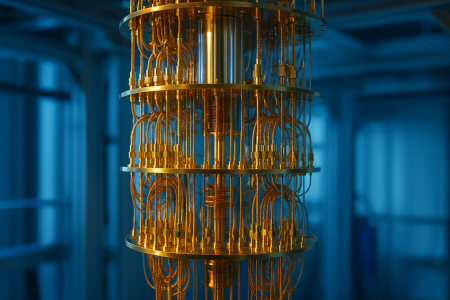

Most pictures of a quantum computer show qubits fixed in place, wired up like transistors on a circuit board. Trapped-ion machines built on a design called QCCD work differently. Their qubits are individual charged atoms, and to run a program the machine physically slides those atoms back and forth across a chip, parking pairs together when they need to interact and pulling them apart when they don't. It sounds almost mechanical, and in a sense it is. The strategy has produced some of the highest-quality qubits anyone has demonstrated.
What QCCD actually means
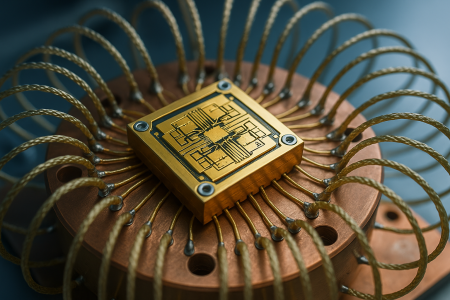
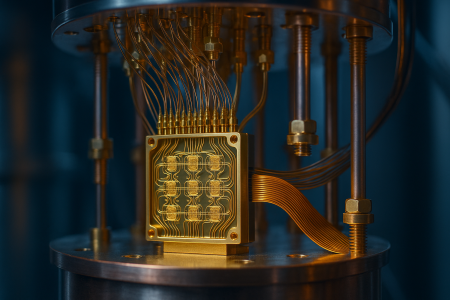
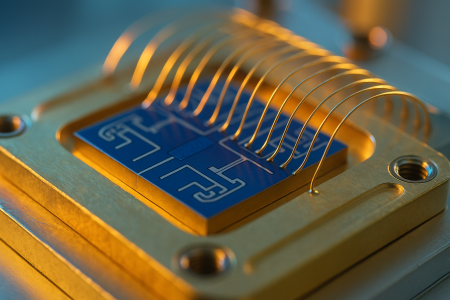
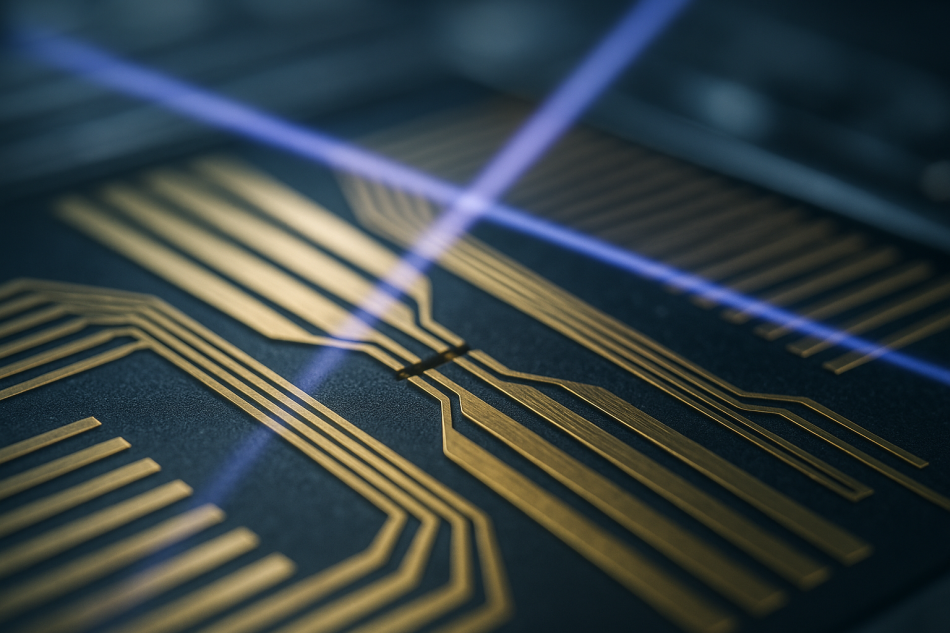
QCCD stands for quantum charge-coupled device, a name borrowed from the light sensors in old digital cameras that shuffled packets of charge from pixel to pixel. Here the packets are ions, typically an isotope of ytterbium or barium, suspended a fraction of a millimeter above a surface trap. The trap is a chip patterned with dozens or hundreds of tiny electrodes. By raising and lowering the voltages on those electrodes in a carefully choreographed sequence, engineers create moving electrical valleys that carry the ions along channels etched into the device.
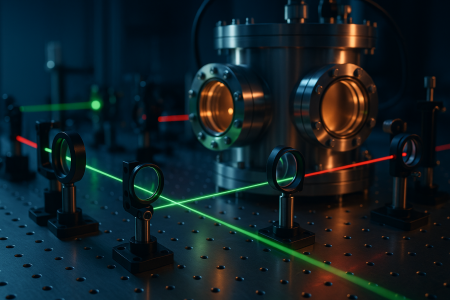
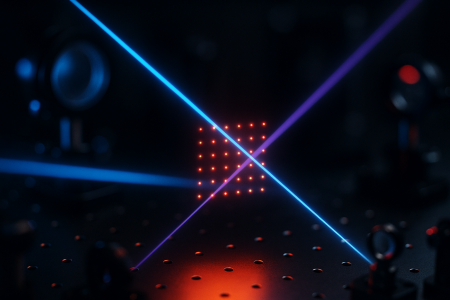
A typical layout looks like a small rail yard. There are storage regions where idle qubits wait, and gate zones where lasers hit pairs of ions to entangle them. When two qubits need to interact, the control system shuttles them into the same zone, performs the operation, then moves them out again. Because any qubit can be brought next to any other, the machine sidesteps the connectivity headaches that plague fixed-layout chips, where distant qubits have to pass their information through a chain of intermediaries.
Why bother moving atoms
The payoff is fidelity. Trapped ions are already prized because they are identical by nature, one ytterbium atom is exactly like the next, and they hold quantum information for a long time. QCCD adds all-to-all connectivity on top of that. In a fixed grid of superconducting qubits, entangling two qubits on opposite sides of the chip requires a cascade of swap operations, each one adding error. In a shuttling architecture you just drive the two ions together. Quantinuum's H-series machines, the best-known commercial example, have used this approach to post two-qubit gate error rates well below one part in a thousand, among the lowest reported for any platform.
That low error floor matters enormously for error correction, where every physical operation you save is an operation that can't go wrong. It also lets these systems perform mid-circuit measurement and qubit reuse, reading out an ion partway through a computation and recycling it, tricks that are difficult on hardware where qubits can't be isolated cleanly.
The cost of all that motion
Nothing is free. Moving an ion takes time, and shuttling is slow compared to the electrical pulses that drive superconducting gates. A single transport and recooling step can take tens to hundreds of microseconds, and a complex circuit may involve thousands of them. That is a large part of why trapped-ion machines run at clock speeds far below their superconducting rivals. The atoms also heat up as they move, picking up vibrational energy that degrades the next gate, so the machine has to pause and cool them back down with additional lasers, a process called sympathetic cooling that often uses a second species of ion mixed into the crystal purely as a coolant.
Scaling brings its own puzzles. A rail yard with a few dozen ions is manageable. A machine with thousands needs an intricate web of junctions where transport channels cross, and getting an ion cleanly around a corner without losing it is genuinely hard engineering. Researchers are exploring two-dimensional trap arrays and photonic links that would connect separate ion traps with light, letting many modest chips act as one larger computer rather than forcing every atom onto a single sprawling device.
A different bet on the future
The shuttling approach represents a clear philosophical choice. Rather than chase raw qubit counts and fast gates, its builders bet that clean, flexible operations will matter more as the field moves toward fault tolerance. So far the wager has held up well on quality benchmarks. Whether the same architecture can grow to the hundreds of thousands of qubits a useful machine will need, without the transport machinery becoming an impossible tangle, is the open question that will decide how far the ion shuttle can travel.