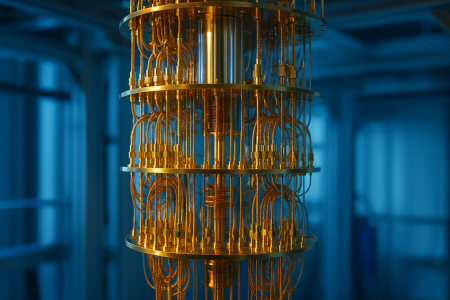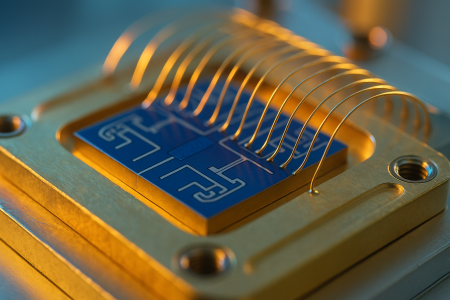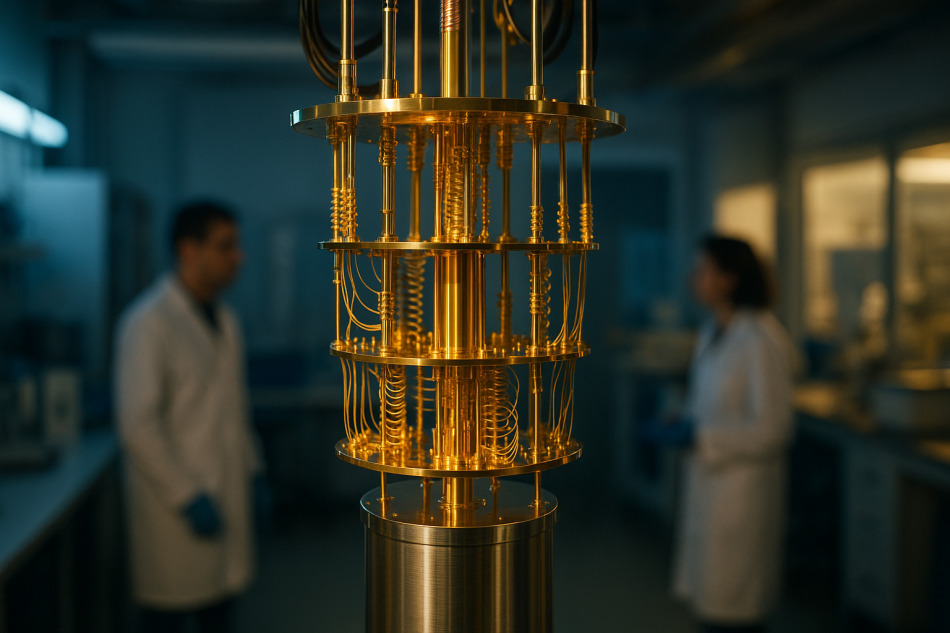

Ask a quantum hardware engineer what keeps them up at night and you might expect an answer about coherence times or gate fidelity. Sometimes the honest answer is a gas. Superconducting quantum processors, the kind IBM, Google, and Rigetti build, only work near absolute zero, and the machine that gets them there depends on a rare isotope with an unusual origin story: helium-3.
Why an isotope decides how cold you can get
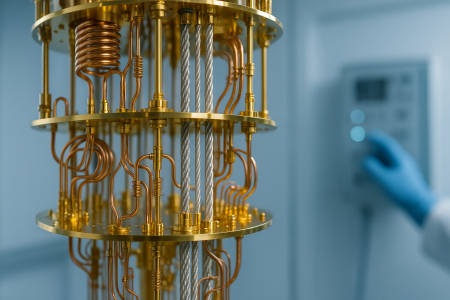
Ordinary helium is helium-4, with two protons and two neutrons. Helium-3 is missing a neutron, which sounds trivial but changes its quantum behavior in a way that engineers have exploited for decades. A dilution refrigerator, the workhorse cooling system under nearly every superconducting quantum computer, uses a mixture of helium-3 and helium-4 to reach temperatures around ten millikelvin, colder than deep space.
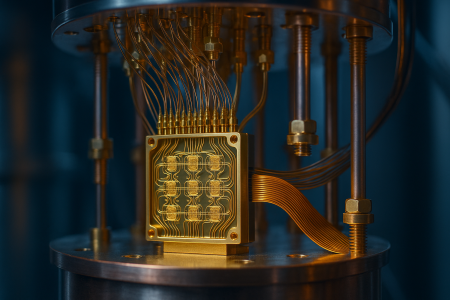
The trick is a physics quirk. When the two isotopes are cooled together, they separate into two phases: one rich in helium-3, one dilute. Forcing helium-3 atoms across the boundary from the concentrated side into the dilute side absorbs heat, much the way evaporating sweat cools skin. Pumps keep the cycle running continuously, and the mixing chamber sits at the coldest point, right where the quantum chip lives. No helium-3, no dilution fridge. No dilution fridge, no superconducting qubits.
The nuclear-weapons connection
Here is the awkward part. Helium-3 does not come out of the ground in useful quantities. Most of the world's supply is a byproduct of nuclear weapons maintenance. Tritium, a radioactive form of hydrogen used in warheads, decays over time into helium-3 with a half-life of about twelve years. Governments that manage tritium stockpiles periodically collect the accumulated helium-3, and for a long time that trickle was enough to satisfy a small research community.
Then demand spiked. After 2001, security agencies deployed large numbers of neutron detectors at ports and borders to screen for smuggled nuclear material, and those detectors ran on helium-3. The scramble drove prices up sharply and exposed how thin the supply really was. Research labs that had bought helium-3 almost as an afterthought suddenly found themselves competing for a strategic material rationed by government allocation.
What this means as quantum scales up
A single dilution refrigerator needs a substantial charge of helium-3, often tens of liters of gas measured at standard pressure. A handful of physics experiments is one thing. An industry that wants to install thousands of fridges, some data centers eventually running racks of them, is another. Every new large superconducting machine represents a real draw on a supply that grows only as fast as tritium decays.
The industry has responded in a few practical ways:
- Closed-cycle systems. Modern fridges recirculate their helium-3 rather than venting it. The isotope stays sealed inside the machine and is reused indefinitely, so the cost is mostly a one-time charge rather than an ongoing consumable.
- Careful recovery. When a fridge is serviced or decommissioned, the helium-3 is captured and returned rather than lost. At the price it commands, no one treats it casually.
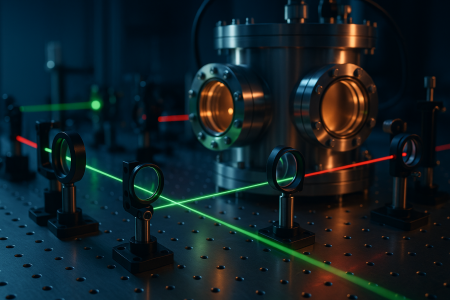
- Alternative approaches. Some cooling architectures aim to reduce the helium-3 charge, and platforms that do not need millikelvin temperatures, such as trapped-ion and neutral-atom machines, sidestep the problem entirely. That is one quiet advantage rarely mentioned in the qubit-technology debates.
A supply chain nobody planned
What makes the helium-3 story revealing is how little it resembles a normal industrial supply chain. There is no mine to expand and no factory to accelerate. Production is tied to the slow radioactive decay of a stockpile built for entirely different reasons, released in quantities set by national security agencies rather than market demand. If quantum computing companies suddenly needed ten times more helium-3, the world could not simply make more this year.
None of this is an immediate crisis. Closed-cycle recycling means the helium-3 already inside the installed fleet is not being burned away, and fridge manufacturers plan their charges carefully. But it is a reminder that a quantum computer is not just a clever chip. It is a stack of dependencies reaching down into materials science, cryogenics, and geopolitics. The path to a million qubits runs through a lot of unglamorous plumbing, and some of that plumbing is filled with an isotope that took a nuclear arsenal to produce.