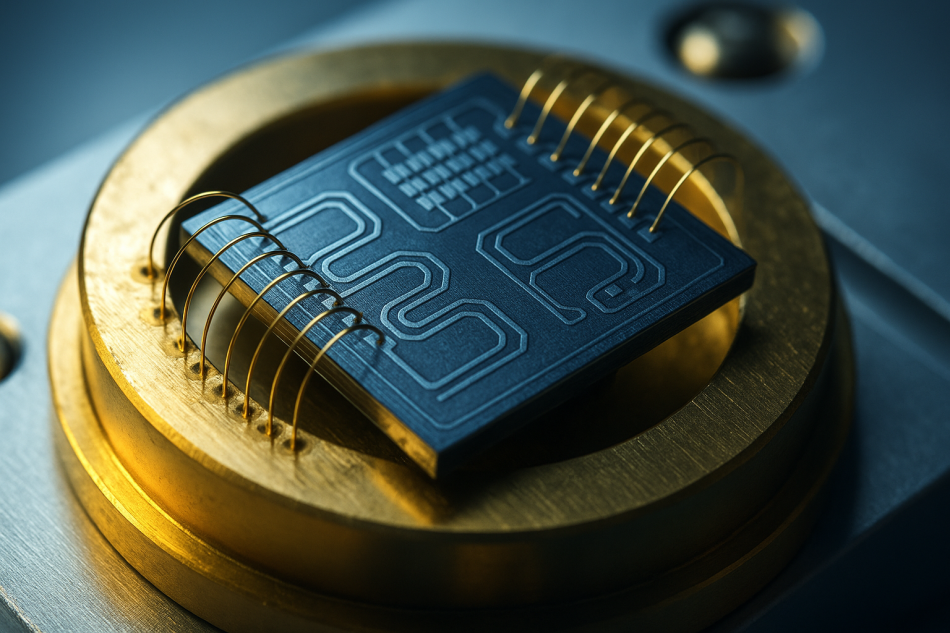

Nearly every superconducting quantum computer you have heard of runs on the same basic building block: the transmon. IBM, Google, and Rigetti all stack their processors from these tiny circuits, and for good reason. Transmons are forgiving, easy to fabricate in large numbers, and well understood. But their dominance has never been total, and one rival circuit has been quietly gaining ground in research labs. It is called fluxonium, and its backers argue it fixes some of the transmon's deepest structural flaws.
What a fluxonium actually is
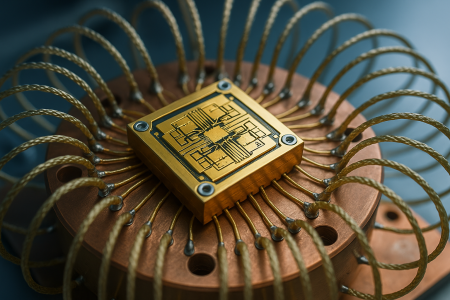
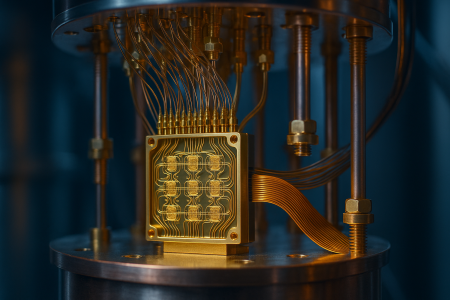
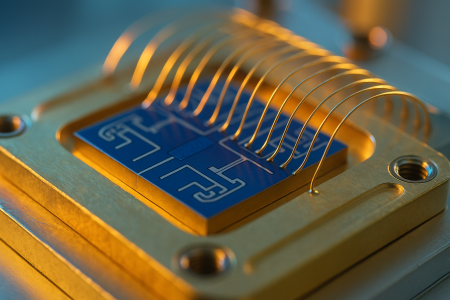
Both transmons and fluxoniums are superconducting circuits cooled to near absolute zero, where they behave like artificial atoms with quantized energy levels. The two lowest levels serve as the qubit's 0 and 1. The difference lies in how the circuit is wired. A transmon pairs a Josephson junction with a large capacitor. A fluxonium takes that junction and shunts it with an enormous inductor, built from a long chain of dozens or even hundreds of additional junctions. That superinductor completely changes the qubit's personality.
The most important consequence is anharmonicity, which is the energy spacing between the qubit levels and the unwanted higher levels above them. Transmons are notoriously crowded at the top. Their levels sit close together, so a control pulse aimed at the 0-to-1 transition can accidentally leak population into higher states and corrupt the computation. Fluxoniums spread those levels far apart. That extra breathing room lets engineers drive gates harder and faster without spilling energy where it does not belong.
The coherence argument
Coherence, the length of time a qubit holds its quantum information before noise scrambles it, is the currency of the whole field. Here fluxonium has posted eye-catching numbers. Operated at its so-called sweet spot, where the qubit sits at a magnetic flux value that shields it from the most common source of noise, fluxonium coherence times have reached the hundreds of microseconds and in some experiments well past a millisecond. That is comfortably beyond what typical transmons deliver, and it matters because more coherence means more operations before errors pile up.
Researchers have also reported two-qubit gate fidelities with fluxonium that rival or edge past the best transmon results, with error rates dipping toward the level where quantum error correction starts to look practical. Combine long coherence with fast, clean gates and you get a qubit that can pack many more high-quality operations into its lifetime. That ratio, not raw coherence alone, is what ultimately decides how useful a qubit is.
The catches
If fluxonium were simply better, everyone would already have switched. It is not that simple. The circuit is harder to build. That superinductor made of a long junction chain adds fabrication complexity and more places for defects to hide. Getting hundreds of junctions to behave uniformly across a full processor is exactly the kind of yield problem that has plagued quantum hardware for years.
Control is trickier too. Because the two qubit states have very different characters, reading them out and driving them can require more elaborate pulse schemes. The frequencies involved are often lower than transmons use, which changes the surrounding electronics. And the deep well of scientific and engineering knowledge that has accumulated around transmons over more than a decade simply does not exist yet for fluxonium at scale.
- Fabrication: the junction-chain inductor is delicate and hard to reproduce across many qubits.
- Control complexity: unusual level structure demands more sophisticated pulses and readout.
- Ecosystem gap: tooling, calibration recipes, and scaling experience trail far behind the transmon.
Why it still matters
The appeal is strategic. As the field pivots toward error correction, every improvement in the underlying physical qubit multiplies through the whole system. Error correction demands enormous numbers of physical qubits to protect a single logical one, and the better each physical qubit performs, the fewer you need. A qubit with intrinsically higher fidelity could shrink those daunting overhead requirements.
Fluxonium is unlikely to unseat the transmon overnight. The transmon's manufacturability advantage is real, and roadmaps at the biggest companies are built around it. But quantum hardware history is full of material swaps and circuit redesigns that looked exotic until they suddenly did not. Fluxonium is a reminder that the superconducting qubit is far from a settled design. The winning circuit may still be taking shape in a lab, one long chain of junctions at a time.