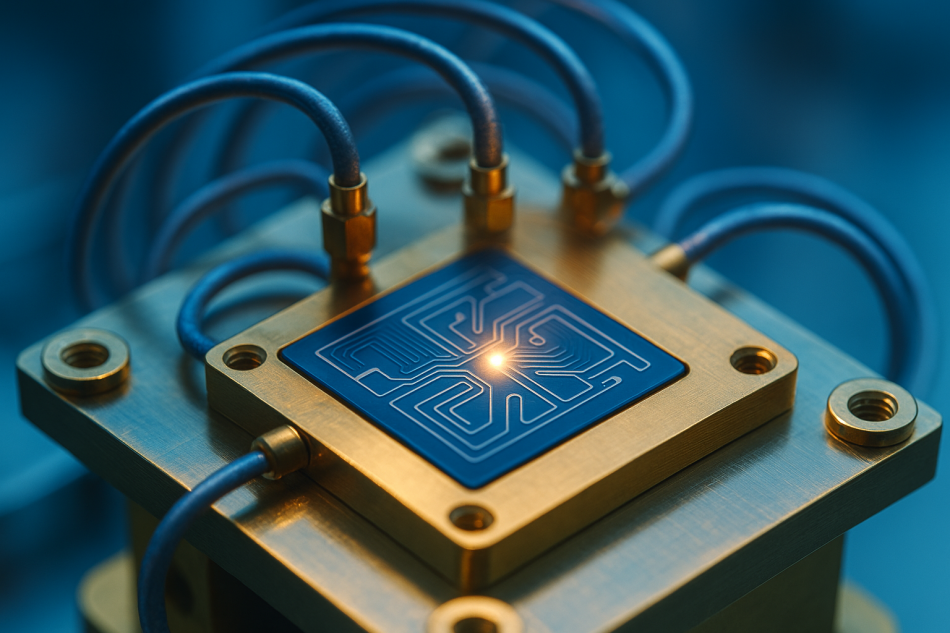

Picture a quantum circuit as a factory floor where some machines are hammering away and others are standing idle, waiting for a part to arrive. In a classical computer, an idle bit is no problem. It sits at 0 or 1 and stays there. A qubit is not so lucky. The moment it stops being actively controlled, it begins to drift, wobbling under the influence of magnetic noise, stray fields, and the slow rumble of its environment. By the time the circuit needs it again, its delicate phase may already be scrambled.
Dynamical decoupling is the trick that fights this drift. The idea is deceptively simple: if a qubit is going to be nudged off course by slow noise, keep flipping it so the errors cancel themselves out. Instead of leaving an idle qubit alone, the control system fires a carefully timed sequence of pulses at it, each one turning the qubit around so that the drift it accumulates in one direction gets undone in the next.
Why waiting is dangerous
Qubits lose their quantum information in two main ways. One is energy loss, where an excited qubit slumps back to its ground state. The other, dephasing, is subtler and often faster. Dephasing is the loss of the relative phase between the two states of a superposition, and it is driven largely by low-frequency noise: magnetic fields that wander slowly, control voltages that sag, temperature that creeps. Because this noise is slow, it acts almost like a steady, unknown push on the qubit over the span of an idle window.
That steadiness is exactly what dynamical decoupling exploits. If the noise barely changes over a short interval, then a pulse that flips the qubit halfway through the interval makes the second half of the drift point the opposite way from the first half. The two halves cancel. When the qubit is finally needed again, the accumulated phase error is close to zero. It is the same principle a photographer uses when panning to keep a moving subject sharp against a blurred background, only here the subject is the qubit's phase.
From one pulse to elaborate sequences
The simplest version is a single flip in the middle of the wait, an idea borrowed straight from the spin-echo experiments physicists have used in nuclear magnetic resonance for decades. Add more pulses, spaced evenly or in tuned patterns, and you can cancel noise that varies more quickly or point in more directions. Sequences with names like CPMG, XY-4, and XY-8 stack flips along different axes so that errors of several kinds all wash out together. More elaborate schemes push the protection to higher orders, buying longer coherence at the cost of firing more pulses.
There is a catch, and it is a familiar one in quantum hardware. Every pulse is itself an imperfect operation. Fire too many and the accumulated pulse errors start to outweigh the noise you were trying to suppress. Real qubits also feel noise fast enough that no sequence catches all of it. Engineers therefore tune the spacing and number of pulses to the specific noise spectrum of their machine, sometimes measuring that spectrum directly and designing the sequence around it.
Where it fits in a real machine
Dynamical decoupling is not error correction. It does not detect or fix a fault after the fact, and it cannot rescue a qubit from energy loss. What it does is stretch the effective coherence time of qubits that are sitting idle inside a larger computation, which happens constantly. In a circuit with dozens of qubits, at any given moment most of them are waiting their turn while a gate acts on a handful. Left unprotected, those bystanders quietly rot.
Cloud quantum platforms from several vendors now apply decoupling sequences automatically, inserting flips into the gaps of a user's circuit without the programmer having to ask. It has become one of the cheapest reliability gains available, a software-level tweak that squeezes better results out of hardware that already exists. It also plays well with error correction rather than competing with it. Keeping idle data qubits quiet between rounds of syndrome measurement reduces the raw error rate the code has to mop up, easing the burden on everything downstream.
None of this makes a qubit permanent. Dynamical decoupling buys time, not immortality. But in a field where coherence is measured in microseconds and every extra one counts, a well-placed sequence of pulses is a bargain that costs almost nothing and pays off on almost every job.