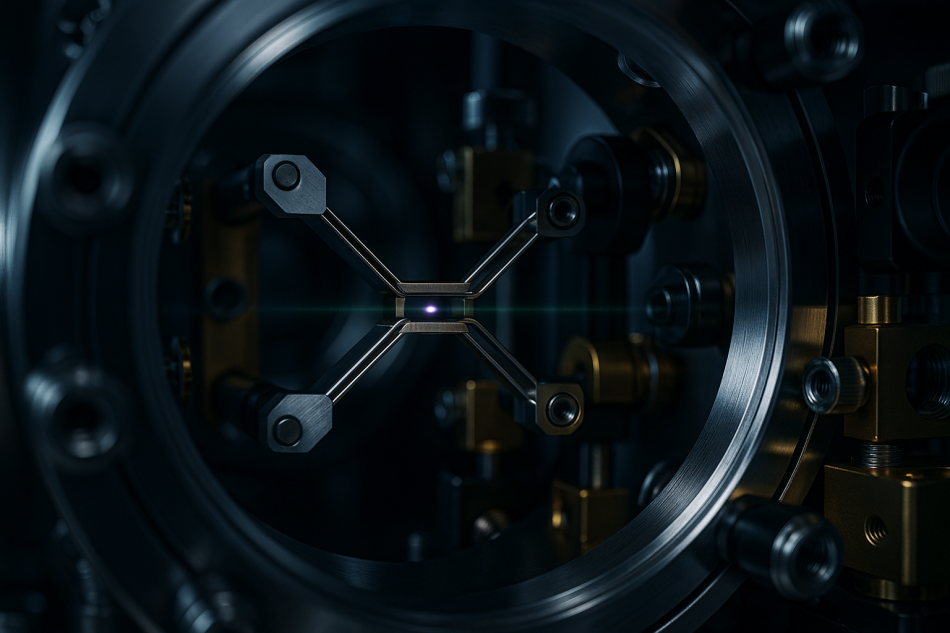

Before a trapped-ion quantum computer can hold a single qubit, someone has to pick which atom to trap. It sounds like a footnote, but it is one of the most consequential decisions in the whole design. The element chosen sets the wavelengths of every laser in the machine, the coherence you can hope for, whether you can use off-the-shelf optics, and even whether you need a radioactive-materials license. Different companies have reached different verdicts, and the disagreements are real.
The usual suspects
A handful of elements dominate the field, all of them singly ionized alkaline-earth or alkaline-earth-like atoms. IonQ built its business on ytterbium, specifically the isotope ytterbium-171. Quantinuum also runs ytterbium-171 as its computing qubit. Academic groups and Alpine Quantum Technologies have long favored calcium, usually calcium-40 or calcium-43. Others work with strontium-88 or barium isotopes. Each of these ions has a convenient structure: a single valence electron whose energy levels can be manipulated with lasers, plus a set of states clean enough to encode a qubit.
The split comes down to how you store the quantum information. Some ions use a hyperfine qubit, where the two states are defined by the orientation of the nuclear spin in the ground level. These states barely interact with stray magnetic and electric fields, so they can hold coherence for extraordinarily long times, sometimes seconds or more. That is why ytterbium-171 and calcium-43, both of which have suitable nuclear spins, are popular. Other setups use an optical qubit, where one state is a long-lived metastable excited level. Optical qubits are simpler in some ways but demand an ultra-stable laser whose frequency drifts less than a hair over the course of a computation.
The wavelength problem
Here is where the arguments get heated. Ytterbium's key transitions sit in the ultraviolet, near 369 nanometers. UV light is harsh. It degrades optical coatings, scatters in fibers, and is difficult to route through the integrated photonics that everyone hopes will eventually replace tabletops full of mirrors. Barium, by contrast, does its work in comfortable visible wavelengths around 493 and 650 nanometers. Those colors travel happily through commercial telecom-grade fiber and play nicely with the kind of on-chip waveguides that could let a trapped-ion machine scale without an unmanageable forest of free-space beams.
That single fact has pushed part of the community toward barium, and specifically toward barium-133, an isotope with the right nuclear spin to make an excellent hyperfine qubit. The catch is that barium-133 is radioactive, rare, and not something you order casually. Working with it means enrichment, careful handling, and regulatory paperwork. Companies betting on barium are wagering that the manufacturing advantages of visible light outweigh the hassle of sourcing an exotic isotope.
Two atoms are better than one
Modern machines rarely use just one element. Trapping a chain of ions and then computing with them heats the chain up, because moving and manipulating charged atoms sloshes energy into their shared motion. If you cool that motion by firing lasers at your qubit ions, you risk scrambling the very information you are trying to protect. The clever workaround is to add a second species purely as a coolant. A different ion, sitting in the same trap, absorbs the excess motion when hit with its own laser, and because it responds to a different color, it can be cooled without touching the qubits. Quantinuum's systems pair ytterbium computing ions with barium ions used for exactly this kind of sympathetic cooling. The two elements share the same electric trap but live in separate optical worlds.
Why nobody has settled it
There is no universally correct answer, which is why the field has not converged. Ytterbium offers a mature, well-characterized qubit with a strong track record and the highest gate fidelities demonstrated to date. Calcium is friendly to work with in a lab and has decades of physics behind it. Barium promises a cleaner path to photonic integration and long-distance links between traps, both of which matter enormously if you want to wire many small processors into one large machine.
The choice ripples through everything downstream. It determines which lasers a company must engineer or buy, how much of the optics can be miniaturized, how the ions are loaded into the trap, and how the whole system might eventually be manufactured at scale. In a technology where a single stray photon can flip a qubit, the element at the center is not a detail. It is the foundation on which the rest of the machine is built, and the people building those machines are still betting on different atoms.