
Ask most people how powerful a quantum computer is and they will reach for a single number: how many qubits it has. IonQ, the trapped-ion company that grew out of research at the University of Maryland and Duke, has spent years arguing that this instinct is wrong. A machine with a hundred noisy qubits can be less useful than one with thirty clean ones, because errors pile up faster than the extra qubits can help. To make that case in public, IonQ leaned on a metric of its own: the algorithmic qubit, written as #AQ.
What the number is trying to capture
The idea behind #AQ is to measure how many qubits a computer can use in a real algorithm before the results dissolve into noise. Rather than counting the physical ions sitting in the trap, the metric runs a suite of small benchmark circuits drawn from the kinds of problems people actually care about, things like chemistry routines, optimization subroutines, and arithmetic. If a machine can run those circuits at a given width and still return answers that beat a coin flip by a defined margin, that width becomes its algorithmic qubit score.
The appeal is obvious. A raw qubit count says nothing about gate fidelity, connectivity, or how quickly coherence bleeds away. #AQ folds all of that into one figure that is supposed to track usefulness. IonQ has published targets for pushing the number upward over successive systems, framing progress not as a race to more ions but as a climb toward higher-quality operations.
Why trapped ions make the argument easier
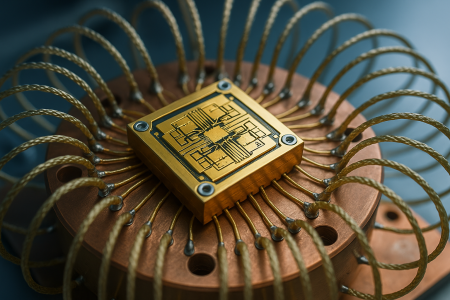
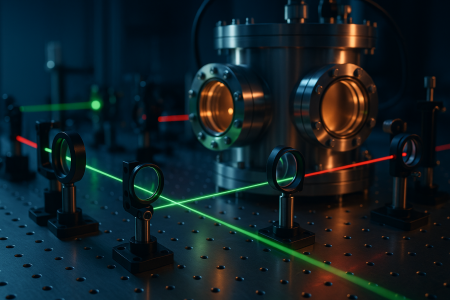
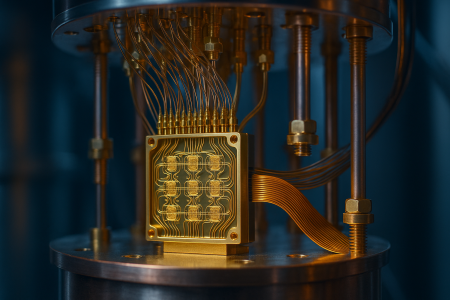
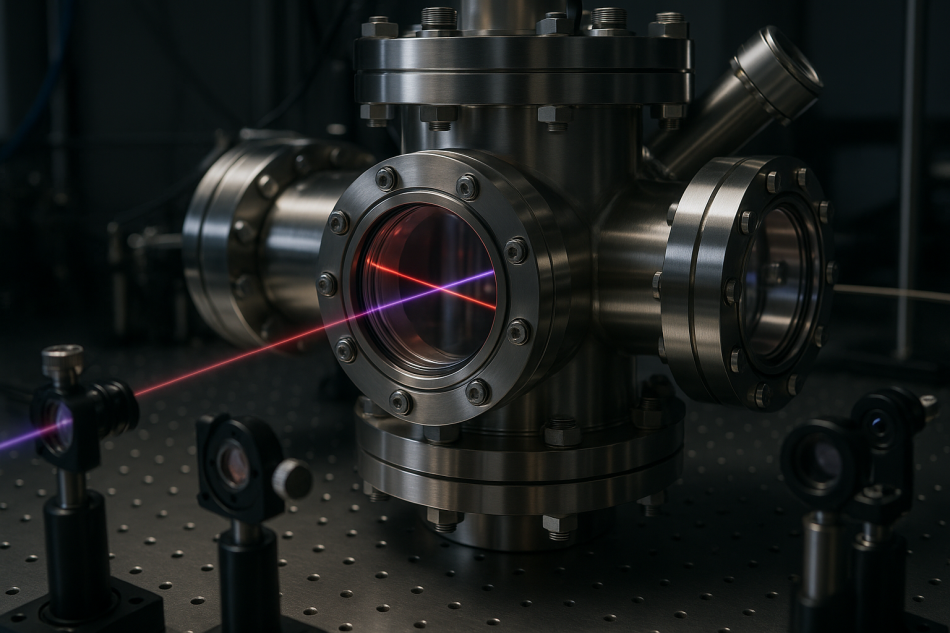
IonQ's confidence rests partly on the physics of its hardware. The company traps individual ytterbium ions, and in newer systems barium, holding them in place with electromagnetic fields and manipulating them with lasers. Two features of this approach feed directly into the algorithmic qubit story. First, every ion is identical, because they are the same atomic species governed by the same quantum rules, so there is no yield problem of the sort that plagues fabricated solid-state qubits. Second, ions in a single chain can interact with any other ion in that chain, giving all-to-all connectivity.
That connectivity matters more than it sounds. On a chip where each qubit only talks to its neighbors, entangling two distant qubits means shuffling the information across the grid through a chain of swap operations, each one an opportunity for error. With all-to-all coupling, a two-qubit gate is direct. Circuits stay shorter, fewer operations means fewer chances to fail, and that shows up as a higher algorithmic qubit score for the same physical count.
Where the metric gets contentious
Not everyone accepts #AQ at face value, and the objections are worth understanding. A benchmark defined and reported by the vendor selling the machine invites skepticism, especially when competitors use different yardsticks like IBM's quantum volume or raw two-qubit gate fidelities. There is no referee forcing everyone onto the same test, so cross-company comparisons often collapse into arguments about methodology rather than results.
Trapped ions also carry a well-known drawback that no connectivity advantage erases: they are slow. Gate operations driven by lasers take far longer than the microwave pulses used on superconducting chips, sometimes by a factor of a thousand. A high algorithmic qubit score tells you the machine can produce good answers, but not how many jobs it can churn through per hour. For workloads that need enormous numbers of circuit repetitions, that throughput gap is a real cost the metric does not surface.
The larger point
Whatever one thinks of the specific number, IonQ's underlying argument has aged well. The field has broadly shifted away from headline qubit counts toward measures that account for error rates, and the arrival of serious error-correction work has made the distinction between physical and effective qubits impossible to ignore. When a machine needs dozens or hundreds of physical qubits to build one reliable logical qubit, the naive count becomes almost meaningless as a measure of capability.
IonQ, now a publicly traded company after going public through a special-purpose acquisition merger, has tied its roadmap and its marketing to this quality-first framing. The company still has to prove it can scale ion chains without gate speeds and control complexity spiraling out of hand. But the central instinct, that a quantum computer should be judged by what it can compute rather than how many parts it contains, is one the rest of the industry has quietly adopted, even when it declines to use IonQ's particular scorecard.