
Ask a quantum computing researcher for a problem that classical machines genuinely cannot handle, and sooner or later the conversation turns to a compact-looking equation written down in 1963. The Hubbard model describes electrons sitting on a lattice of sites, able to hop to neighboring sites and paying an energy penalty whenever two of them crowd onto the same spot. That is nearly the whole story. There is a hopping term and a repulsion term, and the tension between them is the entire drama.
The reason it matters is that this tug-of-war is thought to capture the essential physics of correlated materials, including high-temperature superconductors. When the repulsion is strong, electrons can no longer be treated as independent particles drifting through a static background. Their fates become tangled together, and the system's behavior emerges from the collective. That entanglement is exactly what makes the model so hard to simulate on ordinary computers, and exactly why it keeps appearing on quantum roadmaps.
Why classical machines choke
The trouble is bookkeeping. To describe a quantum system of interacting electrons exactly, you need to track the amplitude of every possible configuration at once, and the number of configurations grows exponentially with the number of sites. A grid of a few dozen sites already outstrips any classical memory. Physicists have built clever approximations to sneak around this, and they work impressively well in many regimes.
But the most interesting corner of the Hubbard model, the doped region near where superconductivity is believed to live, is precisely where those approximations start to disagree with each other. Quantum Monte Carlo methods run into what is called the sign problem, where competing positive and negative contributions cancel and drown the answer in noise. Other techniques trade away accuracy for tractability. The result is a genuine open question in condensed matter physics: nobody is certain what the two-dimensional Hubbard model actually does at low temperature.
Two ways to attack it with qubits
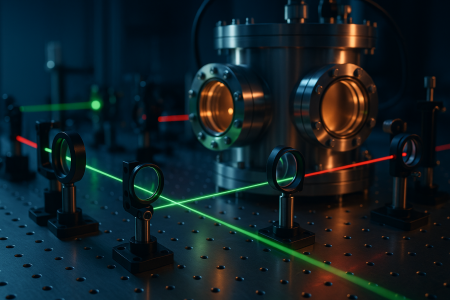
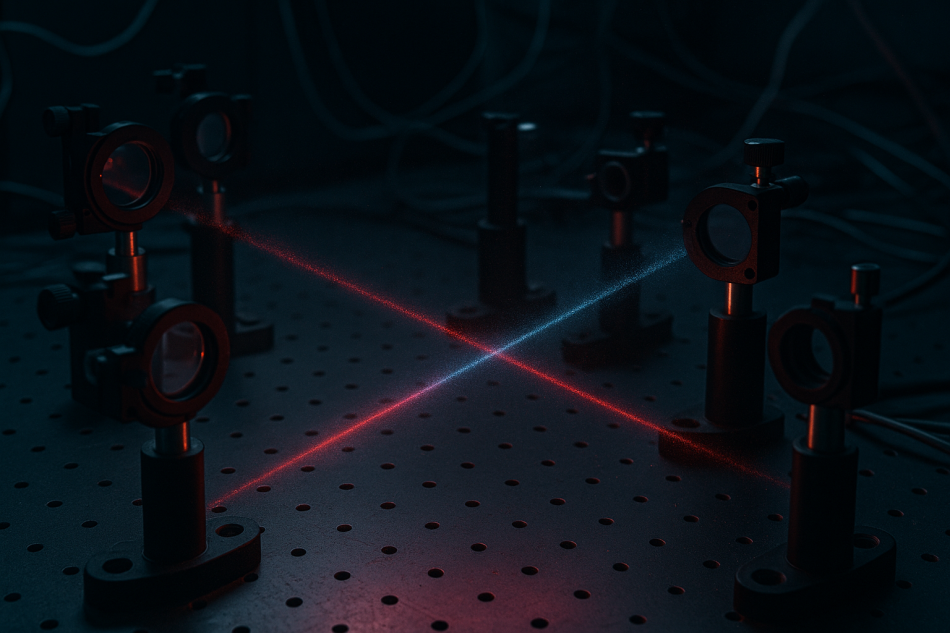
Quantum machines offer two routes. The first is analog simulation, where researchers build a physical stand-in whose behavior mirrors the equation. Ultracold atoms trapped in a lattice of laser light can be tuned so that atoms hopping between wells behave like the electrons in the model, letting experimenters read off the physics directly rather than computing it. Arrays of neutral atoms and trapped ions have been used to emulate related magnetic and fermionic systems, dialing the interaction strength up and down like a knob.
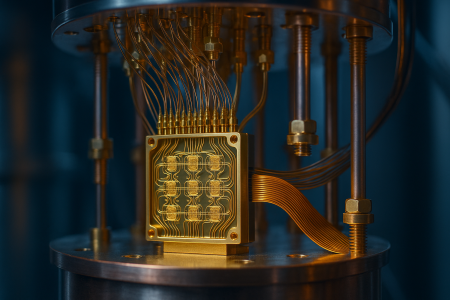
The second route is digital, running the model on a gate-based quantum computer. Here the electrons are mapped onto qubits through encodings that translate fermionic behavior, with its strict rules about no two particles sharing a state, into sequences of quantum gates. The appeal is flexibility: a programmable machine can, in principle, study any variant of the model and extract quantities that an analog emulator cannot easily measure. The cost is that fermionic encodings are expensive, chewing through gates and demanding low error rates.
A benchmark with a purpose
What makes the Hubbard model attractive as a near-term goal is that it sits in a useful sweet spot. It is small enough that modest processors can tackle scaled-down versions, and hard enough that even those small instances stress classical methods. That combination has turned it into an unofficial yardstick for whether a quantum device is doing something physically meaningful rather than merely large.
The honest caveat is that today's noisy machines cannot yet settle the open questions. Errors accumulate faster than the interesting dynamics unfold, and the biggest simulations still fall within reach of a determined classical effort. Progress on error correction and cleaner qubits is what will eventually tip the balance, if it tips at all.
Still, the model has a rare quality for the quantum field: a concrete scientific payoff that everyone agrees would matter. If a quantum simulator ever nails the phase diagram of the doped Hubbard model, it would not just be a demonstration. It might tell materials scientists something they have wanted to know for forty years, and hand the machines a use case that no amount of marketing invented for them.