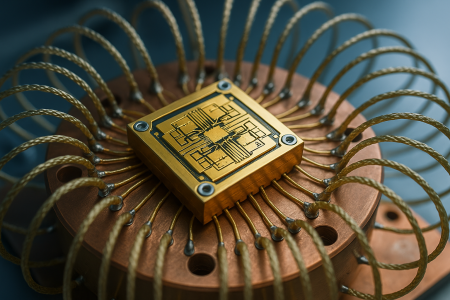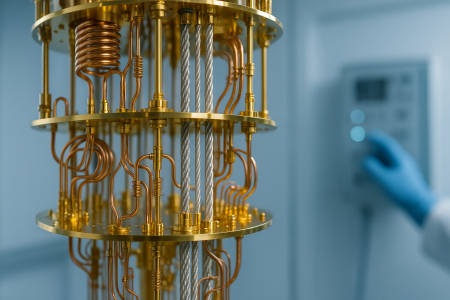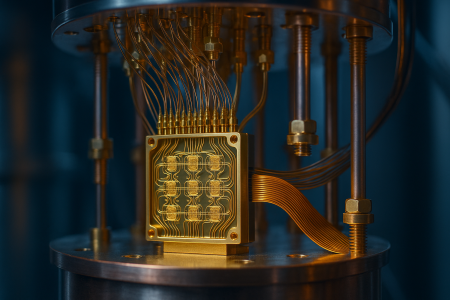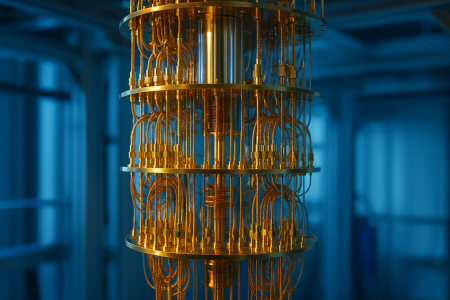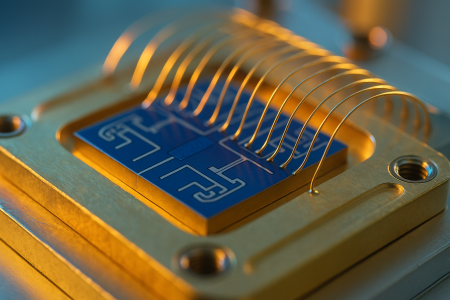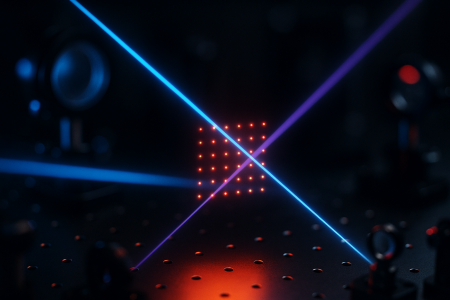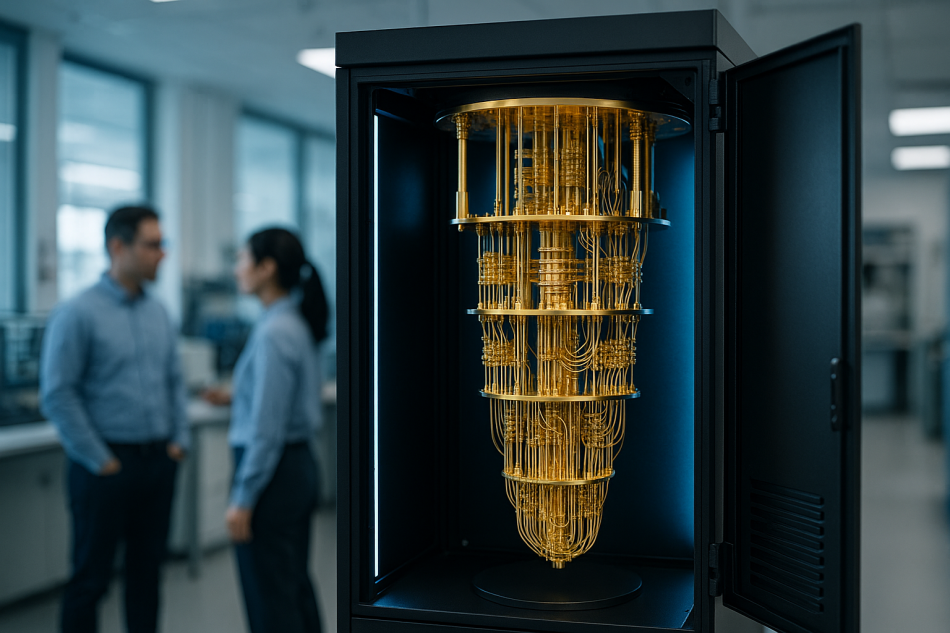

Most of the quantum computing conversation revolves around gate-based machines: chips that run sequences of logical operations, the quantum cousins of the instructions a classical processor executes. IBM, Google, IonQ, Quantinuum, and the rest are all building versions of that idea. D-Wave took a different road years before the field settled on its favorites, and it has stuck with that road ever since. Its machines do not run gates at all. They anneal.
What annealing actually means
Quantum annealing borrows its name from metallurgy, where you heat a metal and let it cool slowly so its atoms settle into a low-energy, orderly arrangement. The quantum version does something analogous with information. You encode a problem as an energy landscape, a surface with hills and valleys, where the lowest valley corresponds to the best answer. The machine's qubits start in a simple, easily prepared state and then the hardware slowly reshapes the landscape until it matches your problem. If you do it slowly and gently enough, the system tends to slide toward that lowest valley on its own.
The physics behind this is called adiabatic evolution. The promise is that quantum effects, including tunneling through energy barriers rather than climbing over them, can help the system escape shallow traps that would snare a classical optimizer. Instead of programming a step-by-step algorithm, you describe the shape of the problem and let the hardware relax into a solution.
Why the machines look so different
D-Wave's processors carry qubit counts that dwarf the gate-based crowd. Where a leading superconducting gate machine might advertise a few hundred qubits, D-Wave has shipped systems with thousands. That gap is not a sign that D-Wave is winning some race. The two kinds of qubits are not interchangeable. Annealing qubits do not need the exquisite control, precise timing, and low error rates that gate operations demand, because they are never asked to perform a clean sequence of logical steps. They just need to be coupled together and coaxed downhill. That relaxes the engineering enormously, which is how the qubit numbers grew so quickly.
The tradeoff is that an annealer is a specialist. A gate-based machine, in principle, can run any quantum algorithm, from chemistry simulation to Shor's factoring routine. A D-Wave annealer is built for one broad job: optimization, and problems that can be squeezed into the optimization mold. Scheduling, routing, portfolio balancing, and certain machine-learning subroutines all fit the shape. Factoring large numbers or simulating a molecule's electronic structure does not, at least not naturally.
The connectivity puzzle
The catch that has dogged annealing is how the qubits connect. Real problems demand that many variables interact with many others, but each physical qubit on the chip can only be wired to a handful of neighbors. To represent a densely connected problem, D-Wave chains several physical qubits together to act as one logical variable, a technique called embedding. That eats into the effective qubit budget fast, and it introduces its own errors when chains break. Successive D-Wave chip generations, with names like Chimera, Pegasus, and Zephyr, have steadily raised the number of connections each qubit gets, which is the whole game for making the machine useful on real problems.
Does it beat a classical computer?
This is where the argument gets heated. D-Wave and its academic collaborators have published results showing the hardware solving certain carefully chosen problems, particular spin-glass and simulation tasks, far faster than the classical methods they tested against. Skeptics counter that better classical algorithms often catch up once someone bothers to write them, and that the problems where the annealer shines can be artificial. The honest summary is that a clear, unambiguous, practically important speedup remains contested, much as it does for the gate-based world.
What D-Wave has genuinely done is put a working quantum machine in front of paying customers earlier than almost anyone, through cloud access and pilot projects with logistics and manufacturing firms. Whether those pilots deliver real advantage or mostly buy familiarity with the technology is a fair question. The company has also begun hedging, developing gate-based hardware alongside its annealers, an acknowledgment that the universal machine is where the biggest prizes sit.
The annealer was a wager that a narrower, easier-to-build machine could earn its keep while the field figured out the harder problem. It is still an open bet.